


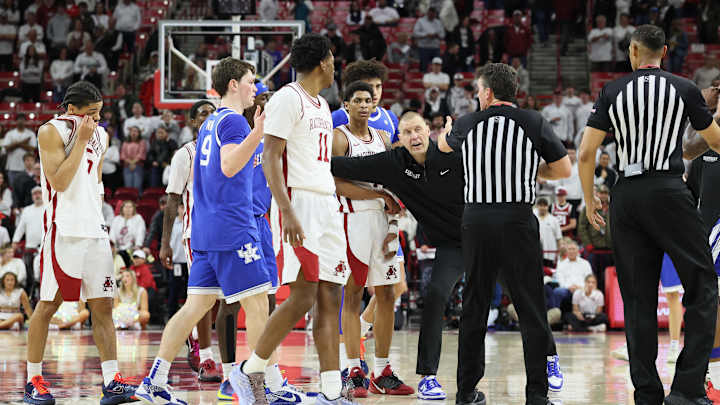
There are moments in a college basketball season that don’t show up neatly in the box score but end up meaning far more than points, rebounds, or assists. They’re emotional moments — volatile, messy, uncomfortable — the kind that either expose a team’s fragility or reveal something deeper about who they are when things start to unravel. Kentucky’s road win at Arkansas on Saturday night was filled with those moments, and none loomed larger than a chaotic 38-second stretch in the second half that could have derailed everything.
Instead, it became the moment that defined the game.
Down in Fayetteville, inside one of the loudest and most hostile environments in the SEC, Kentucky absorbed three technical fouls in rapid succession. The whistles came fast. The crowd erupted. Momentum swung violently toward Arkansas. And for a brief stretch, it looked like the Wildcats’ night — and perhaps their emotional control — was slipping away.
But what happened next told a very different story.
Rather than folding, Kentucky responded with composure, toughness, and an edge that has quietly become the backbone of Mark Pope’s first season in Lexington. They regained the lead almost immediately, steadied themselves, and never let Arkansas back in control. What could have been a collapse instead became a turning point — one that Pope later admitted actually made him feel something rare in the middle of chaos.
It felt right.
A Game That Began Calmly — Almost Too Calmly
Kentucky didn’t look like a team headed for turmoil early. In fact, the Wildcats were sharp, confident, and aggressive from the opening tip. They built a double-digit lead in the first half, pushing the margin as high as 13 points behind efficient offense and disciplined defense.
The ball moved crisply. Shots fell. Arkansas struggled to match Kentucky’s pace and execution. By halftime, the Wildcats held a seven-point advantage and appeared well-positioned to grind out a road win — no drama required.
But anyone familiar with Bud Walton Arena knows that games rarely stay calm for long.
When the Game Turned Chippy
The second half brought a noticeable shift in tone. Physical play escalated. Whistles multiplied. Emotions rose on both sides. The Razorbacks, desperate to claw back into the game, began attacking with urgency, feeding off the home crowd’s energy.
Then came the sequence that changed everything.
Between the 14:49 and 14:11 marks of the second half — a span of just 38 seconds — Kentucky was assessed three technical fouls. Each whistle poured gasoline on the atmosphere. Arkansas capitalized at the free-throw line, surged ahead, and for the first time all night, momentum clearly tilted away from the Wildcats.
For many teams, that stretch would have been the breaking point.
For Kentucky, it became the spark.
The Moment Most Teams Fold — and Kentucky Didn’t
Road games in the SEC are unforgiving. A hostile crowd, controversial officiating, and emotional swings often combine into the perfect recipe for collapse. Kentucky had every reason to unravel: three technicals, a roaring arena, and a sudden deficit.
Instead, the Wildcats responded with a 5–0 run, regaining the lead almost immediately. From that moment on, they never trailed again.
More importantly, they didn’t just survive — they took control.
Kentucky stretched its lead to as many as 10 points down the stretch, playing with poise and intelligence while continuing to attack. The game, once chaotic, suddenly felt dictated by the Wildcats. Arkansas had the crowd, but Kentucky had composure.
That response didn’t happen by accident.
Mark Pope’s Perspective: Chaos With a Purpose
After the game, Mark Pope didn’t shy away from the technical fouls or try to dismiss them as unfortunate officiating. Instead, he leaned into what they represented — and why, in a strange way, they reassured him.
“What I loved about that stretch is the guys’ fight and determination,” Pope said. “Even with the three techs happening back to back to back, I felt like it was coming from exactly the right place in our team that we are searching for — that core of fight and undaunted competitive spirit — and it just overflowed a tiny bit.”
That phrasing matters.
Pope wasn’t excusing the technicals. He acknowledged discipline must improve. But he also made clear that the emotion came from competitiveness, not recklessness. From players fully invested, not checked out.
“The techs were after really extraordinarily competitive plays,” he continued. “So we definitely have to be a little more disciplined, but I actually thought the gym felt good at that point. It felt like, man, these guys are here to fight.”
In a season where Kentucky has been redefining its identity under a new head coach, that distinction carries weight.
A Team Still Discovering Itself
Mark Pope inherited a program steeped in expectations and scrutiny. Every season at Kentucky is measured against banners, Final Fours, and national relevance. But this group — assembled through transfers, new roles, and shifting leadership — has been learning who it is in real time.
Saturday night provided clarity.
Kentucky didn’t crumble under adversity. It didn’t lose composure when the environment turned hostile. Instead, it absorbed the chaos, cleaned up its mistakes, and played with controlled aggression.
That’s not something you can script in practice.
Playing the Whistle, Not the Crowd
One of the underrated aspects of Kentucky’s response was how intelligently it adapted to the game’s officiating. Once it became clear that whistles would be frequent and emotions tightly monitored, the Wildcats adjusted.
They attacked gaps instead of forcing shots. They valued possessions. They made Arkansas defend without gifting transition opportunities. And when the game slowed, Kentucky stayed patient.
Rather than fighting the officiating, they played within it.
That kind of situational awareness — especially after emotional swings — is often what separates good teams from resilient ones.
Why the Moment “Felt Right”
Pope’s admission that the moment “felt right” might sound counterintuitive. Three technical fouls are usually signs of dysfunction, not affirmation. But context matters.
What Pope saw wasn’t a team unraveling. He saw a team standing up.
He saw players unwilling to shrink. Players competing hard enough to occasionally cross the line — but then smart enough to pull themselves back.
“I wouldn’t trade the heart of it for anything,” Pope said.
That sentence speaks volumes about what this Kentucky team values right now. Discipline matters. Control matters. But competitive fire matters more — especially in environments designed to break you.
A Road Win That Carries Weight Beyond One Night
The 85–77 win over Arkansas will matter in the standings. It will help Kentucky’s resume. It will be referenced when seeding conversations begin.
But internally, it likely means even more.
Road wins in the SEC are currency. Road wins that require emotional maturity are character builders. And road wins where adversity is met with composure often linger long after the final horn.
Kentucky didn’t just win a game Saturday night. It passed a test.
Growth Without Losing Edge
Pope was clear: the Wildcats must clean things up.
“We definitely have to be a little more disciplined,” he said.
That balance — keeping the edge while sharpening control — is where Kentucky’s growth now lies. The fire is there. The toughness is real. The next step is channeling it flawlessly when the stakes rise even higher.
March will demand that balance.
What This Means Moving Forward
As the season progresses, moments like Saturday’s will shape how Kentucky is perceived — by opponents, officials, and perhaps most importantly, by itself.
Teams that believe they can weather storms play differently late in games. They don’t panic. They don’t rush. They trust that adversity won’t knock them off course.
Kentucky earned that belief in Fayetteville.
The Bigger Picture: Identity Forming in Real Time
Every successful team has a moment where it realizes who it is. For some, it comes in a blowout loss. For others, in a last-second win. For Kentucky, it may have come in 38 chaotic seconds defined by technical fouls and emotional control.
Instead of collapsing, the Wildcats leaned into their identity: tough, resilient, competitive — and increasingly composed.
That’s the version of Kentucky Mark Pope has been building toward.
And on a night when everything could have gone sideways, that version showed up right on time.




