


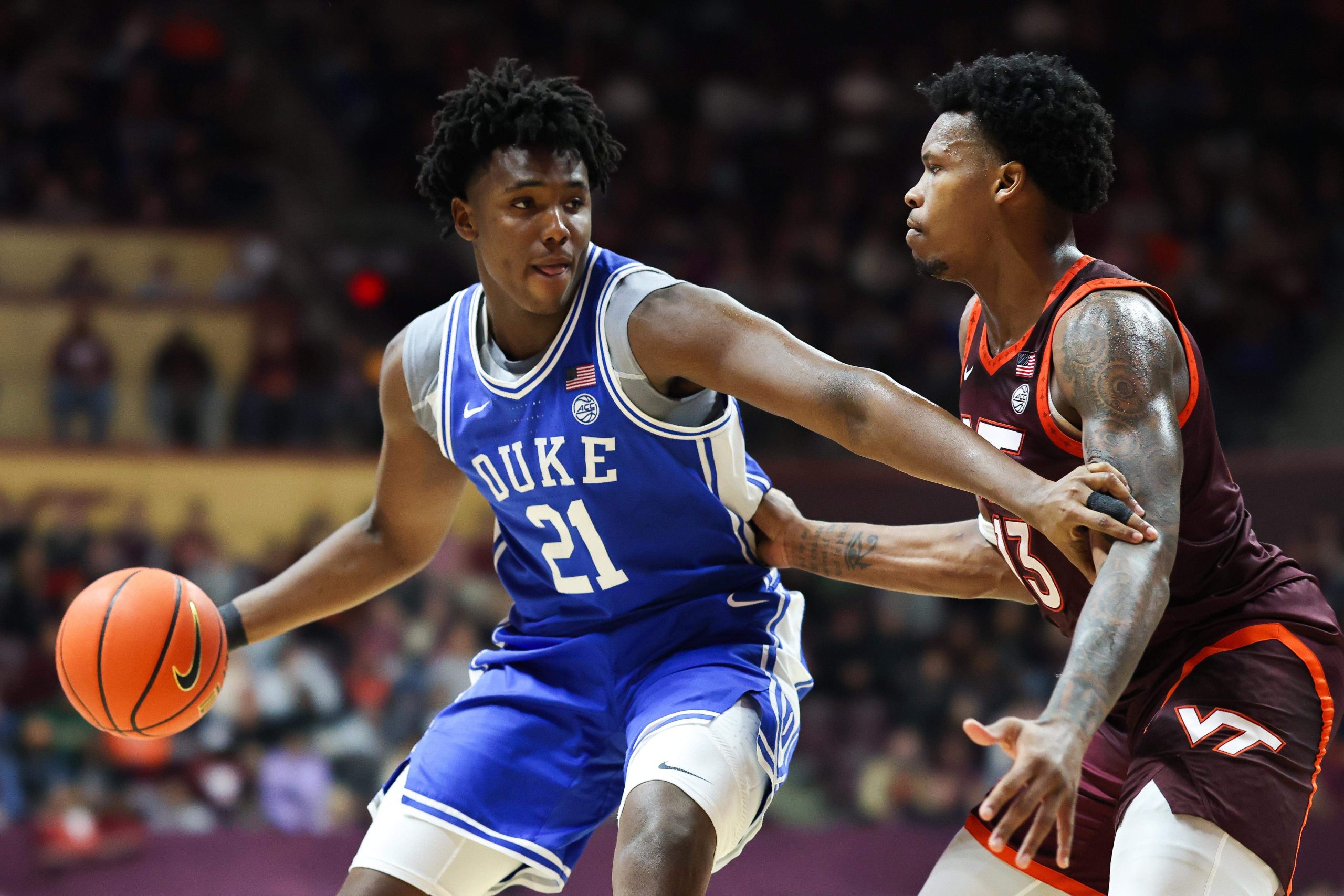
There is a moment in nearly every basketball game when everything is fragile — when a comfortable lead becomes a dangerous illusion, when momentum teeters, and when one mistake can quietly change the direction of the night. Most teams don’t recognize that moment until it’s already passed. Duke basketball, however, has learned to see it coming. And according to Jon Scheyer, that awareness may be the single biggest reason the Blue Devils are enjoying one of the most dominant seasons in the country.
Scheyer calls those moments “inflection points.”
And this season, Duke is winning them.
What Jon Scheyer Means by “Inflection Points”
In strategy meetings, practices, film sessions, and postgame interviews, Scheyer returns to the same phrase over and over. Inflection points. They aren’t plays drawn on a whiteboard or sets called from the sideline. They are emotional and psychological hinges — moments when the game is begging one team to relax and daring the other to surge.
Duke’s head coach believes games are rarely decided by raw talent alone. They are decided in the small windows where focus slips, urgency spikes, or composure is tested.
Freshman guard Cayden Boozer has heard the message repeatedly during his first season in Durham.
“Inflection points have been whether we go on a run or they go on a run — you’ve got to stay the same. Not get too high or too low,” Boozer said. “Let’s say we get the lead to 10. Sometimes early in the season we’d let up and it would become a closer game. We can’t let up.
Those are the things we keep working on.”
That mindset has quietly transformed Duke from a talented team into a ruthless one.
The Lesson That Cost Duke Its Only Loss
Every philosophy is tested by failure. For Duke, that test came in December at Madison Square Garden.
Against Texas Tech, the Blue Devils appeared to have full control. They built a 17-point second-half lead, and even with six minutes remaining, Duke was still ahead by 11 after a basket from Cameron Boozer. The game felt secure.
Then came the inflection point.
Texas Tech’s Christian Anderson hit a deep three. Duke forced a steal — the exact moment to slam the door — but Maliq Brown missed a fast-break layup. Anderson drilled another three. Duke’s Nik Khamenia missed a response. Anderson missed his next attempt, but JT Toppin cleaned it up with a putback.
Just like that, an 8–0 run erased Duke’s cushion.
Momentum shifted. Confidence wavered. Texas Tech surged ahead and escaped with an 82–81 win, handing Duke its only loss of the season.
Scheyer didn’t bury the moment. He weaponized it.
Turning Failure Into Framework
For a team with several new faces, the loss became a foundational teaching tool.
“Every possession in a game is important,” Scheyer said. “There’s no denying that. But what we try to get our guys to understand is that human nature plays a part.
You go on a run, the other team calls timeout — how many times do you see the leading team relax just a little bit? Then the other team ramps up their desperation or energy.”
Rather than pretending those lapses don’t exist, Scheyer forces his players to confront them.
“We try to acknowledge it, put it out there, and then flip it,” he said. “How can we feel like we’re the ones who called the timeout?”
That mental flip — maintaining urgency when comfort arrives — has become Duke’s defining trait.
Putting the Lesson Into Action Against Wake Forest
The concept moved from theory to practice during Duke’s game against Wake Forest at Cameron Indoor Stadium.
The Demon Deacons started strong. They played with poise, absorbed Duke’s early pressure, and held a lead with five minutes remaining in the first half. Duke appeared content to settle for threes, while Wake Forest kept the game within reach — even as leading scorer Juke Harris was limited to just three points.
Then, the inflection point arrived.
Maliq Brown knocked down a three.
Isaiah Evans jumped a passing lane for a steal.
Cameron Boozer finished a layup.
Suddenly, Duke ignited a 13–0 run that Wake Forest never recovered from.
“We got our shots, got our shots to fall, got stops and got on a run,” Cameron Boozer said.
By halftime, Duke led 37–25. By the final horn, the Blue Devils cruised to a 90–69 victory.
Wake Forest head coach Steve Forbes saw the flip clearly.
“We were running a good offense, moving the ball, not getting hurt on the glass,” Forbes said. “And then the game flipped.
Why? Offensive rebounds. Turnovers into atomic bombs. Hurried shots.”
At Cameron Indoor Stadium, those “atomic bombs” — easy transition baskets that ignite the crowd — are often fatal.
Thriving in the “Danger Zone”
Scheyer refers to certain moments as the “danger zone.” It’s the stretch where a game can tilt sharply in either direction.
“That’s when it can go from 10 to 4 — or 10 to 16,” Scheyer said. “And you can push it from there.”
Duke has learned to push.
Virginia Tech: Defense as the Answer
That composure was on full display against Virginia Tech.
The Hokies cut Duke’s second-half lead to 62–56 with six minutes remaining — a textbook inflection point. Instead of tightening up offensively, Duke turned to defense.
A forced turnover.
A Patrick Ngongba block.
Another turnover.
Another missed shot.
Then Cameron Boozer took over.
Two free throws.
A layup.
A three-pointer.
In a blink, the lead ballooned to 69–56 with 1:30 left.
Game over.
The Numbers Behind the Discipline
Duke now sits at 20–1 overall and 9–0 in ACC play, not because they overwhelm opponents for 40 minutes, but because they dominate the moments that matter most.
They’ve become a team that expects resistance — and responds to it.
Louisville: When the Message Comes Back to You
After Duke’s 83–52 demolition of Louisville, Scheyer was told multiple players independently referenced inflection points in their postgame interviews.
He smiled.
“I’m glad to hear that,” Scheyer said. “They’re listening.”
Louisville briefly led 25–24 late in the first half. A Ngongba three-point play sparked a 14–3 closing run. Early in the second half, Ngongba continued his surge, pushing the lead to 16 almost instantly.
Louisville coach Pat Kelsey didn’t sugarcoat it.
“We got our butts kicked.”
Not completely — but decisively when it mattered.
A Team That’s Locked In
Kelsey described Duke as “locked in,” a phrase echoed repeatedly by opposing coaches this season.
Scheyer sees it as growth.
“It’s about understanding the areas where you have to grow and get better,” he said. “I think you saw that in those critical moments.”
Duke hasn’t eliminated adversity. They’ve mastered their response to it.
Why This Matters in March
Tournament basketball is a sequence of inflection points.
A missed box-out.
A careless turnover.
A two-minute run that decides everything.
Teams that survive March aren’t flawless. They’re composed.
Duke is learning to stay the same — whether up 10 or down 6.
The Bigger Picture
Scheyer isn’t building a system dependent on perfection. He’s building one that thrives under pressure.
Inflection points aren’t accidents anymore. They’re anticipated.
And as long as Duke continues to win those moments, the Blue Devils won’t just dominate games — they’ll control them.
That may be the most dangerous thing of all.




