


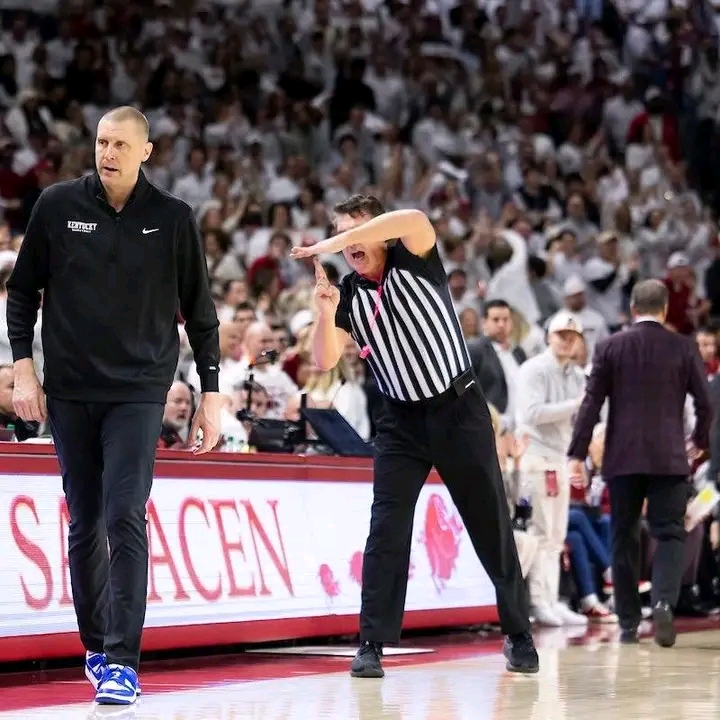
There are whistles — and then there are warnings. The kind that don’t just stop play, but split a game in two. On this night in Bud Walton Arena, one sharp blast of air didn’t merely signal a technical foul — it detonated weeks of tension, years of resentment, and an entire rivalry that had been quietly simmering beneath the surface. Before the scoreboard could catch up, seven technicals were in the book, coaches were turning away in disbelief, officials were commanding the floor like traffic cops in a storm, and the crowd knew instinctively: this was no longer just Kentucky vs. Arkansas. This was the moment everything cracked open.
What unfolded Saturday night was not chaos for chaos’ sake. It was something far more revealing — a pressure point finally exposed in one of college basketball’s most emotionally charged matchups. Kentucky walked out of Fayetteville with an 85–77 victory, but the final score barely scratched the surface of what actually happened. The game will be remembered not for a late three or a decisive run, but for a frozen image: official Doug Shows slicing the air with a technical foul signal as Mark Pope turns his back, the arena roaring in disbelief.
Seven technical fouls were called. Seven. In a single game between two programs tied together by history, bitterness, and one of the most polarizing coaching moves in recent memory.
This was inevitable.
A Rivalry Rewired Overnight
Kentucky and Arkansas have crossed paths for decades, but the rivalry was fundamentally rewired the moment John Calipari left Lexington for Fayetteville. What once felt like a traditional SEC matchup instantly became personal. For Arkansas fans, Calipari’s arrival represented legitimacy, ambition, and national relevance. For Kentucky fans, it felt like betrayal — not just a coach leaving, but their coach succeeding somewhere else.
The tension didn’t need marketing. It didn’t need hype. It walked into the building on its own.
Calipari downplayed it publicly, insisting the focus was on winning basketball games, on building consistency, on “the next possession.” But inside Bud Walton Arena, nobody believed this was just another game. The boos weren’t generic. The cheers weren’t routine. Every whistle was met with suspicion. Every collision felt like a statement.
That’s how games tilt toward volatility — not suddenly, but gradually, possession by possession.
The Sequence That Changed Everything
Midway through the second half, the game sat delicately balanced at 63–63. Arkansas had momentum. Kentucky was wobbling. Then came the possession that would define the night.
Malique Ewin committed a technical foul after tossing the ball toward Mouhamed Dioubate following a foul at the rim. What should have been a routine dead-ball moment instantly escalated. The officials huddled. The crowd erupted. Kentucky stepped to the line.
Before Arkansas could reset, another foul followed on the inbound. A tie game became a five-point Kentucky advantage without the Wildcats even running a set.
“It was a tie game,” Calipari said afterward. “And all of a sudden they get four points and the ball.”
It wasn’t just the points — it was the emotional whiplash. Arkansas never fully recovered.
When Control Slips, Everything Follows
Seven combined technical and flagrant fouls is not an accident. It’s a signal. It tells you that control — emotional, physical, psychological — slipped from multiple hands at once.
Billy Richmond III was hit with a technical in the first half. Trevon Brazile committed a flagrant foul late as frustrations boiled over. Kentucky had its own stretch of three technicals in 38 seconds. Officials were no longer managing basketball — they were managing emotion.
Every stoppage made the arena louder. Every whistle raised arms in disbelief. Players stopped reacting to the scoreboard and started reacting to each other.
And that’s the moment when basketball becomes something else entirely.
Mark Pope, Caught Between Fire and Restraint
For Kentucky coach Mark Pope, the night represented one of the most delicate balancing acts of his tenure. He was coaching against the man whose shadow still looms over Lexington. He was managing a roster still fighting injuries and cohesion. And now, he was navigating a game teetering on emotional collapse.
The image of Pope turning away as the technical is assessed is telling. It wasn’t defiance — it was containment. Coaches know when a game has crossed into dangerous territory. Pope’s job in that moment wasn’t to argue the call. It was to keep the night from unraveling completely.
Kentucky responded the way good teams do in volatile environments: by executing when everything else is burning.
Kentucky’s Poise, Arkansas’ Regret
To Arkansas’ credit, the Razorbacks didn’t fold immediately. Billy Richmond III’s one-handed dunk ignited the arena and briefly swung momentum. Freshman guard Darius Acuff Jr. followed with a three and a driving layup to give Arkansas a 57–53 lead. Bud Walton Arena reached a deafening pitch.
But Kentucky absorbed it.
They weathered the storm. They slowed the pace. They trusted their sets. And when the decisive moment arrived, they took advantage.
That five-point possession — born from a technical foul and a lapse in composure — proved too steep a hill for Arkansas to climb.
“You cannot get a technical or do something that costs us a game,” Calipari said afterward. “And it’s exactly what happened.”
That sentence hung heavier than any statistic.
The Officials, Caught in the Crossfire
Doug Shows and his crew became unwilling characters in the night’s narrative. Seven technicals will always draw scrutiny, but this wasn’t about over-officiating as much as it was about escalation. Once emotion crosses a certain threshold, officials are forced into stricter enforcement.
Every call becomes magnified. Every decision becomes suspect.
The still image of Shows delivering the technical as Pope turns away became symbolic — not of bias, but of a game that had slipped into survival mode.
A Snapshot That Will Live On
Some games are remembered by buzzer-beaters. Others by banners. This one will be remembered by a photograph.
An official’s arm in mid-signal. A coach turning his back. A crowd frozen between rage and disbelief.
It’s the kind of image that will resurface every time Kentucky and Arkansas meet. The kind that will be referenced whenever emotions flare again. The kind that captures, in a single frame, why this rivalry is no longer polite, measured, or predictable.
It’s combustible now.
What This Means Going Forward
Kentucky needed this win — not just for the standings, but for belief. After being embarrassed at Vanderbilt earlier in the week, the Wildcats proved they could withstand pressure, hostility, and chaos on the road.
Arkansas, meanwhile, learned a harsher lesson. Talent and energy mean little without composure. Home-court advantage evaporates the moment discipline breaks.
And for the SEC? This game was a reminder of why the conference remains unmatched in intensity. These aren’t just games. They’re emotional trials.
This Wasn’t the End — It Was the Beginning
Seven technicals didn’t happen by accident. They happened because something larger is unfolding.
Kentucky vs. Arkansas is no longer just a matchup. It’s a referendum. On loyalty. On identity. On what happens when history refuses to stay buried.
And that whistle — sharp, final, unforgettable — didn’t just stop play.
It announced that this rivalry has officially crossed into something far more dangerous.
And far more unforgettable.




