


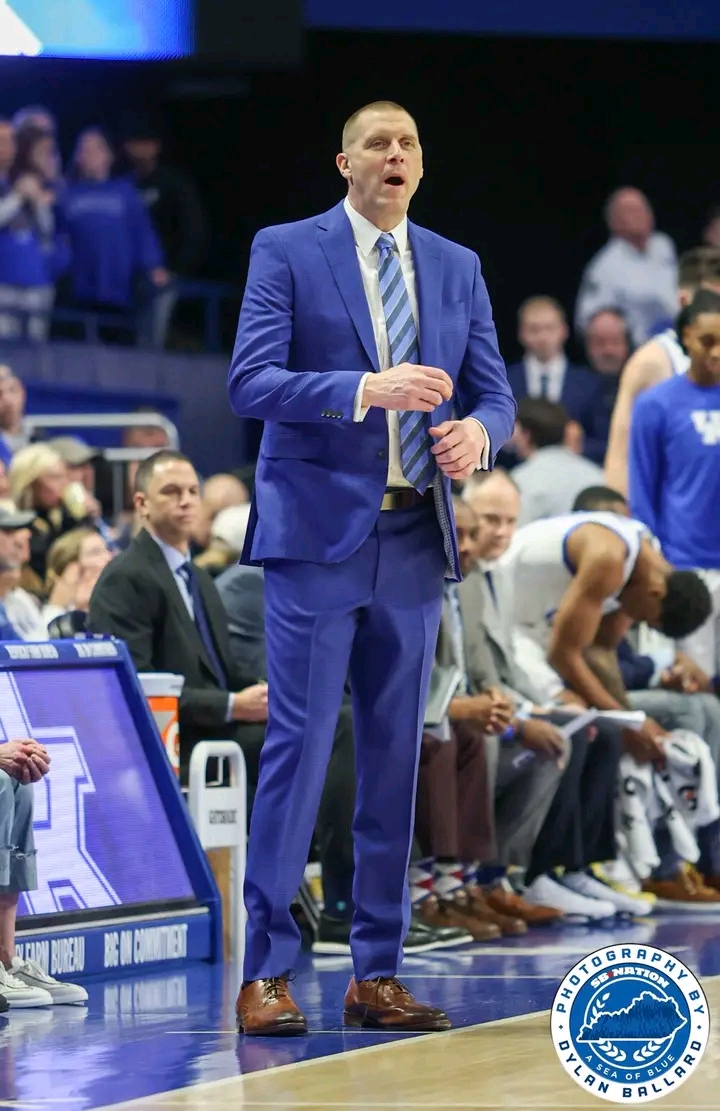
For years, the NCAA has been losing ground — in courtrooms, in public opinion, and in its ability to enforce its own rules. Temporary restraining orders now flip eligibility decisions overnight, and the authority the organization once wielded feels increasingly symbolic. But buried inside a seemingly offhand comment from Kentucky coach Mark Pope was a provocative idea that cuts to the heart of the power struggle: if the NCAA still controls anything absolutely, it’s March Madness. And if that’s true, the sport’s biggest stage may also be its final leverage point in a legal war that’s spiraling out of control.
Against that backdrop, Kentucky coach Mark Pope made a comment that barely registered as a headline at first — but the more you sit with it, the more radical it sounds. Pope suggested that while the NCAA may be losing control everywhere else, it still holds ultimate power over one thing: the NCAA Tournament. And if that’s true, March Madness might not just be the crown jewel of college sports — it could be the NCAA’s last meaningful line of defense.
It’s a provocative idea, and one that deserves serious examination.
How the NCAA Lost the Courts
To understand why Pope’s suggestion matters, you first have to understand how far the NCAA’s authority has eroded. Over the last several years, athletes and their legal teams have increasingly challenged eligibility decisions in court — and they’ve found willing judges.
Temporary restraining orders, once rare in college sports disputes, are now commonplace. Players previously ruled ineligible suddenly take the floor days later. Transfers bypass sit-out rules. Waivers denied by the NCAA are effectively overturned without the NCAA ever winning an appeal.
The message has been unmistakable: the NCAA no longer has the final say.
This isn’t limited to fringe cases or obscure programs. High-profile athletes at major schools have successfully used the legal system to regain eligibility, often citing unfair process, inconsistent application of rules, or restraint of trade arguments. Judges, wary of harming athletes’ earning potential or professional futures, have often sided with the players.
From a human standpoint, it’s understandable. From a governance standpoint, it’s chaos.
The Slippery Slope of “Temporary” Fixes
Temporary restraining orders were designed as short-term remedies — a pause button while disputes are resolved. In college athletics, they’ve become something else entirely: de facto eligibility rulings.
The season moves on. Games are played. Stats are recorded. And by the time the legal dust settles, the damage — or benefit — is irreversible.
The NCAA can argue process violations, competitive balance, or institutional authority all it wants. But when players are already on the floor, those arguments ring hollow. The courts don’t feel the urgency of the NCAA calendar, and judges aren’t tasked with preserving league integrity.
This is where Mark Pope’s idea quietly enters the conversation.
What Pope Actually Said — and Why It Matters
Pope didn’t deliver a manifesto. He didn’t demand change outright. Instead, he hinted at something the NCAA still controls completely:
“Until someone tells me different, I still believe the NCAA has full power over who gets into the NCAA Tournament and what games they count towards your NCAA Tournament bid.”
That sentence is loaded.
Because while courts can grant eligibility, they cannot force the NCAA to invite a team to March Madness. Selection Sunday remains an internal process. The committee decides which games count, which resumes matter, and which teams get left out.
That distinction changes everything.
March Madness as Leverage
March Madness is not just a tournament. It is the financial engine of college athletics. Billions in television revenue. Conference distributions. Recruiting exposure. NIL valuation. Coaching bonuses. Program prestige.
Missing the NCAA Tournament doesn’t just sting — it reshapes careers.
If the NCAA chose to take a hard stance and say, “Players competing under court-ordered eligibility do not count toward tournament consideration,” it would immediately change the risk calculation for schools and athletes alike.
Suddenly, a TRO isn’t just a win. It’s a gamble.
Coaches would have to decide whether playing a legally cleared but NCAA-disputed athlete could jeopardize their tournament résumé. Athletic directors would weigh potential lawsuits against the catastrophic cost of missing March Madness.
For the first time in years, the NCAA would have leverage.
Why the NCAA Hasn’t Pulled the Trigger
So why hasn’t the NCAA already done this?
Because it’s messy. Because it would invite backlash. Because it would almost certainly trigger even more lawsuits — at least initially. And because punishing teams for legal victories feels, at face value, unfair.
But governance is rarely clean. And the NCAA has already learned that trying to please everyone leads to pleasing no one.
Right now, the NCAA sits in a worst-of-both-worlds scenario: it still enforces rules, but it lacks enforcement power. That’s not stability — that’s erosion.
The Risk of Doing Nothing
If the current trend continues unchecked, eligibility rules become suggestions rather than standards. The transfer portal becomes a legal playground. Schools with aggressive legal backing gain competitive advantages. Smaller programs without resources fall behind.
Competitive balance — already fragile — fractures further.
Worse, the NCAA’s authority becomes symbolic. And once authority becomes symbolic, it’s effectively gone.
March Madness may be the last place where symbolism doesn’t matter — only control does.
The Athlete’s Perspective
Critics of Pope’s idea will argue — correctly — that athletes shouldn’t be collateral damage in institutional power struggles. Many players seeking TROs are not villains; they’re young adults trying to protect limited career windows.
That reality matters.
But so does consistency.
If eligibility is determined by who can afford the best legal team, the system isn’t athlete-friendly — it’s lawyer-friendly. The NCAA’s failure to adapt its rules has created the very inequities courts are trying to correct.
Using March Madness as leverage wouldn’t fix everything, but it might force meaningful negotiation rather than endless litigation.
The Precedent Problem
One major concern is precedent. If the NCAA excludes teams due to court-ordered eligibility, it risks accusations of retaliation. Judges may see it as punitive rather than procedural.
But the NCAA could frame it differently — not as punishment, but as criteria. Just as wins against non-Division I opponents don’t count toward NET rankings, wins achieved under disputed eligibility could be treated similarly.
It wouldn’t be personal. It would be policy.
Why Pope’s Timing Matters
Mark Pope’s voice matters because he isn’t speaking as a commissioner or an administrator. He’s speaking as a coach navigating this chaos in real time. His program lives with the consequences of inconsistent enforcement, roster uncertainty, and shifting standards.
When a coach — especially one at a program like Kentucky — suggests the NCAA needs to “regain some tiny ounce of sanity,” it’s not hyperbole. It’s fatigue.
Coaches want rules they can plan around. Players want clarity. Fans want credibility.
Right now, no one is fully satisfied.
March Madness as the Final Arbiter
Whether the NCAA chooses to act on Pope’s logic remains to be seen. But the idea itself is telling: the power struggle has narrowed.
Once upon a time, the NCAA controlled eligibility, scholarships, transfers, and postseason access. Now, most of that authority is fractured. The tournament remains the last uncontested ground.
If the NCAA doesn’t use it, courts will continue to dictate outcomes. And at that point, the NCAA becomes a scheduling service — not a governing body.
A Fork in the Road
The NCAA faces a choice. It can continue reacting — case by case, injunction by injunction — or it can draw a firm, defensible line around the one asset it still controls.
March Madness may not be the perfect tool. But it might be the only one left.
Mark Pope didn’t say all of this outright. He didn’t need to. The implication was enough.
In a sport where chaos has become normal, perhaps the most radical idea is restoring consequence.
And it might start — and end — with the tournament everyone still wants to reach.




