


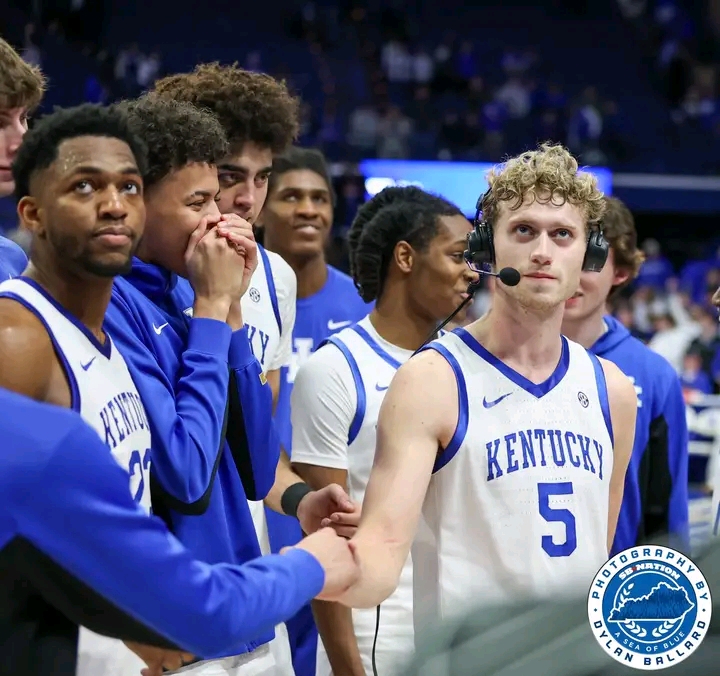
There are few things more unsettling in college basketball than silence — especially when it comes from a program that once dominated the recruiting calendar. At Kentucky, commitments used to arrive early, loudly, and often. Five-star announcements were expected, not celebrated. But as winter turns toward spring, one of the sport’s most powerful brands finds itself in unfamiliar territory: waiting. No commitments. No headliner. No certainty. And that quiet surrounding Kentucky’s 2026 recruiting class is beginning to say far more than any press release ever could.
A Twilight Zone Moment for a Blueblood
In the immediate aftermath of Kentucky’s blowout loss at Vanderbilt, national college basketball writer Isaac Trotter posted a comment that struck a nerve among fans in Lexington.
“We are living in a Twilight Zone because there are 15 program-changing freshmen, and Kentucky didn’t land a single one of them.”
It wasn’t meant as a shot. It was an observation — one rooted in reality. Across the country, freshman stars are reshaping programs and redefining expectations. Cameron Boozer is anchoring Duke. AJ Dybantsa is carrying BYU’s hopes. Darryn Peterson is the centerpiece at Kansas. Caleb Wilson has transformed North Carolina’s frontcourt. Meanwhile, Kentucky’s freshman contributions — while meaningful — have been quieter, developmental, and far removed from the one-and-done superstardom that once defined the program.
More jarring still: Kentucky remains without a single commitment from the 2026 high school class.
A Stark Contrast to the Past
To understand why this feels so uncomfortable, context matters. For nearly 15 years under John Calipari, Kentucky recruiting followed a familiar pattern. Elite prospects identified early. Relationships built quickly. Commitments secured before rivals had a chance to counter. The Wildcats were often done recruiting before other programs truly began.
That rhythm is gone.
Dating back to at least 2010, Kentucky has never gone this deep into a recruiting cycle without a high school commitment. Not during coaching changes. Not during NCAA turbulence. Not even during down seasons. The absence of a 2026 pledge is not just rare — it is unprecedented in the modern era of Kentucky basketball.
And that reality forces a difficult but necessary question: Is this a temporary adjustment period, or a sign of a permanent shift?
Life After Calipari Means a New Identity
When John Calipari left Kentucky for Arkansas in April 2024, the program didn’t just lose a coach. It lost an identity. Calipari’s reputation as a premier recruiter — especially of elite, NBA-bound freshmen — was foundational to Kentucky’s brand. His pitch was simple and proven: come to Kentucky, play on the biggest stage, and leave for the NBA.
Mark Pope inherited a program in transition, not decline — but transition nonetheless.
Pope’s first roster rebuild was done almost entirely through the transfer portal. Not a single returning player from the previous season remained. Only one Calipari-era recruit, in-state guard Travis Perry, stayed through the coaching change. It was a necessary scramble, not a strategic blueprint.
Now, two seasons in, the recruiting picture is clearer — and more complicated.
The 2026 Class That Got Away
What makes Kentucky’s lack of a 2026 commitment particularly alarming is that it wasn’t supposed to happen this way.
At various points in the fall, Kentucky was widely believed to be the leader — if not the outright favorite — for two of the top prospects in the country: Tyran Stokes, the consensus No. 1 player in the class, and Christian Collins, a top-10 forward with size and versatility.
Reports suggested commitments were imminent. Visits were taken. Momentum was real.
And then… nothing.
Stokes has since shifted toward Kansas, where Bill Self has surged late. Collins reopened his recruitment after narrowing his choices to Kentucky, UCLA, and USC. What once looked like wins have become open races — or losses.
From a national perspective, those reversals raised eyebrows.
“I get the sense that Kentucky’s house is not in order,” Trotter told the Herald-Leader. “It feels a bit scrambled right now.”
That word — scrambled — has echoed around Kentucky’s recruiting conversation ever since.
NIL, Timing, and a Shifting Market
Recruiting in 2026 is not recruiting in 2016. The landscape has changed fundamentally.
The NCAA’s House settlement, which went into effect last summer, allows schools to directly distribute money to athletes. That change has altered leverage, timelines, and priorities. High school players are no longer the automatic crown jewels of roster construction. Transfers — older, proven, physically developed — often provide a faster return on investment.
Mark Pope has leaned into that reality.
His approach so far suggests a belief that continuity, scheme fit, and experience may outweigh star rankings — especially in an era where players can leave at any moment.
“Every recruit is different,” Pope said when asked about the lack of 2026 commitments. “Some guys want different things.”
That’s true. But at Kentucky, fans are used to recruits wanting Kentucky.
Is the 2026 Class Even Worth Chasing?
Another complicating factor: the relative strength of the 2026 recruiting class compared to previous years.
Several analysts believe the class lacks the depth and top-end certainty of recent cycles. If that’s the case, a cautious approach may be intentional. Why overspend on a freshman when an older, proven transfer could provide immediate impact?
Tristan Freeman, a national college basketball analyst, hinted at that possibility.
“Kentucky may be better off waiting for the offseason,” Freeman said. “There’s been a lot of talk about NIL, about negative recruiting. Waiting could actually be the smarter play.”
That strategy, however, requires patience — something Kentucky fans have rarely been asked to show.
Recruiting vs. Retention: A New Balancing Act
One of the most under-discussed elements of this situation is retention.
Under Calipari, roster turnover was expected. One-and-dones left. Veterans transferred. Continuity was a luxury, not a priority.
Pope appears to be building differently.
Kentucky retained Otega Oweh and Brandon Garrison. Jasper Johnson and Malachi Moreno are developing pieces, not short-term rentals. International forward Andrija Jelavic is classified as a sophomore and could provide multi-year value.
In that context, aggressively pursuing a one-and-done freshman might disrupt chemistry more than enhance it.
But again, this represents a philosophical shift — and shifts take time to sell.
The Optics Problem
Regardless of internal logic, optics matter at Kentucky.
Fans see Duke land stars. Kansas reload effortlessly. Arkansas surge under Calipari. And they see Kentucky waiting.
That silence fuels anxiety, speculation, and criticism — especially in an era where recruiting news travels instantly.
Even Pope acknowledges the tension.
“I’m excited about where we are,” he said during his radio show. “We’re in play with some players that fit us.”
Fit, however, is not a word Kentucky fans have historically cared about.
They care about banners.
Still in the Mix — But No Longer the Favorite
It’s important to note: Kentucky is not out of the 2026 race.
The Wildcats remain involved with five of the top 10 players in the class, including Stokes, Jordan Smith, Bruce Branch, Caleb Holt, and Collins. That’s not nothing.
But being “involved” is not the same as being in control.
For the first time in years, Kentucky is chasing instead of being chased.
The Bigger Question
So why doesn’t Kentucky basketball have a 2026 recruiting commitment?
The answer isn’t singular. It’s layered.




