


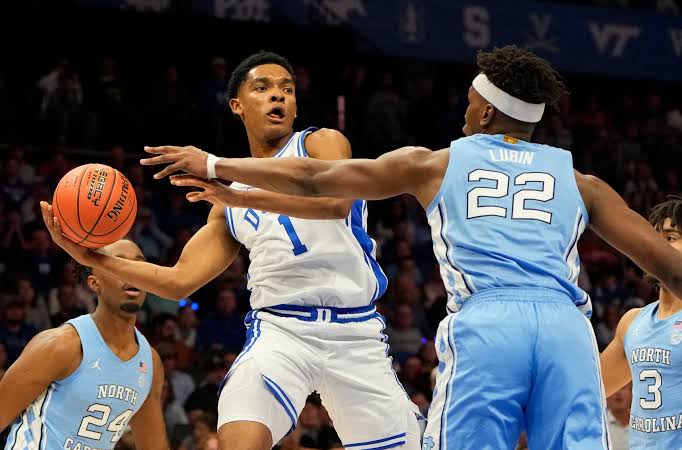
There are college basketball games, and then there are moments—the kind that stop everything else in sports for a few hours and demand your full attention. Saturday night is one of those moments. With the NFL season now in the rearview mirror, the national sports spotlight shifts naturally, almost inevitably, to Chapel Hill and Durham. Carolina vs. Duke doesn’t just feel bigger when football is gone; it becomes the season opener for a massive audience that now remembers why this rivalry has always lived on its own plane. The jerseys are familiar, the stakes are eternal, and the memories—both painful and euphoric—linger long after the final horn. This is not just Round 1 of the rivalry. This is a measuring stick, a referendum, and quite possibly a preview of arguments fans will still be having in March.
You don’t need a sales pitch for this game. You already know what it means. What matters now is how this particular version of UNC vs. Duke might unfold—and which subtle edges could quietly tilt everything.
Here are three things to watch closely, because one of them might decide everything.
1. Cameron Boozer vs. Caleb Wilson: The Rivalry Within the Rivalry
There have been plenty of great players in this rivalry—icons, legends, and future Hall of Famers who learned early what it means to wear either shade of blue. But every so often, the rivalry gifts us something extra: a true parallel, where two stars arrive at the same time, rise together, and are forever linked by proximity, pressure, and performance.
That’s Cameron Boozer and Caleb Wilson.
On paper, the comparison is already irresistible. Boozer is averaging 23.3 points and 9.9 rebounds per game. Wilson sits right there with 20.0 points and 9.8 rebounds per night. Both are dominant in the paint. Both can stretch defenses. Both are already being spoken about less as freshmen and more as franchise-level talents for their programs. Rookie of the Year? Almost certainly one of them. ACC Player of the Year? It’s not premature to say this game could influence that conversation.
But numbers only tell part of the story.
What makes this matchup compelling is that Boozer and Wilson represent two different kinds of dominance. Boozer has been the model of consistency. Night after night, possession after possession, he delivers. He rarely disappears, rarely forces the game, and seems perfectly comfortable letting things come to him. His efficiency and composure are why many draft boards still slot him just ahead of Wilson.
Wilson, meanwhile, is electricity. He’s the kind of player who can tilt the emotional balance of a game with one sequence—a chasedown block, a putback dunk through contact, a coast-to-coast finish that sends the crowd into chaos. His highlights pop. His confidence radiates. And perhaps most importantly, he wants this moment.
Some players shrink under the weight of UNC–Duke. Others try to avoid the spotlight altogether. Wilson doesn’t just accept it—he leans into it. He feeds off the energy, the noise, the expectations. That matters in a rivalry game where emotion often decides more than execution.
The chess match between these two won’t just be about scoring. It will be about foul trouble, defensive attention, and who can impose their will without disrupting their team’s rhythm. If Carolina doubles Boozer early, does Duke make them pay from the perimeter? If Duke bodies Wilson relentlessly, can he stay efficient without forcing shots?
This isn’t just the rivalry’s headline attraction—it’s the heartbeat. And whichever star finds the balance between aggression and control could swing everything.
2. Guard Play: Where Experience Meets Transformation
If the Boozer–Wilson duel is the obvious storyline, the guard play is the quieter one that could determine who’s celebrating when it’s over.
For North Carolina, this season pivoted the moment Hubert Davis committed fully to Derek Dixon as the starting point guard. The change hasn’t just been symbolic—it’s been structural. Dixon’s presence has altered the flow, pace, and confidence of the Tar Heels’ offense in a way that’s been impossible to ignore.
Yes, the first start came with a loss against Cal. But since then? Carolina is undefeated. The offense looks more organized. The spacing is cleaner. The decision-making feels intentional rather than reactive. Dixon doesn’t just bring energy—he brings clarity.
That said, this is a different level of test.
Virginia was a big stage. Duke is something else entirely.
Across the floor stands Caleb Foster, Duke’s steady-handed floor general and one of the more underrated pieces of the Blue Devils’ success this season. Foster has been the starter from day one, logging over 20 minutes per game with a calm efficiency that rarely shows up in highlights but consistently shows up on the scoreboard. His assist-to-turnover ratio hovers around 2-to-1, he avoids foul trouble, and he understands exactly where his team’s advantages are.
That experience gap matters.
So many of Carolina’s struggles earlier in the season were tied directly to instability at the point guard position. While Dixon has brought improvement, Duke is built to test that progress relentlessly. Foster won’t gamble unnecessarily. He’ll probe. He’ll wait. And when Carolina overhelps or miscommunicates, he’ll punish them quietly.
This is also where coaching adjustments loom large. Does Duke pressure Dixon early, trying to disrupt Carolina’s newfound rhythm? Does UNC counter by pushing the pace to prevent Duke from setting its defense?
In rivalry games, guards don’t just run offenses—they regulate emotion. One bad stretch, one rushed possession, one careless turnover can turn a close game into an uphill climb.
If Dixon handles this moment with poise, Carolina’s ceiling rises dramatically. If Foster controls tempo and keeps Duke composed, the Blue Devils gain a subtle but powerful edge.
This matchup may never trend on social media—but it might be the reason one team walks out with a win.
3. Guarding the Three: The Quiet Line That Decides Loud Games
For all the star power in this game, it may ultimately come down to something far less glamorous: a thin white line 22 feet from the basket.
Duke is shooting 33.8% from three-point range this season—not elite, but more than respectable. It makes sense given how dominant the Blue Devils are inside. When you can score at will near the rim, the three becomes a weapon rather than a necessity.
North Carolina, however, knows this stat all too well—and not for comforting reasons.
Even after improvements since the Cal game, opponents are still shooting 37.3% from beyond the arc against the Tar Heels. The defense has tightened. The rotations are better. But the vulnerability remains. And Duke has the personnel to exploit it.
Caleb Foster leads the Blue Devils at 38.6% from deep, while Boozer isn’t far behind at 37.5%. Boozer, in particular, presents a problem that’s difficult to solve. Much like Henri Veesaar for Carolina, his game isn’t defined by the three—but defenses can’t ignore it. Help too aggressively, and Boozer steps out and makes you pay. Stay home, and he punishes you inside.
This is where game-planning becomes delicate.
Does Carolina commit extra bodies to Boozer, daring Duke’s wings to beat them from outside? Or do they stay disciplined on shooters and trust Wilson and the frontcourt to hold their own down low?
Height-wise, Duke doesn’t enjoy the same advantage they did last season. Skill-wise, though, the Blue Devils remain ahead. Their spacing is sharper. Their shot selection is cleaner. And in a rivalry game where every run feels magnified, a pair of well-timed threes can change the emotional tide instantly.
It’s rarely the barrage that decides these games—it’s the moment. A corner three after a defensive breakdown. A transition pull-up that silences a run. A kick-out when the crowd expects a post move.
That thin line has decided this rivalry before. There’s no reason to believe it won’t again.
The One Thing That Might Decide Everything
When you strip away the hype, the history, and the highlight reels, this game comes down to something deceptively simple: which team plays with discipline when emotion is at its highest.
UNC vs. Duke is chaos by nature. Runs come fast. Momentum swings violently. Mistakes feel heavier. Composure becomes currency.
Will Carolina trust its growth at point guard under the brightest lights? Will Duke’s experience translate into patience when the crowd surges? Will Boozer or Wilson impose themselves without forcing the issue? And when the game tightens in the final minutes, who defends the three-point line without blinking?
Every rivalry game creates a new chapter. Some are remembered for shots. Others for stops. A few for moments no one saw coming.
This one feels like it’s waiting on a detaila single decision, a single possession, a single hesitation.
And when the dust settles, that might be what decides everything.




