


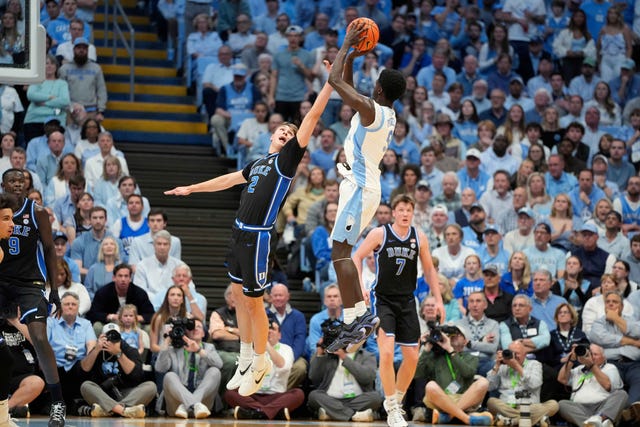
There are college basketball games that feel big, and then there are games that feel inevitable. This is one of those nights.
By the time Saturday arrives in Chapel Hill, the Dean Smith Center won’t just be a building — it will be a pressure chamber. Every bounce, every whistle, every missed rotation will feel louder, heavier, more consequential. North Carolina and Duke don’t just meet on a schedule; they collide at emotional crossroads. One team arrives searching for validation, the other for dominance. Both arrive knowing that nothing — rankings, records, or recent form — truly protects you once the ball goes up.
This particular chapter of the rivalry carries an extra edge. Duke looks powerful, composed, and relentless. North Carolina looks hungry, tested, and increasingly dangerous at home. And buried within that contrast are three defining truths about Duke that UNC must understand — because each one has the power to swing the game, and just as importantly, each one reveals where North Carolina can strike back.
Setting the Stage: Why This Game Matters More Than Usual
North Carolina enters the matchup at 18-4 overall and 6-3 in ACC play, ranked No. 14 in the AP Top 25. The Tar Heels are still very much in the hunt for the ACC regular-season title, but margin for error is shrinking. A win over Duke doesn’t just boost the résumé — it stabilizes the season.
Duke, meanwhile, arrives at 21-1 overall and a perfect 10-0 in the ACC, ranked No. 4 nationally. The Blue Devils are playing with confidence, structure, and a growing belief that this team could be special. Under Jon Scheyer, Duke has embraced a physical, efficient identity that travels well — and that has already translated into success in Chapel Hill.
This isn’t just another rivalry game. It’s a referendum on momentum, identity, and who controls the ACC narrative heading into February.
Thing No. 1: Duke’s Power Runs Through the Boozer Name — and Cameron Is the Centerpiece
Duke’s Advantage
If this game turns into a war of talent and composure, Duke will gladly lean on Cameron Boozer, one of the most complete freshmen in the country and the emotional engine of the Blue Devils.
At 6-foot-9, 250 pounds, Boozer doesn’t just score — he imposes. He leads Duke in points (23.3), rebounds (9.9), assists (4.0), and steals (1.9) per game, a rare statistical footprint that reflects how much of the game flows through him. He’s comfortable attacking from the elbow, finishing through contact, facilitating out of double teams, and defending multiple positions.
And yes, the lineage matters. The name “Boozer” carries weight in this rivalry, and Cameron plays with the calm of someone who understands the moment without being overwhelmed by it.
His twin brother, Cayden Boozer, doesn’t command the same attention, but his role is quietly critical. As a secondary ball-handler and bench stabilizer, Cayden helps Duke maintain control when rotations shift — something that becomes invaluable in hostile environments like the Dean Dome.
UNC’s Counterpunch
For North Carolina, the answer isn’t stopping Boozer — it’s surviving him.
UNC must attack Boozer with layers: early physicality, quick doubles from unexpected angles, and forcing him to give the ball up before he finds rhythm. The Tar Heels’ frontcourt depth becomes critical here, not just to challenge Boozer’s scoring, but to test his stamina across 40 minutes.
If UNC can turn Boozer into more of a distributor than a finisher — and then punish Duke on the other end — the balance of the game begins to shift.
Thing No. 2: Duke’s Interior Efficiency Is Elite — but It Comes With a Risk
Duke’s Strength
Duke is devastating inside the arc.
The Blue Devils are converting 62.1% of their two-point attempts, the fourth-best mark in the nation. That efficiency isn’t accidental. It’s the result of spacing, patience, and an understanding of when to attack. Duke doesn’t rush shots. They carve out angles, seal defenders, and finish with purpose.
This interior dominance allows Duke to control tempo. They don’t need to rely on streaky shooting nights to win — they can grind you down possession by possession.
The Hidden Vulnerability
Here’s the twist: Duke is not a great three-point shooting team.
They shoot 33.8% from beyond the arc, ranking around 200th nationally, and that number dips further in ACC play. Duke can make threes — Cameron Boozer, Isaiah Evans, and Caleb Foster are capable — but it’s not their identity.
That creates a fascinating tension. Duke wants to live inside, but if UNC can clog the paint without surrendering clean perimeter looks, the Blue Devils can be forced into uncomfortable stretches.
UNC’s Opportunity
Ironically, this is where North Carolina’s biggest weakness becomes a defining test.
UNC currently ranks last in the ACC in three-point defense, allowing opponents to shoot over 41% from deep. If Duke’s shooters find confidence early, the Tar Heels could be punished severely.
But if UNC can hold the line — contest without fouling, rotate with discipline — Duke’s reliance on interior scoring could become predictable. And predictability, in this rivalry, is dangerous.
Thing No. 3: Duke Has Owned Chapel Hill Recently — and Believes It Can Do It Again
Duke’s Mental Edge
History matters in this rivalry, and recently, Duke has found comfort in enemy territory.
The Blue Devils have won four of their last six games in Chapel Hill, including last season’s 82-69 victory. Jon Scheyer himself holds a 5-2 record against UNC, with two wins at the Dean Dome.
That matters because confidence travels. Duke doesn’t walk into Chapel Hill hoping to survive — they expect to compete, to execute, to win.
UNC’s Emotional Advantage
But history cuts both ways.
The Dean Smith Center remains one of the few environments where momentum can flip in seconds. UNC feeds off crowd energy, especially when effort meets execution. The Tar Heels don’t need perfection — they need belief, pace, and emotional engagement.
For UNC, this game is about reclaiming emotional territory. It’s about reminding Duke that no matter how polished you look, Chapel Hill still demands a price.
The UNC Perspective: Why This Game Is a Turning Point
North Carolina’s season has been defined by flashes of excellence and moments of frustration. At home, however, the Tar Heels become something else — faster, freer, more dangerous.
To win this game, UNC must:
Rebound with desperation
Defend without panic
Push tempo selectively
Turn the game into a test of resolve, not just execution
UNC doesn’t need to out-talent Duke. They need to out-fight them for 40 minutes.
Final Thought: Why This Game Will Be Decided Late
UNC vs. Duke games rarely hinge on the opening tip. They are decided in the final eight minutes, when legs are heavy and decisions are louder than the crowd.
Duke brings control, efficiency, and star power.
UNC brings urgency, pride, and home-court emotion.
Three things to know about Duke reveal three chances for UNC — and three dangers if ignored. This game won’t just shape the ACC standings. It will shape how both teams see themselves heading into March.
And once again, nothing is settled until the final horn echoes through Chapel Hill.




