


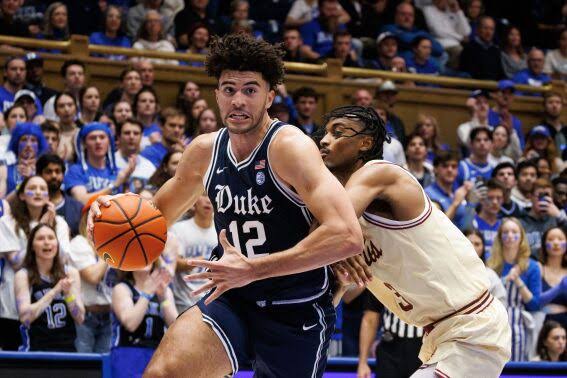
There are college basketball games, and then there are moments when the sport seems to stop breathing. Duke vs. North Carolina is one of those moments — but this one feels different. Not louder. Not bigger. More revealing. With two top-15 teams, two future NBA lottery picks staring each other down, and a rivalry teetering between eras, this matchup at the Dean Smith Center isn’t just about bragging rights or ACC standings. It’s about identity. About who controls the terms of the rivalry now — and who leaves Chapel Hill knowing they were exposed.
Saturday night won’t be decided by emotion alone. It will come down to specific matchups, tiny possessions, and pressure points that only show themselves when the margins are razor thin. And if you know where to look, the game is already telling us how it will end.
Setting the Stage: Duke and UNC Meet Again With Everything on the Line
No. 4 Duke (21-1, 10-0 ACC) arrives in Chapel Hill riding the quiet confidence of a team that knows exactly who it is. Jon Scheyer’s Blue Devils have won 10 straight conference games, control tempo as well as any team in America, and look increasingly comfortable closing games without panic.
No. 14 North Carolina (18-4, 6-3 ACC), meanwhile, is chasing validation. The Tar Heels have stabilized after a midseason wobble and are playing their best basketball again, but they’re still searching for the win that proves they belong on the same tier as the ACC’s elite.
Vegas sees Duke as a 5.5-point favorite on the road. History says ignore the number.
Because Duke–UNC doesn’t care about spreads. It cares about matchups.
The Headliner: Cameron Boozer vs. Caleb Wilson Is More Than a Freshman Duel
Every rivalry game needs a centerpiece. This one has two.
Cameron Boozer and Caleb Wilson aren’t just the best freshmen in the ACC — they are two of the most advanced frontcourt prospects in the country. And for long stretches Saturday, they’ll be staring directly at each other.
Cameron Boozer: The System Breaker
At 6-foot-9, 250 pounds, Boozer plays like a veteran in a freshman’s body. He scores efficiently in the halfcourt, punishes mismatches on the block, and has quietly become one of Duke’s best decision-makers.
Stat line:
23.3 points per game
9.9 rebounds
4.0 assists
1.9 steals
Boozer doesn’t rush. He doesn’t force. And he thrives when games slow down — which is exactly what Duke wants.
Caleb Wilson: The Chaos Creator
Wilson is Boozer’s stylistic opposite. He’s explosive, relentless, and devastating in transition. UNC is at its best when Wilson is flying down the floor, attacking the rim, or creating second chances off missed shots.
Wilson’s impact doesn’t always show up in clean stat lines — it shows up in momentum swings.
Who wins this matchup might decide the game.
But how they’re used may matter even more.
Duke will try to isolate Wilson defensively and test his discipline. UNC will try to drag Boozer into open space and speed him up.
Whose comfort zone survives?
Guard Matchups: Where Duke’s Precision Meets UNC’s Pressure
Isaiah Evans vs. Derek Dixon
Evans is Duke’s most dangerous shooter — and more than that, he’s evolved into a legitimate three-level scorer. Running him off the line is mandatory. Forgetting about his downhill drives is fatal.
Dixon, UNC’s primary ball handler, has to balance defense with offensive responsibility. If he gets tired chasing Evans, Duke will exploit it.
Seth Trimble vs. Caleb Foster
Trimble is UNC’s emotional engine. Foster is Duke’s pressure valve.
Foster doesn’t need to score 20 to impact the game — he just needs to keep Duke organized. If Trimble can disrupt him early, UNC can force Duke into uncomfortable possessions.
If not, Duke’s offense hums.
Duke’s Offensive Edge: Death by Cuts, Not Threes
This Duke team doesn’t beat you by bombing threes. It beats you by moving you to death.
Duke averages 12.7 points per game directly off cuts, the best mark in the country. That’s not a stat — that’s a philosophy.
Scheyer’s offense is built on:
Spacing
Timing
Passing bigs
Constant off-ball movement
Boozer, Patrick Ngongba, and Maliq Brown are all excellent passers. That means UNC’s defense can’t relax for half a second.
If North Carolina loses communication — even briefly — Duke will turn it into layups, dunks, and crowd-silencing runs.
The Glass Battle: UNC’s Path to Survival
If UNC wins this game, it likely looks the same way every time:
Second-chance points.
The Tar Heels average 13 second-chance points per game. Caleb Wilson and Henri Veesaar crash relentlessly. Jarin Stevenson sneaks in for timely boards.
The problem?
Duke has been the second-best defensive rebounding team in ACC play.
If Duke controls the glass, UNC’s margin for error evaporates.
If UNC steals extra possessions, this becomes a street fight.
Transition: UNC’s Secret Weapon Against Duke’s Soft Spot
One area Duke hasn’t fully solved: transition defense.
UNC thrives in quick-strike moments. When they get stops and run, they score before defenses can get set — and Duke has been vulnerable here at times.
This is where Trimble, Wilson, and Young can flip the game.
But there’s a catch:
UNC has to defend well enough first to create those opportunities.
If Duke limits turnovers and controls tempo, transition chances disappear.
Coaching Chess Match: Scheyer vs. Davis
Jon Scheyer is 5-2 against North Carolina. Two of those wins came in Chapel Hill.
His teams are composed. They don’t panic. They don’t beat themselves.
Hubert Davis, meanwhile, coaches with passion rooted in the rivalry’s history. His message this week has been about pride, edge, and urgency — according to Seth Trimble, it’s resonating.
The question isn’t effort.
It’s execution.
Odds, Spread, and What Vegas Might Be Missing
Spread: Duke -5.5
Total: 151.5
Moneyline: Duke favored
Vegas is betting on Duke’s consistency.
But rivalry games punish assumptions.
UNC doesn’t need to be perfect. It needs to:
Win the rebounding battle
Generate transition offense
Avoid long Duke scoring runs
Get something special from Wilson
If those boxes are checked, the spread gets shaky fast.
Prediction: Who Covers — and Why
This game feels tighter than the numbers suggest.
Duke is the better team on paper.
UNC is the more volatile team emotionally.
At home, volatility matters.
Pick: North Carolina +5.5
Not because Duke will play poorly — but because UNC has just enough answers, just enough energy, and just enough chaos to keep this inside one or two possessions deep into the second half.
And once it’s there?




