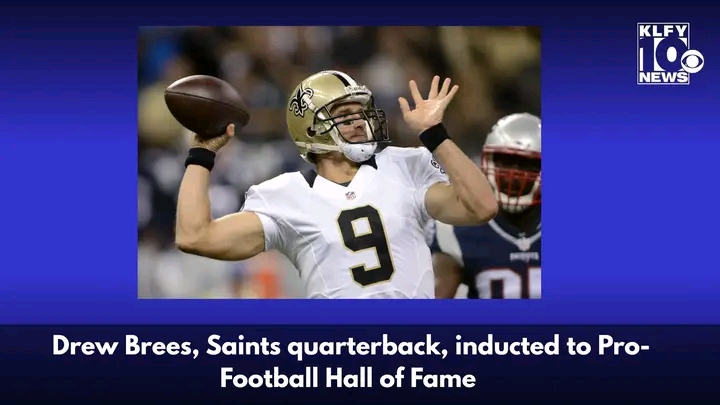
It almost feels inevitable now — but for years, the question lingered quietly in NFL circles: Would Drew Brees’ legacy be appreciated as instantly as it deserved? The statistics were overwhelming, the leadership undeniable, the transformation of an entire franchise undeniable — yet until the moment became official, history still waited for its final stamp. Now, with one announcement, the debate disappears, and the story of a quarterback who reshaped New Orleans, redefined precision passing, and turned doubt into destiny takes its rightful place among football immortals.
For Drew Brees, inevitability was never the same as certainty. His career, much like his Hall of Fame case, was built not on assumed greatness but on relentless proof. He didn’t arrive in the NFL crowned as a savior or marketed as a generational prodigy. He became one — throw by throw, season by season, record by record.
Now, with his election to the Pro Football Hall of Fame in his first year of eligibility, Brees’ place among the game’s elite is no longer a matter of discussion. It is etched into bronze, sealed by history, and secured forever.
A Career That Almost Never Found Its Home
It’s impossible to tell the story of Drew Brees without acknowledging how close the NFL came to missing it altogether.
Selected in the second round of the 2001 NFL Draft by the San Diego Chargers, Brees entered the league with questions already attached. He wasn’t tall enough by prototype standards. His arm strength wasn’t considered elite. He wasn’t flashy. He wasn’t marketed. And when injuries and inconsistency followed early in his career, the Chargers moved on, drafting Philip Rivers and letting Brees walk after a devastating shoulder injury in 2005.
For many franchises, that injury would have been the end of the story.
For New Orleans, it became the beginning of something transformative.
The Saints, still reeling from Hurricane Katrina and searching for direction both on and off the field, took a calculated risk. Head coach Sean Payton saw something deeper than medical reports or physical measurables. He saw timing. Intelligence. Obsession with detail. A quarterback who could elevate everything around him.
Together, Brees and Payton didn’t just rebuild a team — they rebuilt belief.
Redefining What an NFL Quarterback Could Be
Drew Brees changed the quarterback position without changing its fundamentals.
In an era increasingly obsessed with arm strength, size, and spectacle, Brees leaned into accuracy, anticipation, footwork, and mental processing. He made precision fashionable again. He turned the short and intermediate passing game into a lethal weapon, spreading the field horizontally and vertically through timing and trust rather than sheer force.
Defenses knew what was coming — and still couldn’t stop it.
Year after year, Brees carved up coverages with surgical efficiency. His ability to read defenses pre-snap, manipulate safeties with his eyes, and place the football where only his receiver could make a play became his signature. There were no wasted throws. No panic. No ego-driven decisions.
Just control.
That control translated into staggering production. Multiple seasons with 5,000-plus passing yards. Completion percentages that shattered previous ceilings. Consistency that redefined what elite quarterback play looked like across a full decade.
At his peak, Brees wasn’t just productive — he was inevitable.
Records That Forced the Conversation
For years, Hall of Fame debates swirled around Drew Brees not because his résumé lacked substance, but because it challenged how greatness was traditionally measured.
He didn’t have the early-career hype of Peyton Manning. He didn’t have the postseason mystique of Tom Brady. He didn’t rely on physical dominance like some of his contemporaries.
Instead, he stacked results.
Passing yards records. Completion percentage records. Touchdown totals that placed him alongside the most prolific scorers the game had ever seen. Seasons of offensive output that forced the league to reconsider what was sustainable, not just spectacular.
At one point, Brees held the NFL’s all-time passing yards record — a symbol of longevity, excellence, and week-to-week dominance. Even as those records were later surpassed in a pass-heavy era he helped usher in, the context remained clear: Drew Brees didn’t benefit from a trend. He helped create it.
And perhaps most impressively, he did it while making everyone around him better.
The Super Bowl That Sealed His Legacy
While individual accolades and records build Hall of Fame cases, championships validate them.
For Brees, Super Bowl XLIV wasn’t just a title — it was a statement.
Against the Indianapolis Colts, led by Peyton Manning, Brees delivered one of the most efficient and composed performances in Super Bowl history. He completed 32 of 39 passes for 288 yards and two touchdowns, earning Super Bowl MVP honors while guiding New Orleans to its first championship.
The image of Brees lifting his young son after the game became iconic — a symbol not only of victory but of redemption, resilience, and fulfillment.
For a franchise long defined by heartbreak, dysfunction, and near-misses, Brees delivered belief. For a city that had endured unimaginable loss, he delivered joy.
That moment transformed his career from statistically historic to emotionally unforgettable.
Leadership Beyond the Stat Sheet
Perhaps the most compelling part of Drew Brees’ Hall of Fame case can’t be quantified.
Teammates consistently described him as the tone-setter. The example. The standard. The quarterback who stayed late, studied more, and demanded accountability without ego. His leadership wasn’t loud — it was relentless.
Brees was known for handwritten letters to teammates. For precision in preparation. For creating an environment where excellence wasn’t requested — it was expected.
That culture sustained the Saints through injuries, roster changes, and playoff heartbreaks. It turned New Orleans into a perennial contender. And it ensured that even when postseason success didn’t follow regular-season brilliance, the foundation never cracked.
Leadership like that lasts longer than records.
Why First-Ballot Matters
Some Hall of Fame inductions feel ceremonial. Others feel overdue.
Drew Brees’ first-ballot election feels necessary.
First-ballot status isn’t just about credentials — it’s about clarity. It signals that there was never a serious debate. That the impact was immediate, undeniable, and generational. That history didn’t need time to reflect — it already knew.
For years, Brees operated slightly outside the spotlight reserved for the league’s most marketed stars. His greatness was sometimes acknowledged quietly, analytically, even reluctantly by those who favored flash over function.
This election removes any remaining ambiguity.
Drew Brees didn’t just belong in the Hall of Fame. He belongs among the quarterbacks who reshaped how the game is played.
A Legacy That Extends Beyond Football
Since retiring, Brees has remained a presence in the sport and the city he adopted. His influence in New Orleans extends far beyond Sundays — from community rebuilding efforts to philanthropic work that continues to define his post-playing chapter.
That continuity matters.
Great players leave records behind. Great leaders leave foundations.
Brees leaves both.
He leaves a franchise permanently altered, a city forever grateful, and a generation of quarterbacks who learned that anticipation can beat arm strength, preparation can beat raw talent, and leadership can outlast youth.
Immortality Earned, Not Given
Drew Brees’ journey to the Pro Football Hall of Fame mirrors his career itself.
It wasn’t rushed. It wasn’t assumed. It was earned.
From overlooked prospect to injured castoff. From risk signing to franchise savior. From accurate passer to all-time great. From quiet competitor to football immortal.
Now, with his name enshrined in Canton, the final question fades away.
Not if Drew Brees belongs among the game’s greatest — but how long it took some to realize they were watching one all along.
And that, perhaps, is what makes his Hall of Fame election feel both inevitable and historic at the same time.