


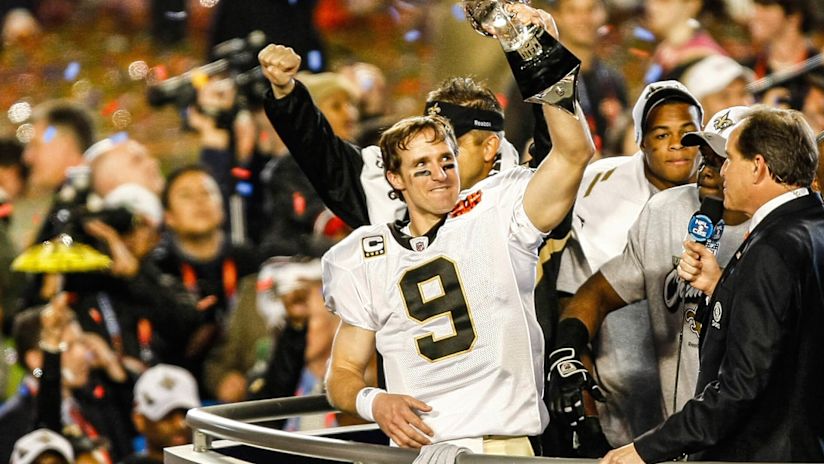
There are Mardi Gras moments that feel festive. And then there are Mardi Gras moments that feel historic. When Drew Brees rolls down St. Charles Avenue this Sunday evening, it won’t just be another celebrity wave from atop a float it will be a collision of football legacy, city pride, and Carnival pageantry in a way only New Orleans can deliver. The beads will fly, the bands will play, and somewhere between the cheers and the brass horns, fans will look up and see something unexpected: a tribute that freezes No. 9 in time, turning a parade into a living monument.
Drew Brees, New Orleans Saints legend and Pro Football Hall of Fame quarterback, is set to ride in the Bacchus parade once again but this appearance carries an added layer of symbolism. According to Kern Studios, Brees will ride on a special float featuring a statue honoring his iconic No. 9. In a city where sports heroes are woven into the cultural fabric as tightly as Mardi Gras itself, the moment promises to feel bigger than football.
A Perfect Match: Bacchus and Brees
The Krewe of Bacchus has long been known for blending celebrity glamour with larger-than-life spectacle. Founded in 1968, Bacchus transformed Mardi Gras by inviting nationally recognized figures to serve as king or ride as special guests. Over the decades, Hollywood stars, music icons, and sports legends have reigned over the parade. But few figures resonate with New Orleans quite like Drew Brees.
For Saints fans, Brees isn’t just a quarterback. He’s the quarterback — the face of a franchise reborn, the leader who helped deliver the city’s first Super Bowl championship, and a symbol of resilience in the wake of Hurricane Katrina. His relationship with New Orleans has always felt deeper than wins and losses. It’s personal. Emotional. Enduring.
That’s why his third appearance in Bacchus feels less like a cameo and more like a homecoming.
A History with Bacchus
This won’t be Brees’ first ride down the Uptown route. He previously served as a celebrity rider in 2007, just one year after helping lead the Saints to their first NFC Championship Game appearance. At that time, the city was still rebuilding physically and emotionally. Seeing Brees wave to crowds felt symbolic of hope and renewal.
In 2010, fresh off a Super Bowl victory, Brees returned to Bacchus as Grand Marshal. That ride was electric. The Lombardi Trophy had changed everything. New Orleans wasn’t just celebrating Carnival it was celebrating validation. Pride. Triumph.
Now, more than a decade later, Brees returns not as an active player, but as a Hall of Famer — enshrined in Canton, immortalized in bronze, and permanently etched into Saints history.
And this time, the celebration includes something new: a statue.
The Special Twist: A Tribute on Wheels
Kern Studios, the legendary float-building company behind some of Mardi Gras’ most elaborate creations, confirmed that Brees will ride on a float featuring a special statue honoring No. 9. In a parade known for spectacle, that detail stands out.
A statue is permanent. It’s not a fleeting wave or a quick photo op. It’s a statement.
While details about the statue’s exact design remain closely guarded, the symbolism is clear. No. 9 isn’t just a jersey number — it represents one of the most transformative eras in Saints history. From record-breaking passing yards to unforgettable comeback victories, Brees’ career in New Orleans redefined what was possible for the franchise.
The idea of that legacy rolling through the streets during Mardi Gras feels uniquely fitting. Carnival is about tradition and storytelling. So is sports. And for Saints fans lining the Uptown route, this float may feel like a visual reminder of memories they’ll never forget.
Why This Moment Matters
Mardi Gras has always been more than beads and parades. It’s a celebration of identity. And in New Orleans, identity is inseparable from the Saints.
When the team won Super Bowl XLIV in 2010, it felt like a communal victory. The parade that followed remains one of the largest celebrations in city history. Brees stood at the center of it all — lifting the trophy, smiling through confetti, and embodying a city that refused to be defined by hardship.
Now, years removed from retirement, Brees’ presence still carries that same emotional weight. Seeing him ride in Bacchus reminds fans that some connections don’t fade with time.
The Route and the Anticipation
Bacchus rolls Sunday at 5:15 p.m. along the Uptown route, one of the most beloved parade paths in the city. Beginning near Napoleon Avenue and weaving its way through historic neighborhoods before ending near the Convention Center, the route draws massive crowds each year.
This Sunday, those crowds will be watching a little more closely. Children wearing No. 9 jerseys will sit on ladders. Adults who remember every touchdown pass will raise their phones. And somewhere in the sea of purple, green, and gold, chants of “Who Dat!” will echo through the night air.
A Legacy Beyond Football
Part of what makes Brees’ return to Bacchus so meaningful is that his legacy extends beyond the field. Throughout his career, Brees and his family became deeply involved in community efforts across Louisiana. From rebuilding schools to supporting local charities, his impact reached far beyond the Superdome.
That connection is why moments like this resonate. He isn’t just a sports figure making an appearance — he’s someone who invested in the city and earned its loyalty in return.
The Power of Nostalgia
There’s something powerful about revisiting icons in celebratory settings. It invites reflection. It encourages storytelling. Fans will undoubtedly swap memories while waiting for the float to pass:
“Remember the touchdown to Lance Moore?”
“Remember the onside kick in the Super Bowl?”
“Remember when we thought this team would never get there?”
Bacchus provides the backdrop, but the stories belong to the fans.
Carnival Meets Canton
The timing of Brees’ Hall of Fame status adds another layer to the moment. Being inducted into the Pro Football Hall of Fame cements a player’s legacy in the broader NFL narrative. But riding in Bacchus reminds everyone where that legacy was built.
Canton may hold the bust, but New Orleans holds the heart.
More Than a Parade Appearance
Celebrity riders are common in Bacchus, but not all appearances feel the same. Some are fun. Some are flashy. Brees’ ride feels reflective — a chance for the city to celebrate not just a career, but an era.
And the statue? It turns a parade float into something almost museum-like. A moving exhibit. A rolling tribute.
A City That Never Forgets
New Orleans has a long memory when it comes to those who embrace it fully. Saints legends like Archie Manning and Steve Gleason remain revered not just for their play, but for their connection to the community.
Brees stands firmly in that tradition.
Sunday night, as the float glides past balconies draped in beads and Saints flags, it will serve as a reminder that heroes here aren’t temporary. They’re part of the city’s story.
The Emotional Undercurrent
For longtime fans, this moment may stir something deeper. Sports memories often attach themselves to personal milestones — watching games with family, celebrating victories with friends, finding joy during difficult times.
Seeing Brees again, in such a celebratory setting, taps into those memories.
What to Expect
Expect cheers. Expect camera flashes. Expect plenty of No. 9 jerseys lining the streets. And expect that when the float carrying Brees and his statue passes by, the noise will swell just a little louder.
Because this isn’t just another Mardi Gras Sunday.
It’s a celebration of legacy, loyalty, and a quarterback who helped redefine what it meant to be a Saint.
Final Thoughts
Mardi Gras is built on spectacle, tradition, and heart. Drew Brees embodies all three in the context of New Orleans football history.
As Bacchus rolls at 5:15 p.m. along the Uptown route, fans won’t just be reaching for beads. They’ll be reaching for a moment a glimpse of a legend, a reminder of glory days, and a statue that symbolizes a number forever tied to the soul of the city.
The twist this time isn’t just the float or the tribute.
It’s the realization that some legacies don’t fade they roll right back through the streets, carried by cheers, brass bands, and the unmistakable rhythm of New Orleans.




