


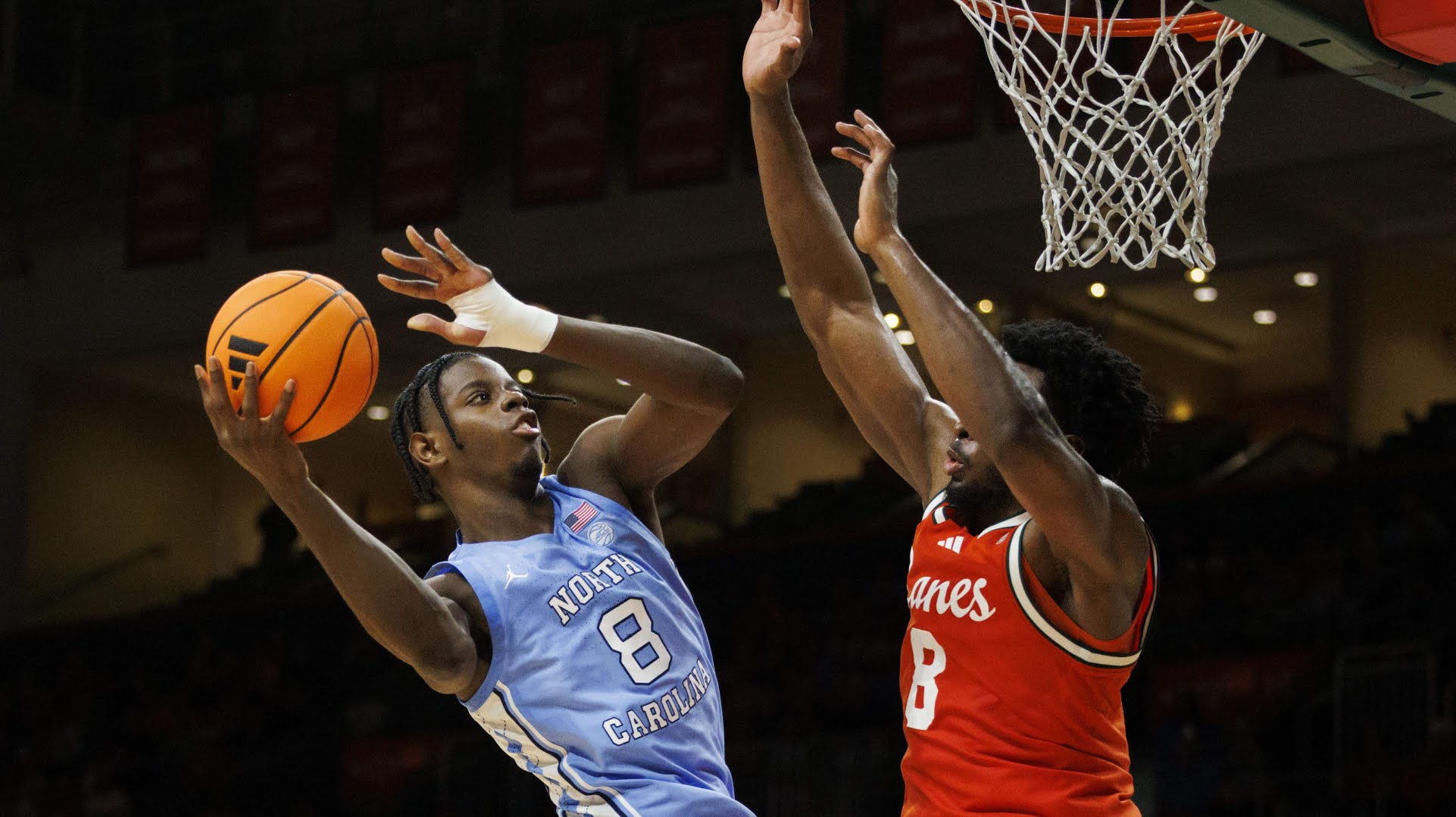
If you watched the final minutes in Coral Gables closely, you could feel it — something wasn’t right. Not just with the score, not just with North Carolina’s cold shooting stretch, but with the way Caleb Wilson flexed his left hand before heading toward the locker room. For a few tense minutes, the Tar Heels’ season seemed to hang in the balance. And while coach Hubert Davis insisted afterward that “there is no situation,” the optics told a more complicated story. In a 75-66 loss to Miami that snapped UNC’s five-game winning streak, the bigger concern wasn’t just the missed shots — it was the health of the freshman star who has become the heartbeat of this team.
A Night That Shifted Quickly
North Carolina entered Tuesday night riding momentum. The Tar Heels had just secured a massive home win over No. 4 Duke — a statement victory that reignited national conversation around Hubert Davis’ squad. At 19-4 entering the matchup, confidence was high.
But Miami had other plans.
The Hurricanes never trailed at the Watsco Center. From the opening tip, they controlled tempo, imposed physicality inside, and forced UNC into a half-court game that gradually squeezed the life out of the Tar Heels’ offense.
Still, the defining moment of the night didn’t come from a Miami run.
It came when Caleb Wilson walked off the floor.
The Injury Moment: What We Saw
With just under 15 minutes remaining in the second half, Wilson exited the game and headed toward the locker room alongside UNC trainer Doug Halverson. The scene immediately sparked concern. Wilson’s mother and sister left their courtside seats after speaking briefly with a UNC staffer — a detail that didn’t go unnoticed by those watching closely.
For a player who rarely leaves the floor, it was unusual. For UNC’s leading scorer, it was alarming.
When Wilson returned several minutes later, his left hand and wrist were heavily taped. He re-entered the game with 8:47 remaining but appeared limited. He eventually sat for the final 1:43 as Miami sealed the win at the free-throw line.
He finished with 12 points — a season low.
And while that stat line may not jump off the page, the context makes it significant.
Hubert Davis’ Response: Calm, But Questions Remain
After the game, Hubert Davis downplayed the situation.
“There is no situation,” Davis said, adding that the wrap did not affect Wilson “to my knowledge.”
It was a composed answer. Predictable, even.
But Wilson was not made available to reporters afterward — and that absence leaves room for speculation.
In college basketball, especially in February, transparency is often limited. Coaches protect their players. Programs protect their postseason positioning. And injuries are frequently framed in the most optimistic light possible.
The key phrase from Davis’ answer might not be “there is no situation.”
It might be “to my knowledge.”
The Bigger Issue: UNC’s Offensive Collapse
Even before Wilson’s injury scare, UNC’s offense had begun to stall.
The Tar Heels shot an impressive 55.2 percent in the first half and trailed only 43-40 at the break. The efficiency suggested they were within striking distance.
Then came the second half.
North Carolina shot just 26.5 percent after halftime. They missed 10 of their final 12 shots. They went 1-for-14 from three-point range in the second half.
One made three.
Fourteen attempts.
That’s not just a cold stretch — that’s structural breakdown.
Wilson scored only three points in the first half and never found consistent rhythm. Whether the hand played a role or not, UNC’s offensive identity seemed disrupted.
Miami’s Interior Dominance
While the spotlight shines on Wilson’s injury, credit must go to Miami.
The Hurricanes dominated the paint, outscoring UNC 46-28 inside. They also won the rebounding battle 41-35 and controlled physical matchups throughout.
Malik Reneau delivered a double-double with 16 points and 10 rebounds. Ernest Udeh Jr. added 15 points and 10 boards. Tre Donaldson chipped in 14.
Miami didn’t just outshoot UNC.
They outmuscled them.
When transition opportunities dried up for North Carolina, the Tar Heels struggled to generate easy offense in the half court. Miami’s defensive discipline forced contested jumpers and limited driving lanes.
And once UNC’s shots stopped falling, the pressure mounted.
Caleb Wilson’s Role in UNC’s Identity
To understand why this injury scare matters, you have to understand Wilson’s role.
As a freshman, he has become:
UNC’s leading scorer
A primary creator
A reliable late-game option
An emotional tone-setter
He is more than just a stat-sheet contributor.
He stabilizes the offense.
When Wilson is aggressive, UNC flows. When he struggles whether due to defense, fatigue, or injury the Tar Heels often look disconnected.
Tuesday night felt like the latter.
The Psychological Impact
Beyond the physical concern, there’s a psychological element.
When a team sees its star walk off with a trainer, even briefly, it changes energy. Players tighten up. Rotations shift. Rhythm breaks.
Wilson’s absence for several minutes coincided with Miami building separation.
Even when he returned, the visible heavy tape served as a reminder that something wasn’t normal.
Basketball is rhythm. And rhythm is fragile.
What This Means Moving Forward
The good news for UNC fans is this:
Wilson returned to the game.
He played meaningful minutes afterward.
Hubert Davis did not signal long-term concern.
But the calendar matters.
North Carolina sits at 19-5 (7-4 ACC). The margin for error in the ACC is slim. Every game impacts seeding, tournament positioning, and confidence.
The Tar Heels return home Saturday to host Pittsburgh at the Smith Center — a critical bounce-back opportunity.
If Wilson is fully healthy, the loss in Miami becomes a temporary setback.
If the hand lingers, it becomes a storyline.
Was This Just an Off Night?
It’s possible Tuesday was simply a convergence of bad factors:
Road environment
Emotional letdown after beating Duke
Miami’s physical frontcourt
Shooting regression
Good teams sometimes lose games like this.
But elite teams respond.
The question now isn’t whether UNC can beat quality opponents — they just beat Duke.
The question is whether they can sustain high-level play when adversity hits mid-game.
The Importance of Depth
Jarin Stevenson led UNC with 13 points. Henri Veesaar added 11. But the secondary scoring never consistently threatened Miami.
When Wilson is limited even slightly someone else must seize control.
That didn’t happen in Coral Gables.
If UNC wants to make a deep March run, balanced scoring and interior resilience will be essential.
Miami’s Statement Win
For Miami (19-5, 8-3 ACC), this victory reinforces legitimacy.
They never trailed.
They controlled tempo.
They closed the game by outscoring UNC 11-6 in the final 2:07.
This wasn’t luck.
It was execution.
And in a crowded ACC race, it sends a message: Miami is very much in the conversation.
Final Thoughts: A Scare Bigger Than the Score
The final box score reads 75-66.
But this game may be remembered less for the margin and more for the moment Caleb Wilson walked off the floor.
Hubert Davis says there is no situation.
Maybe he’s right.
Maybe the heavy tape was precautionary.
Maybe the season-low 12 points were circumstantial.
Maybe UNC simply had a bad half.
Or maybe this was a reminder of how thin the line is between momentum and uncertainty in February basketball.
The Tar Heels have talent. They have resilience. They’ve already proven they can rise for big moments.
Now comes the next test:
How do they respond?
If Wilson is healthy and UNC regains its offensive rhythm Saturday at the Smith Center, this loss will fade into the background.
But if his hand becomes a lingering issue, Miami might be remembered as the night the Tar Heels’ margin for error narrowed.
For now, all eyes shift to practice reports, warmups, and that left hand.
Because in Chapel Hill, one thing is clear:
When Caleb Wilson flexes his fingers, the entire season seems to move with them.




