


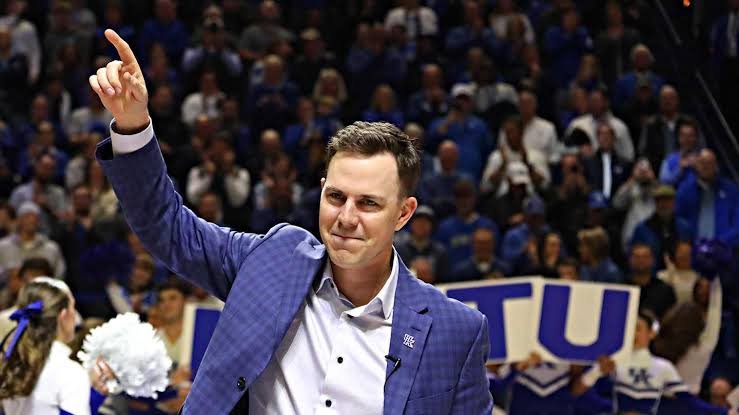
If you walk the sidelines of a Texas high school football game on a Friday night, you can feel it immediately — the scale, the urgency, the pride. The bands are louder. The stadium lights feel brighter. The expectations are heavier. For decades, this state has been a recruiting gold mine guarded fiercely by its in-state powers and a handful of national heavyweights. So when Kentucky’s revamped coaching staff started showing up more frequently — building relationships, extending offers, hosting prospects — it raised eyebrows. The Wildcats weren’t just passing through. They were planting flags. And under offensive architect Will Stein, it’s becoming clear that this push into Texas isn’t random. It’s strategic. And it may only be the beginning.
A Calculated Expansion, Not a Casual Visit
Recruiting territory in college football is rarely accidental. Programs identify pipelines years in advance, weighing geography, relationships, roster needs, and competition. For Kentucky, Texas represents both opportunity and challenge — a state overflowing with Power Five talent but saturated with SEC, Big 12, and now Big Ten presence.
The decision to lean into Texas recruiting signals something important: Kentucky believes its brand has grown strong enough to compete outside traditional borders. The Wildcats are no longer operating strictly within familiar Southeastern lanes. They’re expanding the map.
That expansion aligns perfectly with the arrival of Will Stein and a refreshed staff dynamic.
The Will Stein Effect
Will Stein’s offensive reputation precedes him. Known for modern concepts, quarterback development, tempo variation, and creative spacing, Stein brings an offensive philosophy that mirrors what Texas high school prospects are already comfortable running.
Texas football culture thrives on quarterback play, spread systems, and high-volume passing attacks. Stein’s scheme doesn’t feel foreign — it feels familiar, yet elevated. That matters on recruiting visits.
When prospects sit in meeting rooms and see cut-ups that resemble what they’re already executing on Friday nights — only faster, cleaner, more SEC-ready — the transition feels natural. Instead of selling a drastic system change, Kentucky can sell progression.
For quarterbacks especially, Stein’s presence is magnetic. Development pathways are clearer. Offensive identity is sharper. And in a state where elite quarterback talent emerges annually, that pitch resonates.
Building Relationships From the Ground Up
Breaking into Texas requires more than glossy presentations. It requires relationships — with high school head coaches, position coaches, trainers, 7-on-7 directors, and sometimes entire communities.
Kentucky’s revamped staff has approached Texas with consistency rather than flash. Multiple visits. Follow-ups. Film breakdown sessions. Honest conversations about roster fits and long-term roles.
That approach matters in Texas, where trust isn’t granted easily. High school programs value continuity and loyalty. A staff that shows up once won’t make waves. A staff that returns repeatedly earns attention.
Early indications suggest Kentucky is earning that attention.
Identifying the Right Fits
Kentucky’s strategy isn’t built on trying to out-recruit Texas, Texas A&M, Oklahoma, or LSU for every five-star prospect in the state. Instead, it’s about identifying players who fit both the culture and developmental arc of the program.
For some recruits, the pitch of being foundational rather than rotational is compelling. At blue-blood programs, depth charts are crowded instantly. At Kentucky, particularly in an evolving offensive system, opportunity can be immediate.
That distinction creates openings.
And for prospects who value playing time, development, and SEC exposure without being buried behind multiple five-star peers, Lexington starts to look appealing.
The Quarterback Pipeline Possibility
Perhaps the most intriguing aspect of Kentucky’s Texas push lies at quarterback.
Texas produces elite quarterback talent every recruiting cycle. With Stein’s reputation as a quarterback developer, Kentucky can present a narrative rooted in progression — from high school star to SEC starter to potential NFL prospect.
In today’s NIL-driven landscape, quarterbacks are brand-builders. Expanding into Texas doesn’t just add depth; it enhances the Wildcats’ visibility among high-profile skill players.
And quarterbacks attract receivers. Receivers attract defensive attention. The domino effect is real.
Expanding Speed and Skill
Historically, Kentucky has built its identity around physicality — disciplined defense, strong running games, and gritty line play. But the modern SEC demands more speed in space. It demands explosive perimeter athletes.
Texas offers that in abundance.
By targeting Texas skill players — receivers, defensive backs, hybrid athletes — Kentucky can gradually reshape its roster speed profile. Competing in the SEC isn’t just about strength anymore. It’s about separation, acceleration, and adaptability.
If Kentucky consistently lands two to three Texas prospects per class at skill positions, the cumulative impact over four recruiting cycles could redefine the program’s athletic ceiling.
Competing in a Crowded Arena
The challenge, of course, is immense.
Texas is home to two flagship programs. It borders Oklahoma. LSU recruits the state aggressively. Alabama and Georgia maintain national footprints. Even Big Ten programs are investing more resources into Texas recruiting.
Kentucky’s advantage won’t be prestige alone. It must be precision.
That means identifying prospects early, offering before rankings explode, and building loyalty before larger programs swoop in.
It also means differentiating the pitch. Kentucky isn’t selling tradition at Texas’ level. It’s selling trajectory.
The Trajectory Argument
Programs like Kentucky can recruit Texas by leaning into momentum rather than history.
The Wildcats can point to steady bowl appearances. NFL draft picks. Program stability. Coaching consistency. A growing offensive identity.
For recruits looking to help elevate a program rather than simply maintain a dynasty, that narrative carries weight.
Texas prospects are competitive by nature. Many want to build something — not just join it.
NIL and the Modern Recruiting Landscape
NIL opportunities have reshaped recruiting conversations. Texas markets are robust. But Kentucky isn’t without its own growing NIL ecosystem.
The Wildcats can sell SEC exposure, national television slots, and an opportunity to stand out in a major conference. In some cases, being a star in Lexington may offer clearer brand identity than being one of many in Austin or College Station.
For the right prospect, that calculus matters.
Cultural Fit and Identity
Beyond X’s and O’s, recruiting is cultural alignment.
Kentucky’s program culture emphasizes development, accountability, and cohesion. The staff’s outreach into Texas isn’t about volume — it’s about alignment.
Players who buy into Kentucky’s culture can thrive, regardless of geography.
Early feedback from Texas prospects suggests that transparency during visits has been a selling point. Honest depth chart discussions. Clear expectations. Defined development plans.
In a recruiting world sometimes filled with vague promises, clarity stands out.
Long-Term Implications
If this Texas push proves sustainable, the long-term implications extend beyond a single class.
Establishing even a modest Texas pipeline opens doors for future staff members, future recruiting cycles, and deeper connections with high school programs.
One successful recruit can influence teammates. Teammates influence underclassmen. The cycle builds.
Programs that crack Texas rarely do so overnight. They do so incrementally.
Kentucky appears committed to that incremental climb.
A Statement of Ambition
More than anything, this recruiting push signals ambition.
Kentucky isn’t content to remain regional. It wants national reach. It wants to compete not just for bowl eligibility but for upper-tier SEC positioning.
Expanding into Texas is bold. It’s challenging. It’s resource-intensive.
But it’s also forward-thinking.
What Comes Next?
The next year will reveal whether this momentum converts into commitments.
Official visits will matter. Summer camps will matter. Relationships will be tested when larger programs intensify their pursuit.
But even if immediate returns are modest, the groundwork matters.
Texas recruits now know Kentucky is present. They know Will Stein’s name. They’ve seen Wildcats staffers on campus.
Recognition is the first step in expansion.
Final Thoughts
Texas Friday nights are sacred. The competition is relentless. The talent is abundant.
For Kentucky’s revamped staff under Will Stein to make noise in that environment speaks to intentional strategy and rising confidence within the program.
This isn’t about a single recruit. It’s about reshaping perception.
It’s about proving that Kentucky can walk into Texas — one of the most competitive recruiting territories in the country — and be taken seriously.
And if early signs hold true, this isn’t a short-term visit.
It’s the foundation of something larger.
Because sometimes, new staff and new territory don’t just signal change.
They signal ambition.
And in Kentucky’s case, the noise in Texas might just be the beginning.




