


A few hours before Kentucky tipped off at Arkansas — still stinging from a blowout loss at Vanderbilt — the Wildcats found themselves under the national spotlight on ESPN’s College GameDay. The verdict from analysts was blunt. By traditional Kentucky standards, this season had been disappointing.
Jay Bilas didn’t mince words, calling the Wildcats underwhelming “by any objective standard.” Jay Williams pointed to the lofty expectations surrounding Mark Pope’s roster — widely believed to be one of the most expensive in college basketball — and the reality that Kentucky was trending toward a middle seed in the NCAA Tournament. That combination, he suggested, wouldn’t sit well with Big Blue Nation.
Injuries have certainly played a role. Starting point guard Jaland Lowe is out for the season. Key contributors Jayden Quaintance and Kam Williams have missed significant time. But the criticism hasn’t focused solely on availability — it’s centered on competitiveness. In several marquee matchups, Kentucky hasn’t just lost; it’s been outplayed decisively.
Then Seth Greenberg took the conversation a step further.
“Kentucky fans are absolutely unrealistic,” he said. “They think they’re supposed to win every single game.”
It was a strong statement — one that cut to the heart of a decades-long debate surrounding one of college basketball’s most passionate fan bases. Greenberg pointed out that the modern landscape of the sport has shifted dramatically. Veteran players are staying in school longer. International prospects are choosing the college route. NIL opportunities have redistributed talent across the country. The days of a handful of blue-blood programs hoarding elite rosters are fading.
“It’s harder now,” Greenberg emphasized. “There are more players in the game.”
And yet, in Kentucky, the standard hasn’t changed.
Since those comments aired, the Wildcats have responded with resilience. They upset Arkansas on the road. They handled Oklahoma. They stormed back to defeat Tennessee in Rupp Arena. Suddenly, the narrative shifted — at least temporarily.
But this season has been anything but smooth.
There was the 35-point loss to Gonzaga. The lopsided defeat at Michigan State. The blowout at Louisville. The home loss to Missouri as a double-digit favorite. And, of course, the 80-55 collapse at Vanderbilt — a night that sent social media into a frenzy and ignited renewed frustration toward Pope.
For a coach who entered Year 2 as one of the most celebrated figures in the commonwealth, the mood has fluctuated dramatically. In a matter of weeks, Pope went from beloved program builder to target of vocal criticism.
So are the expectations too high?
Kentucky great Derek Anderson offers a more balanced perspective.
“You’re supposed to have expectations,” Anderson said. “This is Kentucky. The standard is high. But it’s about progress.”
Anderson, a key figure on the 1996 national championship team and close friend of Pope, believes the conversation should center less on perfection and more on development.
“Mark is making progress,” he said. “If there wasn’t progress, that would be different. But there is.”
He challenges fans to remember one simple truth: no one wins every game. The last undefeated national champion was Indiana in 1976 — half a century ago.
“That’s unrealistic,” Anderson said. “We’re not going to win every game. Who does?”
For Anderson, the real issue isn’t losing — it’s effort. During his playing days, he said, losses happened. But they didn’t happen because Kentucky lacked passion.
“We didn’t lose by effort,” he said. “As a Kentucky player, you play with passion. You show it.”
Earlier in the season, that intensity was questioned. Even Pope admitted frustration at times. Anderson and other members of the 1996 championship team — connected through an active group text — weren’t shy about holding their former teammate accountable.
“Oh, he gets it,” Anderson laughed. “We tell him, ‘Come on, man.’ But it’s always positive. We push him.”
That balance — accountability without abandonment — is what Anderson hopes fans will adopt.
Since starting SEC play 0-2, Kentucky has won eight of nine games and positioned itself near the top of the conference standings. That surge is evidence, Anderson believes, that growth is happening in real time.
“You judge someone when they’re complete,” he said. “Not after a bad stretch.”
The message isn’t blind loyalty. It’s measured belief.
Kentucky’s expectations are not wrong. The banners inside Rupp Arena demand excellence. But Anderson urges perspective in a modern era where parity is real and patience is rare.
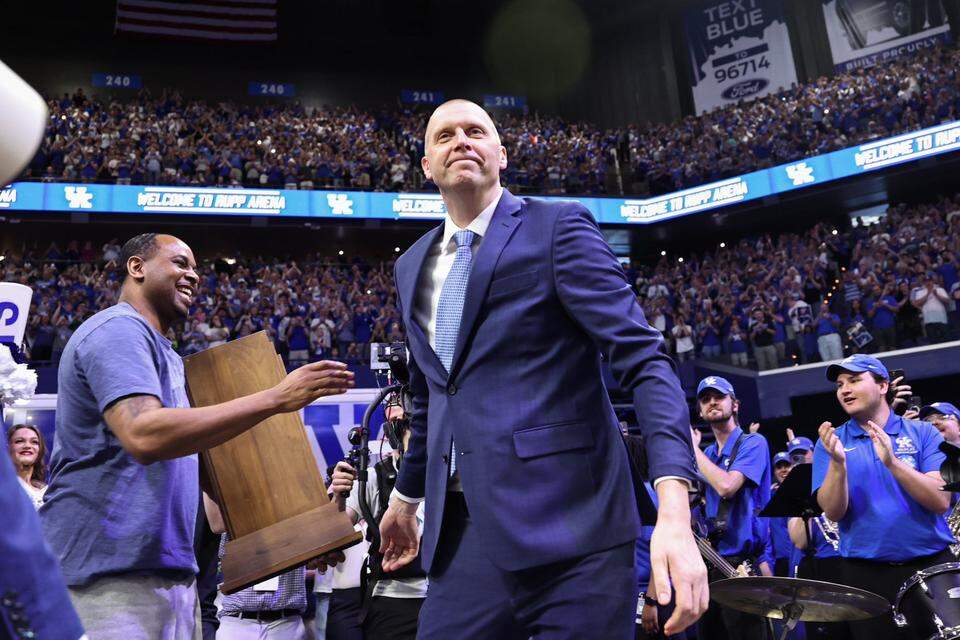
When the 1996 championship team was honored recently, Pope received the loudest ovation of the afternoon — a sign that, despite the noise, support still runs deep.
There will be more tough losses. There will be more criticism. That comes with the job.
But if the Wildcats continue to compete, improve, and play with visible heart, Anderson is confident the bigger goals will follow.
“If you see progress, you see a championship coming,” he said.
In Lexington, expectations will never disappear. Nor should they. But perhaps the real challenge isn’t lowering the bar — it’s understanding that the path back to the top requires resilience from everyone involved.




