


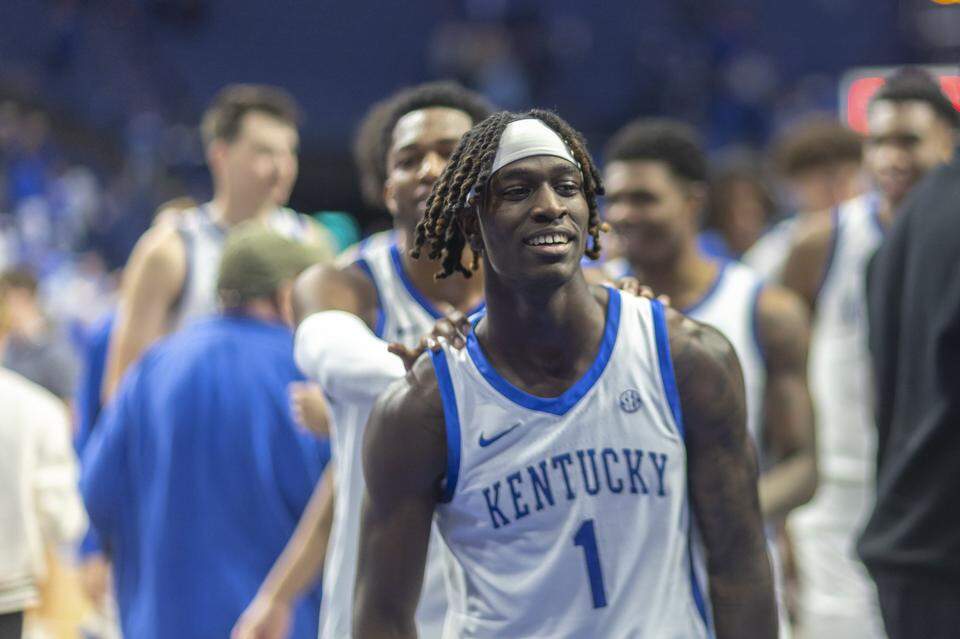
What happens when a program fresh off a national championship decides not to pay to keep one of its own? Does it risk unraveling chemistry? Does it gamble with momentum? Or does it quietly double down on belief in its internal development and recruiting strategy?
On a charged Saturday afternoon inside the O’Dome, that lingering offseason question hovered in the air long before tipoff. When Denzel Aberdeen walked back onto Florida’s home floor — this time wearing Kentucky blue — the storyline practically wrote itself. But by the final buzzer of Florida’s 92-83 win over Kentucky, the narrative felt clearer, sharper, and perhaps even settled — at least for now.
For the Florida Gators, moving on may not have been comfortable. But it might have been correct.
The Offseason Decision That Sparked Debate
The Gators entered the offseason riding the high of a national championship. Momentum was on their side. Expectations were higher than ever. In that position, most programs double down on continuity.
Aberdeen seemed poised to be part of that continuity.
A talented guard who had shown flashes of becoming a featured contributor, he likely would have stepped into a starting role for Florida this season. Instead, negotiations reportedly fell apart. The reasons depend on perspective — valuation, role expectations, NIL compensation structure — but the result was concrete: Aberdeen transferred to Kentucky and joined what has been described as a $22 million Wildcats roster.
From the outside, the move created understandable skepticism:
Did Florida underestimate his value?
Would losing him weaken backcourt depth?
Was Kentucky getting a bargain?
Could Florida replace his production internally?
Those questions lingered for months.
Saturday offered the first tangible response.
The Setting: A Charged O’Dome Return
GAINESVILLE, Florida – The O’Dome rarely lacks energy when Kentucky visits. But this one carried extra electricity.
Aberdeen’s return added emotional layers. Teammates from last year stood on opposite sides. Fans who once cheered his name now watched him try to spoil Florida’s home floor.
He didn’t shrink from the moment.
Aberdeen played aggressively, finishing with 19 points and four assists, shooting 8-of-21 from the field. He attacked early. He hunted matchups. He embraced the spotlight.
But the story wasn’t just about his performance.
It was about the answer Florida delivered.
Xaivian Lee’s Statement Performance
If Aberdeen’s departure left a void, Xaivian Lee filled it emphatically.
Lee scored a game-high 22 points, controlling pace and exploiting defensive gaps with precision. His ability to stretch the floor, attack off the dribble, and manage late-game possessions proved critical.
Florida coach Todd Golden didn’t hesitate in his praise.
“I mean, he’s playing great, right?” Golden said. “I mean, he was fantastic at Georgia, he was great at Vanderbilt. He’s stacked some really good games over the last couple of weeks, and I thought he was fantastic today.”
Lee’s performance wasn’t just efficient — it was symbolic.
It represented investment elsewhere. It represented strategic redistribution of resources. It represented belief in a different roster construction path.
And it worked.
Defense Defines the Outcome
While Lee’s scoring grabbed headlines, Florida’s defensive execution may have been more telling.
Aberdeen and Kentucky’s preseason SEC Player of the Year, Otega Oweh, entered as primary threats. Together, they shot a combined 12-of-35 from the floor.
Oweh, Kentucky’s leading scorer, managed just 13 points on 4-of-14 shooting.
Golden’s defensive blueprint was clear.
“I thought we did a great job on (Aberdeen),” Golden said. “I thought he’d get some tough shows. But if we could cut their water off then we would give ourselves a good chance to win. They’re both really good players, and you’re not going to make them miss every time. But you know to go combined 12-of-35, that’s winning basketball for sure.”
Florida didn’t attempt to eliminate Aberdeen. They forced difficulty.
Tough twos. Contested pull-ups. Defensive switches with discipline. Closeouts that ran shooters off the line.
Alex Condon echoed that defensive pride.
“I knew ‘Zel was going to be aggressive tonight and try to fuel off the crowd a little bit,” Condon said. “Credit to him. He played a solid game, was aggressive. I think our guys did a great job making him take tough 2s, running him off the 3-point line. Yeah, as a whole, I was really proud of the team.”
This wasn’t emotional defense. It was calculated.
Urban Klavzar: The Quiet Development Win
If Lee represented strategic acquisition, Urban Klavzar represented patient development.
After barely seeing the floor last season, Klavzar chose to remain at Florida. That decision paid off in a major way.
He scored 19 points off the bench, knocking down shots with confidence and spacing Kentucky’s defense. Alongside Lee, he combined for nine 3-pointers.
That shooting surge underscores a subtle evolution in Florida’s offensive identity.
The Gators have grown more efficient from beyond the arc during their five-game win streak. When perimeter shots fall consistently, Florida becomes multidimensional — able to punish defenses both inside and out.
Lee articulated the mindset.
“I think the message before was also how good, you know, what our ceiling can be as shots start to fall,” Lee said. “I think we’re seeing that a little bit now, for sure. But, honestly, I don’t think that’s really what we’re focusing on, to be honest. I think it’s more just controllables, and then when that happens, it makes us that much harder to beat.”
That philosophy — controllables over narratives — may explain Florida’s steady rise to 19-6 overall and 10-2 in SEC play.
Rebounding: The Program’s DNA
While shooting headlines fluctuate, Florida’s identity remains grounded in rebounding dominance.
Alex Condon made that clear.
“Inside, especially rebounding is a big emphasis. That’s our DNA. Every game we try to win the rebound count by at least 12,” Condon said. “It sucks the guys inside, and then you throw it out, and these guys hit 3s. It’s really unbeatable basketball I think.”
Rebounding isn’t glamorous. But it’s foundational.
Florida’s ability to control the glass against Kentucky limited second-chance opportunities and fueled transition offense. It also neutralized potential emotional momentum swings tied to Aberdeen’s scoring bursts.
In many ways, rebounding symbolizes Florida’s broader roster philosophy — invest in effort, physicality, and sustainable traits.
The Financial Subplot
The reported $22 million valuation of Kentucky’s roster adds unavoidable context.
In the modern NIL era, roster decisions are financial decisions. Allocating resources toward one player inevitably means less for others.
Florida’s decision to move on from Aberdeen suggests belief in balanced distribution over concentrated spending.
Saturday’s outcome doesn’t settle that philosophical debate permanently. But it provides evidence that Florida’s model — at least in this instance — worked.
The Gators didn’t crumble without him.
They evolved.
Was the Outcome Inevitable?
Perhaps the more intriguing question isn’t whether Florida was validated — it’s whether this result was inevitable given how the Gators restructured.
Lee’s emergence.
Klavzar’s growth.
Condon’s interior stability.
Defensive cohesion.
These elements didn’t appear overnight. They were cultivated.
Aberdeen’s departure may have accelerated opportunity for others. Sometimes subtraction creates clarity.
Sometimes it forces recalibration.
And sometimes, it unlocks a higher collective ceiling.
The Bigger Picture in the SEC Race
At 10-2 in SEC play, Florida sits firmly in conference contention.
This win over Kentucky wasn’t merely emotional. It was strategic. It strengthened postseason positioning and reinforced internal belief.
There is, of course, another chapter pending.
Kentucky will host Florida in the regular-season finale at Rupp Arena. That rematch promises renewed intensity. Narratives will resurface. Adjustments will unfold.
But for now, Florida holds the upper hand.
What This Means Moving Forward
Saturday’s victory doesn’t erase Aberdeen’s talent. It doesn’t diminish his production at Kentucky. It doesn’t close the door on long-term comparisons.
But it does affirm Florida’s direction.
The Gators appear:
More balanced
More defensively disciplined
More comfortable in defined roles
More dangerous from beyond the arc
When they hit double-digit threes, Condon believes “no one in the country can play with us.”
That may sound bold. But confidence often accompanies clarity.
Florida seems clear in its identity.
Final Reflection: A Decision, A Statement, A Direction
The offseason question was simple: Should Florida have kept Denzel Aberdeen?
Saturday didn’t provide a philosophical thesis.
It provided a scoreboard.
Florida 92. Kentucky 83.
Lee outdueled Aberdeen.
The defense executed.
The rebounding edge held.
The perimeter shooting clicked.
Perhaps most importantly, the locker room’s tone remained steady — not vindictive, not celebratory beyond the norm.
Just focused.
Sometimes validation isn’t loud.
Sometimes it’s measured in composure, execution, and upward trajectory.
Florida moved on.
And in one of the season’s most emotionally charged games, that move looked not only defensible — but decisive.
The rematch awaits.
But for now, the Gators’ gamble appears to be paying dividends.




