


Welcome to Mock Draft Monday 5.0, where we continue exploring possible paths for the Pittsburgh Steelers in the 2026 NFL Draft. With roster needs becoming clearer and long-term questions still looming at key positions, this projection focuses on building immediate contributors while strengthening foundational depth. This isn’t necessarily a prediction — it’s one realistic blueprint for how Pittsburgh could attack the board.
Let’s dive in.
Round 1: Denzel Boston – WR, Washington
Projected Role: Year 1 Starter
The Steelers’ wide receiver room still needs refinement and reliability. Adding a physical perimeter presence like Denzel Boston would give Pittsburgh a strong complementary option opposite its current top targets.
At 6-foot-4, Boston thrives in contested-catch situations and uses polished route-running to create separation. While he may not possess elite breakaway speed, his size, body control, and football IQ make him a quarterback-friendly target. Pittsburgh has historically valued physical receivers who can win in traffic, and Boston fits that mold perfectly.
He could immediately step into a starting role and provide red-zone value while helping stabilize the passing attack.
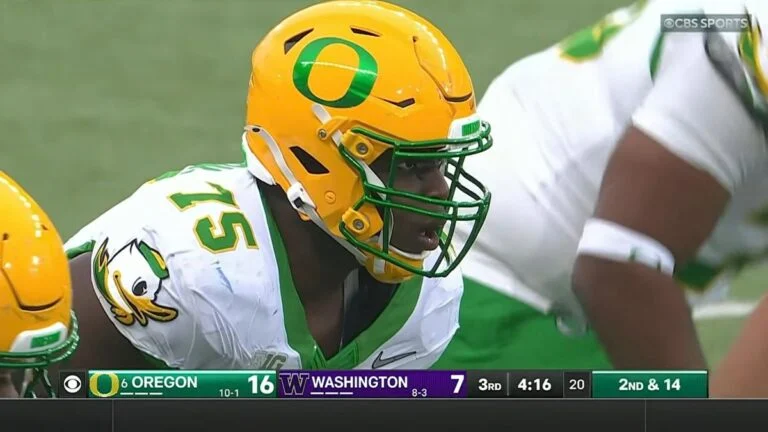
Round 2: Emmanuel Pregnon – OG, Oregon
Projected Role: Year 1 Starter
The offensive line remains a priority, particularly along the interior. Emmanuel Pregnon brings power, anchor strength, and a mauling presence in the run game — traits that align with Pittsburgh’s physical identity.
Pregnon excels in pass protection against bull rushers and shows strong hand placement and leverage control. While lateral quickness isn’t his elite trait, his ability to reset and hold the pocket makes him a dependable interior option.
If Pittsburgh is building toward long-term quarterback stability, protecting the interior must remain a top concern. Pregnon could step in immediately and solidify a guard spot for years.
Round 3: Kamari Ramsey – S, USC
Projected Role: Rotational Contributor With Starting Upside
The secondary could undergo turnover in the near future, making depth and versatility essential. Kamari Ramsey offers flexibility as both a deep safety and slot defender.
Ramsey plays with physicality and discipline. His awareness in coverage schemes allows him to read and react quickly, and he takes smart angles to the ball. While not the most explosive athlete in the class, his technique and football intelligence give him a solid developmental floor.
He could contribute immediately in sub-packages and grow into a starting role.
Round 3: Ted Hurst – WR, Georgia State
Projected Role: Special Teams Contributor / Developmental Receiver
Double-dipping at wide receiver wouldn’t be surprising given Pittsburgh’s recent turnover at the position. Ted Hurst brings strong ball-tracking ability and reliable hands.
Hurst may not be a vertical burner, but he wins with positioning and timing. His ability to adjust mid-air and compete for 50-50 balls gives him situational value. Early in his career, he could contribute on special teams while developing into a rotational receiver.
Round 3: Julian Neal – CB, Arkansas
Projected Role: Rotational Corner With Upside
Cornerback remains a position that can never have too much depth. Julian Neal brings size, length, and press-man ability — traits that fit Pittsburgh’s defensive philosophy.
Neal’s physicality at the line of scrimmage disrupts timing routes, and he’s a willing tackler in run support. While he may not possess elite long speed, his instincts and strength help compensate.
In a division known for physical football, Neal’s style would translate well.
Round 4: Oscar Delp – TE, Georgia
Projected Role: Sub-Package Tight End
Adding depth at tight end could give the offense additional flexibility. Oscar Delp offers size and mobility, capable of lining up in-line or flexed out.
Delp shows natural hands and red-zone potential while continuing to develop as a blocker. He wouldn’t need to carry the load immediately but could grow into a dependable two-way tight end in multiple personnel groupings.
Late-Round Selections
Round 5: Cole Payton – QB, North Dakota State
A developmental quarterback prospect with dual-threat ability, Payton brings athletic upside. Even if not expected to start immediately, adding a quarterback in the middle rounds keeps long-term options open.
Round 6: Sam Roush – TE, Stanford
Roush profiles as a traditional in-line tight end with blocking strength and dependable hands in short areas. Depth at tight end remains valuable in Pittsburgh’s scheme.
Round 7: Josh Moten – CB, Southern Miss
Moten brings special teams value and developmental defensive upside. Late-round cornerbacks often carve out roles through versatility and effort.
Round 7: Le’Veon Moss – RB, Texas A&M
Moss is a downhill, physical runner who fits a north-south rushing attack. Adding competition in the backfield creates depth and potential rotational power.
Overall Draft Strategy Breakdown
This mock draft emphasizes:
Reinforcing the offensive line to protect the future.
Adding multiple wide receivers for long-term stability.
Strengthening secondary depth.
Investing in developmental upside at quarterback and tight end.
Maintaining physical identity across all units.
The Steelers have traditionally built through the trenches and defensive versatility. This approach mirrors that philosophy while addressing offensive explosiveness.
With 12 projected selections, flexibility will be key. Trades could reshape the board, but this version balances immediate contributors with long-term roster building.
As always, mock drafts are snapshots in time. But if Pittsburgh walks away from April with this class, it would signal a commitment to both toughness and offensive evolution heading into the next era of Steelers football.




