


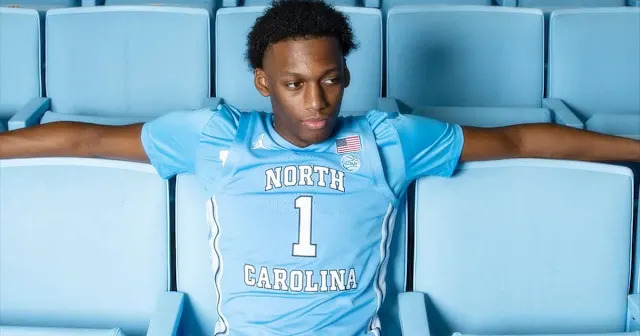
For weeks, North Carolina fans hoped. They speculated. They watched recruiting insiders shift predictions and debated every social media clue. And then, in one nationally televised moment, the waiting ended. Five-star combo guard Dylan Mingo chose the Tar Heels live on ESPN — and suddenly, the energy around Hubert Davis’ program feels different. But beyond the celebration and the headlines, what does this commitment truly mean? Is this simply a recruiting win — or is it the beginning of something much bigger in Chapel Hill?
On Tuesday, Feb. 17, UNC didn’t just land an elite prospect. It secured a potential cornerstone for the future.
A Commitment That Felt Bigger Than One Player
When Dylan Mingo announced his decision on ESPN’s First Take, it wasn’t just another recruiting ceremony. It was a statement. The 6-foot-5 combo guard from New York picked North Carolina over Baylor, Penn State, and Washington, giving Hubert Davis and the Tar Heels a major victory on the national stage.
The commitment also carried a symbolic full-circle moment. Earlier this season, UNC students greeted Mingo with “We Want Mingo” signs ahead of the Tar Heels’ matchup against N.C. Central. That kind of reception doesn’t go unnoticed by elite prospects. It signaled excitement. It showed priority. And on Tuesday morning, Mingo delivered exactly what those students had asked for.
Now, he becomes the second player in UNC’s 2026 recruiting class, joining top-25 wing Maximo Adams. Together, they immediately elevate the trajectory of the class — and perhaps the program.
Breaking Down Dylan Mingo’s Game
Ranked as the No. 5 overall prospect in the 2026 class and the second-ranked combo guard nationally according to 247Sports Composite rankings, Mingo arrives in Chapel Hill with elite expectations.
At 6-foot-5 with a remarkable 6-foot-11 wingspan, Mingo possesses physical tools that immediately translate to the college level. His length allows him to disrupt passing lanes, contest shots, and rebound at a high level for a guard. In an era where positional versatility dominates the sport, that wingspan alone makes him a valuable defensive weapon.
But his game extends far beyond physical measurables.
Two-Way Potential
Mingo projects as a dynamic two-way player. Defensively, he has the quickness to guard opposing point guards and the strength to switch onto wings. His instincts shine in transition defense and help-side rotations. That ability to defend multiple positions fits perfectly into modern ACC basketball.
Offensively, Mingo thrives attacking downhill. He understands spacing. He knows how to get to his spots. While his shooting mechanics will need refinement at the collegiate level, his confidence as a scorer is evident.
An ankle injury limited him during his senior year at Long Island Lutheran, but when healthy, Mingo showcased his ceiling. At the NBPA Top 100 Camp, he averaged 23.8 points, 6.8 assists, and 6.5 rebounds across four games — earning MVP honors. That performance wasn’t accidental. It was confirmation of his high-level playmaking and scoring ability against elite competition.
As a 2025 MaxPreps All-America selection, he averaged 14.1 points, 5.3 rebounds, 3.3 assists, and 2.1 steals per game. Those numbers reflect balance — a player who impacts every phase of the game.
A Seth Trimble-Type Role?
One of the more intriguing projections is how Mingo might fit into a Seth Trimble-type role within UNC’s system.
Trimble brought defensive energy, toughness, and downhill attacking to the Tar Heels’ backcourt. Mingo shares similar physical attributes but arguably carries even higher offensive upside. The difference may lie in Mingo’s playmaking polish and length advantage.
If Mingo develops his shooting consistency, he could become a more complete version of that archetype — a guard capable of defending the opponent’s best perimeter player while also serving as a primary or secondary offensive initiator.
For Hubert Davis, that versatility is invaluable.
The 2026 Recruiting Class Takes Shape
With Mingo and Maximo Adams now in the fold, UNC’s 2026 recruiting class has a legitimate foundation.
Adams, a top-25 wing, provides size and perimeter scoring. Pairing him with Mingo creates balance: length on the wing, versatility in the backcourt. It’s the type of recruiting synergy that successful programs build around.
UNC has also extended an offer to California combo guard Malloy Smith, indicating the staff’s desire to continue strengthening backcourt depth.
But here’s where the bigger picture emerges.
What Does the Roster Look Like in 2026-27?
Roster construction plays a massive role in evaluating this commitment.
On UNC’s current 2025-26 roster, only senior guard Seth Trimble is guaranteed to depart next season. Freshman forward Caleb Wilson is projected as a likely top-10 pick in the 2026 NBA Draft. Junior center Henri Veesaar has also gained momentum as a potential first-round selection.
If Wilson and Veesaar leave early, UNC could have significant frontcourt adjustments to make. But outside of those potential departures, the Tar Heels are positioned to return much of their key rotation.
Alabama transfer Jarin Stevenson (junior), West Virginia transfer Jonathan Powell (sophomore), Virginia Tech transfer Jaydon Young (junior), and international prospect Luka Bogavac (junior) are all candidates to return and provide veteran stability.
That continuity matters.
Rather than relying solely on freshmen, UNC may enter 2026-27 with a balanced mix of returning experience and elite young talent. Mingo won’t be stepping into chaos. He’ll be entering a structured, competitive environment.
Portal Strategy + Elite Recruiting = Sustainable Success?
Hubert Davis has shown a willingness to embrace the transfer portal aggressively. That strategy has helped UNC remain competitive in the short term.
But adding a five-star prospect like Mingo signals that high school recruiting remains a priority.
The modern formula for success appears to blend both worlds — elite freshmen and experienced transfers. If UNC can retain key contributors while adding difference-makers like Mingo and Adams, the Tar Heels could position themselves for sustained success rather than year-to-year rebuilding.
The “best options could be the players you’re able to retain,” as the analysis suggests. But elite recruits raise the ceiling.
Why This Commitment Matters for Hubert Davis
Every major recruiting win reinforces confidence in leadership.
For Hubert Davis, landing Dylan Mingo represents validation. It proves UNC can still compete head-to-head with national programs for top-five talent. It demonstrates that the Tar Heels’ pitch resonates in the NIL era. And it signals stability within the program.
Recruiting momentum often snowballs. When top players commit, others take notice. It becomes easier to build future classes.
Davis isn’t just collecting talent — he’s constructing identity. Versatility. Length. Two-way ability. These traits align with modern championship basketball.
The Chapel Hill Energy Shift
Sometimes, one commitment changes the mood of a fanbase.
When UNC students held up “We Want Mingo” signs, it reflected belief. It reflected desire. And when Mingo chose Carolina live on national television, that energy returned tenfold.
Chapel Hill thrives on moments like this. The intersection of tradition and future potential fuels excitement.
And make no mistake — this commitment has injected optimism.
What Still Needs Development?
While Mingo’s upside is undeniable, growth areas remain.
His shooting consistency will be crucial. College defenders close out faster. The spacing shrinks. Refining his mechanics and improving his efficiency from three-point range will determine how quickly he can assume a starring role.
Decision-making under pressure will also evolve at the next level. But those are developmental checkpoints — not red flags.
The foundation is elite.
Final Thoughts: A Cornerstone Secured
Dylan Mingo’s commitment to UNC is more than a headline.
It’s a foundational piece. It’s a recruiting statement. It’s a glimpse into what the 2026-27 Tar Heels could become.
Pairing him with Maximo Adams gives UNC length, versatility, and star potential. Surrounding them with experienced transfers and returning contributors creates balance.
And for Hubert Davis, this commitment may represent something even bigger — a signal that the next era of Tar Heel basketball is being built deliberately and confidently.
What changed in Chapel Hill?
Momentum.
Belief.
And perhaps, the long-term outlook of the program itself.
With Dylan Mingo officially in Carolina blue, the future feels brighter — and far more intriguing.




