


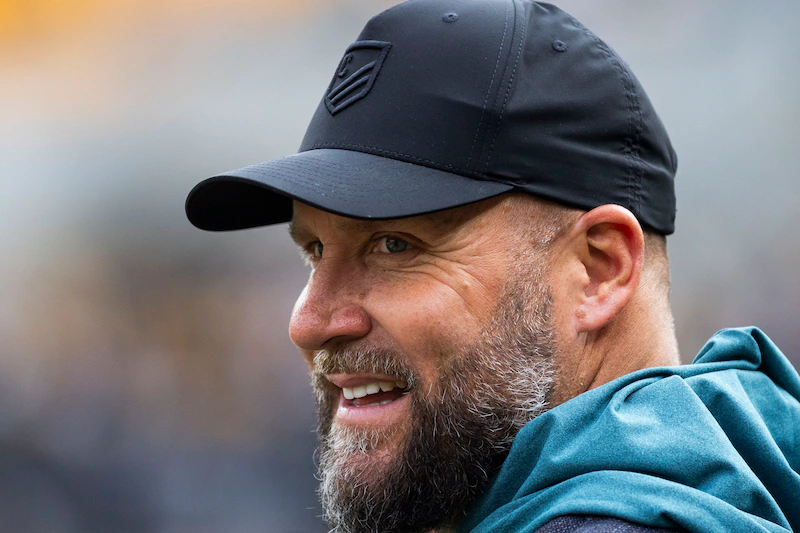
What happens when champions stop protecting each other? When former teammates who once bled black and gold begin airing grievances in public? The Pittsburgh Steelers have always prided themselves on “the brotherhood” — a locker room culture built on loyalty, toughness, and silence when it comes to internal business. But that brotherhood has recently been tested in a very public way. Harsh words were exchanged. Allegations flew. Old wounds resurfaced. And yet, in the middle of the noise, the most important voice of all said nothing. That silence — from Ben Roethlisberger — may have just changed everything.
The Spark That Lit the Fire
The latest chapter of Steelers drama began when Joey Porter Sr., former linebacker and Hall of Honor inductee, made explosive comments on Cam Heyward’s podcast Not Just Football. Porter didn’t hold back.
He accused Roethlisberger of “breaking the brotherhood” of the Steelers, grouping him alongside former outside linebacker James Harrison. According to Porter, certain actions during their time in Pittsburgh fractured the unity that once defined the locker room.
“He should never grab a microphone and really talk Steeler business,” Porter said. “If we’re talking Steelers business, his ass is foul of all foul. The (expletive) that he did is foul of all foul. He’s not a good teammate. Won a Super Bowl with him, but the person? He’s just not a good teammate. He knows that. Anybody in the Steeler building knows that. But we protected him because I’ve only won one Super Bowl, and that was my quarterback. So do I love my quarterback? Yeah. But is he a good person? No.”
Those weren’t subtle jabs. They were direct accusations — personal, pointed, and impossible to ignore.
The Brotherhood Question
For decades, the Steelers organization has marketed itself differently than many NFL franchises. Stability. Loyalty. Consistency. From Chuck Noll to Bill Cowher to Mike Tomlin, the franchise has avoided chaos and public infighting.
The phrase “Steelers brotherhood” isn’t just branding — it’s part of the culture. Players often speak about accountability staying inside the building. Disagreements happen, but they are handled internally.
Porter’s comments struck at the heart of that culture. Suggesting that Roethlisberger — the franchise quarterback for nearly two decades — fractured that unity is a serious claim.
And it raises a larger question: Was the brotherhood always as intact as fans believed?
James Harrison Fires Back
Unlike Roethlisberger, James Harrison didn’t stay quiet.
Harrison, known for his intensity on and off the field, responded directly. He pushed back on Porter’s narrative and flipped the accusation.
“Something else he said, Ben and I broke the brotherhood? First, Mike (Tomlin) ain’t my brother. We broke the brotherhood? You broke the brotherhood more than we did,” Harrison said.
That response escalated the situation. Now it wasn’t just Porter versus Roethlisberger — it was Porter versus Harrison too.
The conversation shifted from isolated criticism to an all-out war of words among former champions.
Other Steelers Join the Conversation
In today’s social media era, silence rarely lasts long. Other former Steelers quickly weighed in.
Maurkice Pouncey, longtime center and close ally of Roethlisberger, didn’t hide his stance. Zach Banner voiced his opinion. David DeCastro entered the discussion. Some defended Roethlisberger. Others endorsed Porter’s comments.
Suddenly, what began as a podcast remark turned into a full-blown public debate about legacy, loyalty, and leadership inside one of the NFL’s most respected organizations.
It was messy.
It was emotional.
And it felt like something fans weren’t used to seeing from Pittsburgh.
Then Came the Silence
Amid all this noise, one man had the most to lose — and perhaps the most to say.
Ben Roethlisberger.
A two-time Super Bowl champion. A future Hall of Famer. The quarterback who defined a generation of Steelers football. If anyone could have shut down the accusations with a few sharp words, it was him.
Instead, on his podcast Footbahlin, Roethlisberger never mentioned Joey Porter. He didn’t respond to the criticism. He didn’t defend himself publicly. He didn’t escalate.
He said nothing.
And that nothing may have spoken the loudest.
Why Silence Can Be Powerful
In modern sports culture, public rebuttals are common. Athletes defend themselves quickly. Social media encourages immediate reaction. Podcasts amplify every disagreement.
Roethlisberger choosing not to respond stands out precisely because it’s unexpected.
By refusing to engage, he avoided validating the controversy. He prevented the feud from becoming a weekly back-and-forth spectacle. He denied the drama oxygen.
Sometimes, responding fuels the fire.
Silence, in this case, may have extinguished it.
Leadership, Perception, and Legacy
Roethlisberger’s career has never been free of controversy. On-field brilliance often overshadowed off-field questions. Teammates praised his competitiveness. Critics questioned his leadership style.
Porter’s comments touched on that longstanding debate: Was Roethlisberger always the ideal teammate?
But legacy is complex.
Two Super Bowl rings. Multiple AFC Championship appearances. Franchise records. Comeback victories. Roethlisberger delivered on Sundays in ways few quarterbacks ever have.
Leadership styles vary. Some are vocal motivators. Others lead through performance. Some build relationships quietly. Others command presence through dominance.
Public accusations years after retirement complicate perception, but they don’t erase accomplishments.
Why This Feels Bigger Than Just Words
This feud resonates because it challenges a narrative fans have long embraced.
The Steelers were supposed to be different.
Internal disagreements weren’t aired publicly. Former teammates didn’t take shots at each other on podcasts. Even when players left the organization, there was an unspoken respect.
Seeing that façade crack feels uncomfortable for fans.
But perhaps it’s also a reminder that every locker room — no matter how decorated — contains tension. Winning can mask disagreements. Retirement can loosen tongues.
Time often reveals what competition concealed.
Did Big Ben Take the High Road?
There are two ways to interpret Roethlisberger’s silence.
One perspective views it as maturity. A veteran understanding that revisiting old conflicts serves no productive purpose. A champion secure enough in his legacy not to defend himself publicly.
Another perspective could argue that silence avoids accountability.
But in the context of escalating drama, the practical effect is undeniable: without Roethlisberger engaging, the controversy loses momentum.
Harrison responded. Others chimed in. But the central figure remained still.
That choice shifted the energy.
The Steelers Organization’s Position
Notably, the organization itself has remained quiet. No official statements. No internal rebuttals. No endorsements of either side.
That consistency aligns with Pittsburgh’s longstanding approach. Handle business internally. Avoid public distractions.
While former players debate, the current Steelers roster prepares for another season, focused on the future rather than revisiting the past.
What This Means for Fans
For longtime Steelers supporters, this episode may feel bittersweet.
On one hand, hearing legends criticize each other tarnishes nostalgia. On the other, it humanizes them.
These were competitive, strong personalities sharing a high-pressure environment. Friction isn’t shocking — it’s inevitable.
The surprising part isn’t that disagreements existed.
It’s that they surfaced publicly.
Final Thoughts: Silence as Strategy
In an age where every comment generates headlines, restraint can be powerful.
Roethlisberger’s decision not to respond may not satisfy everyone. Some fans may want clarity. Others may crave rebuttal.
But strategically, it ended the escalation.
Without a counterpunch, the feud lacks fuel.
Ex-Steelers may continue debating. Podcasts may revisit the topic. Social media may speculate.
Yet the central figure chose calm over chaos.
And sometimes, the loudest statement is the one you never make.
In a war of words that threatened to fracture old alliances, Big Ben’s silence may have restored a measure of control — not by arguing, but by refusing to.
For now, at least, the drama appears to have reached its quietest moment.
And in Pittsburgh, quiet often wins.




