


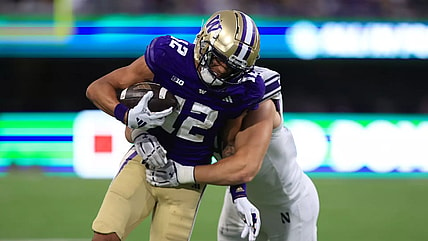
What if the Pittsburgh Steelers have already tipped their hand for 2026? What if the missing piece to unlocking their offense isn’t a quarterback debate, not an offensive line tweak — but a physical, explosive playmaker on the outside? In the latest mock draft from NFL Network’s Daniel Jeremiah, the Steelers make a move that feels both bold and inevitable. At No. 21 overall, Pittsburgh selects Washington wide receiver Denzel Boston. And suddenly, the vision of the Steelers’ offense looks very different.
This isn’t just another projection. It’s a fit that makes football sense — and perhaps signals what the franchise believes it truly needs.
Daniel Jeremiah’s Projection: “Boston Makes Too Much Sense”
When Daniel Jeremiah slotted Denzel Boston to Pittsburgh at No. 21 overall in his 2026 NFL mock draft, his reasoning was straightforward.
“Boston makes too much sense here. The Steelers would have two power forwards on the outside with the rookie playing opposite DK Metcalf,” Jeremiah wrote.
Two power forwards.
That description alone paints a clear picture.
Pairing Boston with DK Metcalf would give the Steelers one of the most physically imposing wide receiver duos in the league. Metcalf is already known for his size, strength, and ability to overwhelm defenders. Adding Boston would double down on that identity.
The Steelers wouldn’t just be adding speed. They’d be adding physical dominance.
Who Is Denzel Boston?
Boston is coming off a strong season at Washington, hauling in 62 passes for 881 yards (14.2 yards per catch) and 11 touchdowns. He also contributed as a punt returner, bringing back eight punts for 104 yards and a touchdown.
Across four seasons with the Huskies, Boston accumulated 132 receptions for 1,781 yards (13.5 average) and 20 touchdowns.
Those numbers reflect consistency, growth, and versatility.
He’s not simply a deep-ball specialist. He’s not just a red-zone target. He’s a well-rounded receiver who can operate at multiple levels of the field.
And that versatility matters for a Steelers offense that has, at times, lacked balance in the passing game.
How Boston Compares to Other Top Receivers
Jeremiah had Boston as the fourth wide receiver off the board in his mock draft.
Ahead of him:
Ohio State’s Carnell Tate to the New York Giants at No. 5
USC’s Makai Lemon to the New Orleans Saints at No. 8
Arizona State’s Jordyn Tyson to the Baltimore Ravens at No. 14
That placement underscores Boston’s value. He isn’t projected as the very top wideout in the class — but he’s firmly in the upper tier.
And at No. 21 overall, the Steelers would be landing a prospect who many teams likely have graded as a top-20 talent.
Value and need rarely align so cleanly.
Why Wide Receiver Makes Sense for Pittsburgh
The Steelers’ offense in 2025 was middle of the pack. Not terrible. Not elite.
But consistent offensive explosions were rare.
One glaring issue has lingered for two seasons: the absence of a reliable No. 2 wide receiver.
Despite efforts to address the position, Pittsburgh has struggled to find a true complement to DK Metcalf. Defenses often key on the primary threat. Without a second physical mismatch, coverage schemes become easier to manage.
Adding Boston could shift that dynamic immediately.
Imagine opposing defenses trying to match up against two large, contested-catch specialists who can win jump balls and fight through contact.
Suddenly, the Steelers’ offensive ceiling rises.
CBS Sports Agrees: Ryan Wilson’s Endorsement
Daniel Jeremiah isn’t alone in projecting Boston to Pittsburgh.
CBS Sports’ Ryan Wilson also has the Steelers selecting him at No. 21 overall in his mock draft.
Wilson described Boston as:
“A big, physical WR with a massive catch radius, contested-catch ability and the speed to separate quickly and hit top-end velocity in 2-3 steps. Boston is an effective route runner at all three levels, will run through arm tackles in space, and can outmuscle defenders in the red zone. While primarily an outside threat, his size, strength and hands make him a potential matchup problem in the slot, too. Added bonus: he’s a legit threat as a punt returner.”
That scouting report reads like a Steelers prototype.
Physical. Tough. Competitive.
The ability to separate quickly in short bursts addresses concerns about pure long speed. His red-zone production solves another Steelers issue — finishing drives with touchdowns rather than settling for field goals.
The Puka Nacua Comparison
Lance Zierlein of NFL.com added an intriguing wrinkle by comparing Boston’s competitive toughness to Puka Nacua.
“Two-year starter with elite ball skills that should supersede athletic/speed limitations,” Zierlein wrote. “A Puka Nacua comparison might feel strong, but like Nacua, Boston enters the draft with speed/separation concerns and outstanding competitive toughness.”
The Nacua comparison is notable.
When Nacua entered the NFL, questions centered around separation speed and athletic ceilings. But elite ball skills, route intelligence, and relentless competitiveness translated quickly.
Zierlein also noted Boston’s burst off the line, ability to maintain speed through routes, and red-zone effectiveness. While he may face challenges beating press coverage consistently at the next level, those issues can be mitigated through scheme and development.
He may not be a plug-and-play superstar from Day 1.
But the long-term upside appears real.
How Boston Would Fit with DK Metcalf
This is where the projection becomes fascinating.
DK Metcalf thrives on physicality and vertical routes. He forces defenses to account for him with safety help. But too often, opponents have been comfortable shading coverage toward him.
Insert Boston on the opposite side.
Now defenses must pick their poison.
Do you double Metcalf and leave Boston in single coverage?
Do you rotate safety help to the rookie and give Metcalf favorable matchups?
Either scenario benefits Pittsburgh.
Additionally, Boston’s ability to operate in the slot at times adds formation flexibility. Offensive coordinators could move him pre-snap, force mismatches, and exploit linebacker or nickel coverage.
Red-Zone Implications
The Steelers have struggled at times converting red-zone opportunities into touchdowns.
Boston’s 11 touchdown receptions last season highlight his red-zone value. His catch radius and body control allow quarterbacks to trust him in tight windows.
In close games — especially AFC North battles — that matters.
Field goals don’t win playoff matchups against elite offenses.
Touchdowns do.
Special Teams Value
Boston’s contributions as a punt returner add another dimension.
Eight returns for 104 yards and a touchdown show legitimate return ability. While he may not become a full-time returner in the NFL, that versatility increases his roster value.
Coaches love multi-dimensional contributors.
Potential Development Curve
Zierlein cautioned that acclimating to NFL competition could take a year.
That’s not unusual.
Many receivers require time to adjust to press coverage, route precision demands, and physicality at the professional level.
If Pittsburgh drafts Boston, expectations should be realistic. He may not immediately produce Pro Bowl numbers.
But with proper development, he projects as a productive possession target with strong red-zone upside.
A Statement About Offensive Philosophy
Drafting Boston wouldn’t just fill a need.
It would signal philosophy.
The Steelers would be committing to size and physicality at the receiver position. They’d be prioritizing contested-catch dominance and toughness over pure track speed.
In a division featuring physical defenses like Baltimore and Cleveland, that approach makes sense.
It’s AFC North football.
Final Thoughts: Is This the Move That Unlocks the Offense?
Mock drafts are projections. Nothing more.
But when multiple respected analysts independently connect the same player to the same team, it’s worth paying attention.
Denzel Boston checks boxes for Pittsburgh:
Size and physicality
Red-zone production
Complementary fit with DK Metcalf
Versatility inside and outside
Competitive toughness
The Steelers have spent two seasons searching for a reliable No. 2 option.
At No. 21 overall, they may finally find one.
If Daniel Jeremiah and Ryan Wilson are right, the Steelers won’t just be adding a receiver.
They’ll be reshaping their offensive identity.
And in a conference where explosive playmakers define championship runs, that might be exactly what Pittsburgh needs.




