


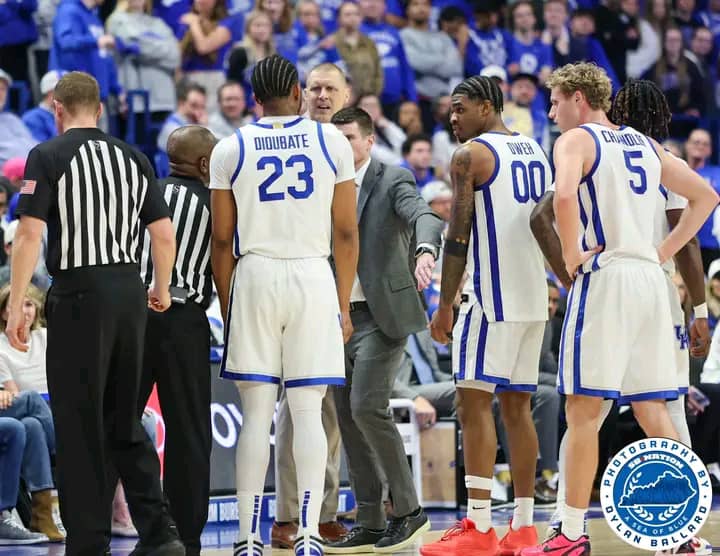
There is something important — something Big Blue Nation absolutely cannot afford to ignore — buried inside the fallout of Kentucky’s loss to Georgia. And it isn’t just about one bad night, one cold shooting stretch, or one defensive lapse at Rupp Arena. It’s about trajectory. It’s about perception. And most importantly, it’s about how quickly security can turn into uncertainty in March.
Because for the first time in weeks, Kentucky is no longer being discussed as a comfortable NCAA Tournament lock.
After falling at home to Georgia in an 86–78 stunner, the Wildcats didn’t just lose a game. They lost momentum. They lost margin for error. And according to ESPN’s latest Bubble Watch, they lost their “lock” status — slipping down a tier to the uncomfortable, sweat-inducing label of “should be in.”
That may not sound dramatic on the surface. A 94% chance to make the tournament still feels safe. But in March, perception shifts fast. Résumés are dissected. Trends are scrutinized. And narrative matters more than ever.
And right now, Kentucky’s narrative has changed.
From Lock to “Should Be In”: Why the Shift Matters
Just days earlier, Kentucky had climbed into “lock territory” after defeating Tennessee for its eighth win in nine games. The Wildcats were building momentum at exactly the right time. They were stacking quality wins. They were rising in predictive models. They looked like a team peaking when it mattered most.
Then came back-to-back losses.
First, a road defeat at Florida — understandable, competitive, not devastating. But the follow-up? A home loss to Georgia. At Rupp Arena. In a game Kentucky was expected to control.
That’s the one that triggered the warning.
According to ESPN analytics writer Neil Paine, the Wildcats’ odds dipped to 94% — still strong, but enough to move them from “lock” to “should be in.” In bracketology language, that shift is significant. It means there’s now vulnerability. It means the margin has thinned.
And in a conference like the SEC — projected to send nine or even ten teams to the tournament — every slip is magnified.
The Georgia Loss Wasn’t Just a Loss
The 86–78 defeat to Georgia wasn’t simply a statistical blemish. It was layered with uncomfortable context.
It marked Georgia’s first win at Rupp Arena since 2009.
It was only Georgia’s fifth-ever win in that building.
It gave Georgia three wins in the last four meetings with Kentucky — something that hasn’t happened in over 100 years.
It handed Mark Pope his third home loss of the season.
For a program that prides itself on dominance at home, those details sting.
Even more concerning? Georgia entered the game with a Quad Two résumé label. For Kentucky, that means the loss won’t carry the kind of contextual forgiveness a Quad One defeat might.
In other words: it hurts more than it looks.
The Résumé: Strong — But No Longer Bulletproof
Let’s be clear — Kentucky’s résumé still has weight.
The Wildcats boast five Quadrant 1 wins, including three Quadrant 1A victories. That’s legitimate tournament currency. Their résumé average ranks 27th nationally. Within the SEC, they remain among the top six.
That is not bubble desperation territory.
But the warning isn’t about where Kentucky stands today.
It’s about what’s ahead.
The Brutal Reality of the Remaining Schedule
According to BPI projections, Kentucky has the toughest remaining schedule in the nation.
Four of the final five regular-season games are against Quadrant 1 opponents. Three of those are Quadrant 1A.
That is both opportunity and danger.
Win those games? Kentucky not only secures its bid — it strengthens seeding and restores momentum.
Lose most of them? The 94% could slide quickly.
This is where inconsistency becomes costly.
Inconsistency: The Season’s Lingering Shadow
Kentucky entered the season with high expectations. Talent wasn’t the issue. Experience wasn’t entirely absent. The pieces were there.
But consistency hasn’t been.
This team has shown flashes of brilliance — knocking off top competition, climbing into “lock” territory, delivering statement performances. Yet those highs have often been followed by puzzling lows.
Mark Pope himself has not been shy about criticizing recent effort. After the Georgia loss, frustration was visible. That public accountability signals urgency.
But urgency alone doesn’t guarantee correction.
And in March, inconsistency can define you.
Rupp Arena: A Fortress Showing Cracks
For decades, Rupp Arena has been a symbol of Kentucky’s dominance. Visiting teams walked in knowing the odds were stacked against them.
This season? Three home losses.
And that Georgia defeat added historical weight.
When you consider that Georgia hadn’t won there since Billy Gillispie’s final season in 2009, it magnifies the moment. The Bulldogs aren’t supposed to walk into Lexington and leave with control.
Yet they did.
And in doing so, they reinforced a subtle but growing narrative: Rupp isn’t automatic anymore.
That matters in the committee room.
Home losses carry weight.
Mark Pope’s Crossroads Moment
Mark Pope’s tenure has included impressive highs. He has delivered signature wins. He has navigated tough stretches. He has positioned Kentucky inside the projected field.
But this moment may define his second season.
Not because Kentucky is suddenly doomed.
But because how they respond will determine whether this becomes a blip — or a turning point.
Three home losses.
Back-to-back defeats.
A bubble warning.
That combination creates pressure.
And pressure in Lexington is never light.
The SEC Factor
The SEC’s strength is both blessing and burden.
On one hand, Kentucky’s five Quadrant 1 wins are enhanced by conference quality. On the other, a league projected to send nine or ten teams means internal competition for seeding is fierce.
Kentucky isn’t fighting just for inclusion.
They’re fighting for positioning.
And seeding impacts everything — path, matchups, confidence.
A slip from lock status doesn’t just threaten entry. It threatens trajectory.
Why 94% Isn’t Comfortable
A 94% tournament probability sounds safe. But that means 6% uncertainty.
In college basketball terms, that 6% can be one bad week.
One more home loss.
One early SEC Tournament exit.
One more résumé dent.
And suddenly, conversations shift from “how high will they be seeded?” to “are they sweating on Selection Sunday?”
Kentucky doesn’t want to flirt with that narrative.
Opportunity Still Knocks
For all the alarm, there is an undeniable upside.
Four Quadrant 1 games remaining means four chances to erase doubt.
Kentucky controls its destiny.
Win two or three? The bubble talk fades. The “lock” label returns. Seeding climbs.
Win four? The Georgia loss becomes a footnote.
But that requires stability — something that has eluded the Wildcats in stretches.
What Must Change
Effort consistency must improve.
Defensive lapses must shrink.
Home-court dominance must be restored.
Kentucky cannot afford emotional swings. March rewards steady growth, not roller-coaster performances.
If Mark Pope can recalibrate focus now, this team could enter the tournament battle-tested.
If not, the warning will feel prophetic.
The Bigger Picture
Kentucky is not in crisis.
They are not outside the projected field.
They are not collapsing.
But they are at a fork in the road.
The Georgia loss didn’t eliminate them. It alerted them.
And perhaps that is the most important takeaway.
Sometimes a warning arrives before disaster. Sometimes a stumble resets urgency. Sometimes slipping from “lock” to “should be in” is exactly the spark a team needs.
Or sometimes it’s the beginning of a slide.
Can They Flip the Narrative?
The next five games will answer that.
The résumé is strong.
The odds are still favorable.
The opportunity is real.
But so is the risk.
Kentucky’s season now hinges on response.
Will they treat the Georgia loss as a wake-up call — or will it become the moment analysts circle if Selection Sunday grows tense?
That’s the tension. That’s the drama. That’s March.
And that’s why this bubble warning — however subtle it may seem — is something Big Blue Nation absolutely needed to notice.
Because in college basketball, history doesn’t always change with a collapse.
Sometimes, it changes with a warning.
And Kentucky just received one.




