


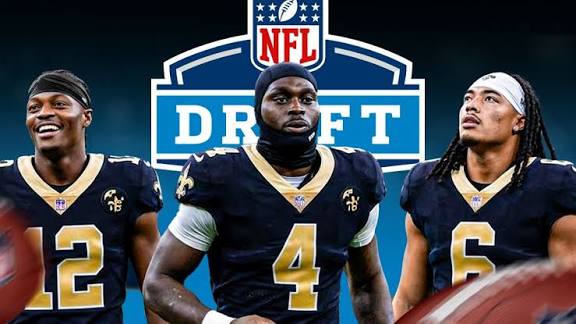
There is something quietly monumental unfolding in the projections for the New Orleans Saints’ 2026 NFL Draft — and it goes far beyond names on a board. This isn’t just another mock draft exercise meant to fill offseason headlines. It’s a window into how national analysts view the direction of the franchise. It’s a reflection of how much confidence — or uncertainty — surrounds the quarterback position. And perhaps most importantly, it signals what kind of identity the Saints could be building toward over the next several seasons.
The 2026 NFL Draft may still be months away, but early mock drafts are already shaping a compelling narrative. Across multiple projections, one thing becomes clear: there is no universal agreement on what New Orleans should do. That lack of consensus might actually say more about the Saints than any single pick ever could.
The Quarterback Question Still Looms
At the center of every Saints mock draft discussion is the quarterback position.
After investing in Tyler Shough, the organization appears to be giving him an opportunity to grow into the role. But mock drafts reveal that analysts remain divided. Some projections assume the Saints will stay committed and continue building around him. Others suggest that if performance stalls, the franchise could pivot quickly and consider a new signal-caller.
That uncertainty dramatically shapes how these mock drafts unfold.
If Shough shows legitimate long-term potential, the Saints’ priority becomes straightforward: surround him with protection and weapons. If doubts linger, however, 2026 could turn into a reset year at the most important position in football.
For now, most projections lean toward building around him rather than replacing him — and that signals cautious optimism.
A Popular Early Theme: Defensive Reinforcement
Several mock drafts project the Saints targeting defense with their early first-round selection. Linebackers, edge rushers, and disruptive defensive linemen frequently appear in projections tied to New Orleans.
Why?
Because even in seasons where the offense fluctuates, the Saints’ identity has often been rooted in defensive competitiveness. Reinvesting in the front seven would reflect a belief that games are still won by controlling the line of scrimmage and generating pressure.
One projected scenario features the Saints selecting an elite linebacker prospect — someone capable of transforming the middle of the defense with speed, range, and leadership. That kind of addition could solidify the unit for years.
Other projections lean toward pass rushers. In today’s NFL, consistent quarterback pressure is non-negotiable. A young, explosive edge defender would immediately boost a defense seeking long-term stability.
If New Orleans goes defense early, it suggests the organization believes its offensive structure is serviceable — but its defense needs reinforcements to compete in the NFC.
The Offensive Weapon Scenario
Not all projections go defense first.
Some mocks see the Saints leaning into offense, particularly if they remain confident in their quarterback’s development. Wide receiver and running back appear frequently as first-round possibilities.
A dynamic running back selection, for example, would mirror a modern offensive philosophy: ease the burden on a young quarterback by establishing balance. A versatile back who can catch passes out of the backfield would create mismatches and open play-action opportunities.
Meanwhile, wide receiver projections often center on adding speed and route precision. The Saints have experienced uncertainty in the receiver room in recent seasons, and adding a reliable, explosive playmaker could redefine the offense’s ceiling.
Choosing offense early would represent a bold declaration: the Saints believe their quarterback is the answer — and now they’re ready to accelerate the process.
Building Depth Across the Roster
Beyond the first round, mock drafts consistently highlight depth building.
Interior offensive line appears as a recurring theme. Protecting the quarterback is foundational, and depth in the trenches prevents late-season collapses. Developmental guards and centers are common mid-round projections.
Defensive tackle depth also appears regularly. Rotational defensive linemen are critical over a 17-game season. Fresh legs in December often determine playoff positioning.
Cornerback is another position linked to New Orleans in multiple projections. With today’s pass-heavy schemes, having multiple capable defensive backs is no luxury — it’s survival.
What these projections collectively show is a franchise focused less on flashy splashes and more on structural reinforcement.
No Clear Consensus — And That’s Telling
One striking feature of Saints mock draft coverage is the lack of consensus. Different analysts project entirely different directions.
Some have the Saints drafting in the top ten, suggesting a difficult 2025 season. Others project them slightly later in the round. That variation speaks volumes about how uncertain their trajectory remains.
A franchise with clear upward momentum usually sees consistent projections. A team widely viewed as rebuilding often sees uniform quarterback mocks. The Saints, however, exist in a gray area — competitive enough to avoid full collapse, but uncertain enough to generate debate.
That gray area makes 2026 pivotal.
The Kellen Moore Factor
Coaching philosophy heavily influences draft strategy.
If the Saints continue embracing an aggressive, creative offensive system, adding skill players and protection becomes a logical path. An innovative offense thrives on versatility — tight ends who can stretch the seam, backs who can motion into the slot, receivers who create separation quickly.
If the Saints lean more conservative, defense-first investments could dominate.
The draft will reveal which philosophical direction ultimately wins out inside the building.
The Salary Cap Reality
Another layer shaping these projections is financial flexibility.
Draft picks are cost-controlled assets. For teams navigating cap pressures, hitting on mid-round players becomes essential. Mock drafts reflect that need by focusing on versatile prospects who can contribute immediately.
A smart 2026 class could reset the Saints’ financial outlook and allow them to build sustainable depth rather than relying on expensive veterans.
Risk and Reward in Every Direction
No matter which direction New Orleans takes, risk is unavoidable.
Drafting defense early assumes offensive stability.
Drafting offense early assumes defensive competence.
Drafting a quarterback assumes dissatisfaction.
Passing on a quarterback assumes belief.
Every path carries consequences.
But what these mock drafts ultimately show is a franchise at a crossroads — not in crisis, but in transition.
What Success Would Look Like
If the Saints nail the 2026 draft, it won’t necessarily be because they drafted the flashiest name.
Success would look like:
A defensive starter emerging from the first two rounds.
An offensive lineman solidifying protection.
A mid-round skill player outperforming expectations.
Late-round depth pieces contributing on special teams.
Draft success rarely screams immediately. It unfolds over seasons.
Why This Draft Feels Bigger Than Usual
Some drafts are about filling holes. Others are about defining identity.
The Saints’ 2026 draft appears to fall into the latter category.
This class could determine whether the franchise commits fully to its current quarterback path, pivots dramatically, or simply reinforces a balanced roster approach.
It will shape roster construction for the next four to five seasons.
It may also determine whether the Saints are viewed as contenders, pretenders, or perpetual question marks.
Final Thoughts
The early mock drafts surrounding the New Orleans Saints are not unified — and that lack of agreement may be the most revealing takeaway of all.
Some see a defense-first rebuild.
Others see offensive reinforcement.
A few see a quarterback shakeup.
What everyone agrees on, however, is this: the Saints cannot afford to miss.
The 2026 NFL Draft represents more than another offseason event. It represents direction. Stability. Commitment. Identity.
And when the commissioner steps to the podium in April 2026, the name announced may echo far beyond that moment — because it will signal exactly what the Saints believe about themselves.
For a franchise seeking clarity in a competitive NFC landscape, that belief could shape everything that follows.




