


There are wins that look routine on paper. And then there are wins that quietly signal something bigger is happening beneath the surface.
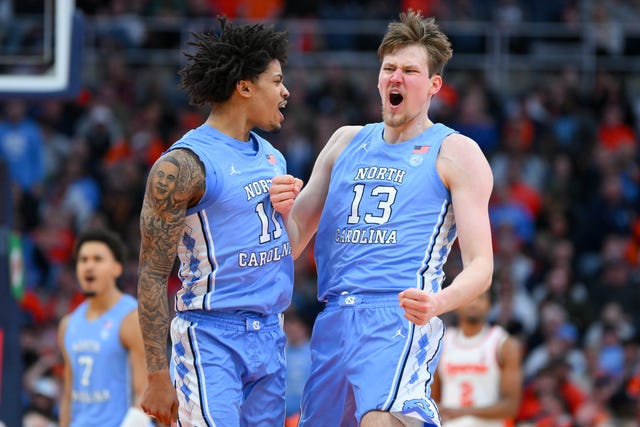
On Saturday night inside the loud confines of the JMA Wireless Dome, North Carolina Tar Heels men’s basketball didn’t just defeat the Syracuse Orange men’s basketball 77–64. They found something. A rhythm. A response. A resilience that head coach Hubert Davis had been searching for.
And when Davis stepped to the podium afterward, his words told a deeper story than the final score.
The Zayden High Emergence: “His Play Has Been Real”
Early in the season, Zayden High’s minutes often came when games were already decided. Valuable reps, yes—but not necessarily moments that shaped outcomes.
That has changed.
Against Syracuse, High delivered nine points and 11 rebounds. But the stat line doesn’t fully explain why Davis couldn’t stop praising him. It was a loose ball in the first half—one of those 50-50 plays—that perfectly captured the turning point in this team’s mentality. High dove on the floor without hesitation. No glamour. No highlight reel. Just effort.
For Davis, that mattered.
He emphasized the “little boring, mundane things” that win games. High’s rebounding wasn’t accidental. It wasn’t luck. It was technique—blasting off the floor, carving out space, boxing out with purpose.
More importantly, this was the first time all season Davis was able to play High alongside Henri Veesaar. Instead of downsizing in the frontcourt, UNC preserved its length and physical presence. That adjustment alone altered the game’s tone.
Over the last three contests, High has gone from rotation piece to impact contributor. Davis made it clear: when your number is called, you must be ready. High has been ready. And that internal growth may be one of the most important developments of the season.
The Return of Henri Veesaar: A Gravity That Changes Everything
Henri Veesaar’s stat production has never been the mystery. He can score in the paint. He can stretch the floor. He can pass. He demands attention.
But what Davis highlighted after the win was something even more significant: gravity.
When Veesaar steps onto the floor, defensive schemes shift. Opponents collapse into the paint. Help defenders cheat toward him. Passing lanes open. Shooters gain breathing room.
It was his first game action without Caleb in the lineup, and that context matters. The offense had to reorient. Spacing had to adjust. Roles had to recalibrate.
Even defensively, Veesaar’s value isn’t limited to blocked shots. His size alters trajectories. Guards think twice. Bigs hesitate. That hesitation alone can be the difference between a made basket and a miss.
Davis admitted he played Veesaar slightly more than planned—25 minutes—but the big man insisted he felt strong. After limiting his reps in practice and monitoring him through warmups, Davis made the calculated decision to trust him.
The result? A stabilizing force in the frontcourt.
Seth Trimble’s Second-Half Takeover: Leadership When It Mattered Most
If High represented hustle and Veesaar represented presence, Seth Trimble represented ignition.
The first half was quiet. Almost too quiet. Davis admitted he “didn’t feel him” early. But something shifted after halftime.
Five minutes into the second half, Trimble found his rhythm. Then he found the lane. Then he found control of the game.
He finished with 13 points, but again, the box score only tells part of the story.
Trimble’s downhill aggression changed the tempo. He attacked the rim, forced rotations, earned free throws. On defense, he jumped passing lanes and created transition opportunities. Those steals weren’t random gambles—they were calculated reads born from energy and urgency.
When the game was tied at 44, momentum could have swung toward Syracuse. The Dome crowd was ready. The moment was tense.
That’s when Trimble took ownership.
Davis pointed to that stretch as the defining run. A four-minute window where UNC found separation. It began with Trimble’s pressure, his pace, his refusal to let the moment overwhelm the team.
Sometimes leadership doesn’t come with speeches. Sometimes it comes with steals and straight-line drives.
“Finding a Way”: The Phrase That Defined the Night
Earlier in the week, Davis publicly challenged his team’s fight. He didn’t feel the competitive edge he expected.
Saturday was different.
Before the game, his message was simple but powerful: box out. Get stops. Make the extra pass. Dominate the paint. Take care of the basketball.
Not complicated. Just intentional.
Throughout the game, during every huddle, he repeated a theme—“find a way.”
When Syracuse made a push, UNC didn’t unravel. When shots didn’t fall, they defended. When possessions stalled, they attacked the paint.
That adaptability—finding solutions in real time—was the turning point Davis referenced. Not one single play. Not one single run. But a collective commitment to problem-solving.
Defensive Adjustments: Correcting the First Mistake
The first matchup between these teams told a different story. Syracuse’s length and scoring versatility created issues, especially without Caleb and with limited size available.
This time, Davis adjusted.
Syracuse’s Donnie—described by Davis as “real” with tremendous length—was a priority. When he caught the ball near the block against a smaller defender, UNC sent immediate double teams. They forced the ball out of his hands, took away easy touches, and made others beat them.
Later in the second half, UNC scaled back the doubles, but by then the rhythm had shifted.
That flexibility—knowing when to pressure and when to recover—was critical.
It wasn’t about stopping three-point shooting with a gimmick. It was about crowding the interior, protecting size mismatches, and trusting rotations.
The Tar Heels executed with discipline.
The Rebounding Identity: Davis Is Still “Greedy”
Rebounding has long been Davis’s obsession. With players like Veesaar and Caleb anchoring the glass, UNC’s identity is built on second chances and defensive closures.
For two straight games, they finished plus-two on the boards.
Davis wasn’t entirely satisfied. He pointed out two missed box-outs on free throws that led to offensive rebounds—details most fans overlook but coaches remember.
Still, the broader picture was encouraging.
Guards crashed the boards. Wings fought inside. It wasn’t just the big men carrying the load.
That collective rebounding effort ignited transition opportunities. Quick outlet passes. Fast breaks. Easy points.
Those are momentum builders. And they reflect buy-in from the entire roster.
The Bigger Picture: Rotation Confidence
What made this win significant wasn’t just the scoreboard—it was the depth revealed.
Zayden High earning extended minutes.
Henri Veesaar returning effectively.
Seth Trimble embracing late-game leadership.
Guards rebounding.
Frontcourt size preserved.
Davis often tells his players he can’t predict when their number will be called—but when it is, they must be ready.
Saturday was proof that multiple players were prepared for that moment.
And that changes everything moving forward.
Why This Road Win Matters
Winning on the road in conference play is never routine. Doing it convincingly—by breaking away late—signals maturity.
The North Carolina Tar Heels men’s basketball didn’t rely on one star. They relied on cohesion.
They survived a tie at 44.
They adjusted defensively.
They rebounded collectively.
They attacked downhill.
They found a way.
For Hubert Davis, that’s the blueprint.
The Turning Point That Changed Everything
So what was the true turning point?
It wasn’t just Trimble’s surge.
It wasn’t just High’s hustle.
It wasn’t just Veesaar’s return.
It was the response.
The willingness to fight for loose balls.
The discipline to double the post.
The hunger to rebound free throws.
The resilience to answer momentum swings.
That collective response is what Davis had been seeking.
And inside the JMA Wireless Dome, his team finally showed it.
If this performance becomes a pattern rather than an exception, this 77–64 victory won’t just be remembered as another conference road win.
It will be remembered as the night the Tar Heels found themselves.




