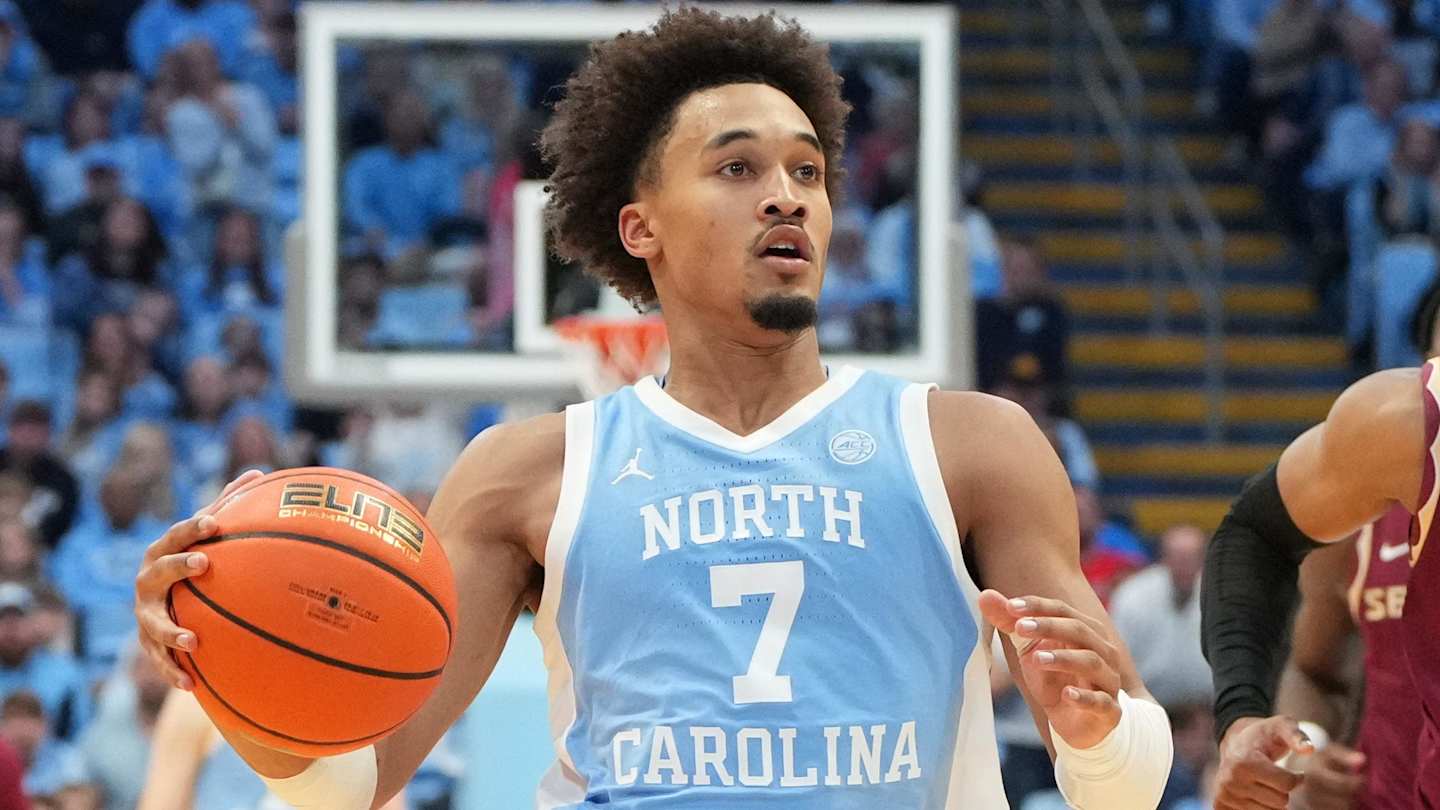
There are games that look simple on paper — comfortable home favorite, better record, stronger résumé — and then there are games that quietly whisper danger. Saturday night in Chapel Hill feels like one of those moments. The North Carolina Tar Heels men’s basketball are riding momentum, sitting firmly in the upper half of the ACC standings, and welcoming a Virginia Tech Hokies men’s basketball team that hasn’t exactly dominated conference play. But beneath the surface, subtle warning signs linger. A missing star. A slightly slower offense. A dangerous opponent that has already proven it can shock ranked teams. Is this simply another step forward for UNC or the kind of trap game that reshapes the narrative of a season?
Saturday’s 8:30 p.m. EST showdown isn’t just another late-February matchup. It’s a pivotal contest for two programs trending in very different directions — yet still carrying plenty to play for.
The Stakes as February Closes
As the regular season winds down, every ACC matchup carries weight. Seeding implications. Tournament momentum. Psychological positioning. The Tar Heels enter the contest at 22-6 overall and 10-5 in conference play. They are not running away with the ACC crown, but they remain very much in the hunt for a strong NCAA Tournament seed.
Virginia Tech, meanwhile, sits at 18-10 overall and 7-8 in conference play. On paper, that record suggests mediocrity. But context matters. The Hokies have been competitive in stretches, and while their 2-8 mark against Quad 1 opponents raises concerns, they’ve shown flashes of upset potential with ranked victories earlier this season.
For UNC, the objective is simple: protect home court, continue stacking wins, and avoid giving the selection committee any reason for pause.
For Virginia Tech, this is an opportunity perhaps one of the last to boost its résumé and inject life into its postseason hopes.
Virginia Tech: Dangerous Despite the Record
The Hokies’ ACC record doesn’t tell the entire story. They currently rank 58th nationally in KenPom with a +13.67 net rating, a mark that suggests they are more than just a fringe bubble squad.
Offensively, Virginia Tech averages 78.8 points per game while shooting a respectable 45.3% from the field and 35.6% from three-point range. Their 1.393 assist-to-turnover ratio ranks inside the top 80 nationally, reflecting disciplined guard play and smart ball movement.
The Hokies are not explosive in a chaotic way. They are calculated.
Amani Hansberry leads the team with 14.7 points and 7.7 rebounds per game, offering versatility in the frontcourt. Tobi Lawal anchors the glass with 8.8 rebounds per contest while contributing nearly 12 points per game. Ben Hammond provides perimeter shooting at a 43% clip from deep a potential x-factor against UNC’s occasionally shaky three-point defense.
And then there’s Neoklis Avdalas, whose 4.9 assists per game quietly drive Virginia Tech’s offensive rhythm.
This is not a team that overwhelms you with raw athleticism. Instead, it grinds. It executes. It stays within striking distance.
And that’s what makes it dangerous as a road underdog.
Virginia Tech is 6-1-1 against the spread when playing as an away underdog this season. That stat alone should raise eyebrows. The Hokies have embraced the spoiler role before — and may be positioned to do so again.
UNC: Momentum with a Missing Piece
North Carolina has compiled one of the stronger résumés in the ACC this season. Wins over Kansas, Kentucky, Duke, Louisville, and Virginia stand out as defining moments. A 6-6 record against Quad 1 teams is solid. Undefeated against Quad 2 and below? Even better.
But the Tar Heels are not the same team they were a month ago.
The absence of leading scorer Caleb Wilson sidelined with a hand fracture has subtly altered UNC’s offensive ceiling. Before Wilson’s injury, the Tar Heels scored 80+ points in 15 of their first 24 games. Since his departure, they’ve struggled to consistently hit that mark.
The offense hasn’t collapsed — but it has cooled.
UNC averages 80.6 points per game overall and ranks 33rd nationally in offensive rating. Their assist-to-turnover ratio of 1.722 ranks 11th in the country, a testament to their discipline and ball movement.
But three-point shooting (33.7%) remains a lingering weakness.
Henri Veesaar has elevated his role in Wilson’s absence, leading the team with 16.3 points and 8.5 rebounds per game while shooting a blistering 61.4% from the field. His ability to stretch the floor (43.1% from three) adds a modern dimension to UNC’s frontcourt.
Seth Trimble has matched Veesaar with 16.3 points per game, offering dynamic perimeter scoring.
Still, without Wilson’s presence as both scorer and rebounder, the Tar Heels lack some of their early-season explosiveness.
Which raises the central question: Can UNC generate enough offense to comfortably cover a 6.5-point spread?
The Tempo Factor
One of the most overlooked components of this matchup is pace.
Virginia Tech prefers a measured tempo. They are comfortable shortening games, reducing possessions, and forcing opponents into half-court execution battles.
UNC, by contrast, thrives when the game opens up when transition opportunities emerge and depth wears opponents down.
If Virginia Tech successfully controls tempo, this contest could remain within single digits deep into the second half.
And if it stays close late? Pressure shifts entirely to the Tar Heels.
Defensive Matchups to Watch
UNC ranks 39th nationally in defensive rating and allows just 70.8 points per game. They also rank among the best in the nation at limiting opponent free throw attempts.
Virginia Tech’s ability to score efficiently without relying heavily on foul shots could be key.
Meanwhile, the Hokies must find ways to limit Veesaar’s interior dominance. If UNC establishes paint control early, the game could tilt quickly.
The battle on the boards also looms large. UNC averages 38.5 rebounds per game compared to Virginia Tech’s 35.0. Extra possessions could determine the final margin.
Is This a Trap Game?
Let’s address the headline question directly.
Is this a sneaky ACC trap game for the Tar Heels?
Here’s why it might be:
UNC is coming off momentum-building wins.
Virginia Tech has little to lose.
Caleb Wilson remains sidelined.
The Hokies have covered spreads effectively as road underdogs.
Late February games often produce unpredictable results.
But here’s why it might not be:
UNC protects home court exceptionally well.
The Tar Heels are fighting for NCAA Tournament positioning.
Their defensive consistency remains intact.
Virginia Tech has struggled against elite competition.
Ultimately, “trap game” implies complacency.
There’s little evidence that this UNC team — under current circumstances — can afford complacency.
Betting Outlook and Prediction
DraftKings lists UNC as a 6.5-point favorite with a total set at 148.5.
Given Virginia Tech’s slower tempo and UNC’s slightly reduced offensive output without Wilson, the game may trend toward a controlled, half-court battle rather than a high-scoring shootout.
The Hokies’ 6-1-1 ATS record as road underdogs is significant. They’ve proven capable of hanging around in hostile environments.
While UNC likely finds a way to win at home, covering 6.5 points feels less certain.
Best Bet: Virginia Tech +6.5
Expect a competitive contest. UNC’s discipline and depth should be enough to secure the victory, but Virginia Tech’s structure and pace could keep the margin tight.
Projected Score:
UNC 76, Virginia Tech 72
Final Thoughts
This matchup may not headline the national slate, but its implications are real. For UNC, it’s about maintaining trajectory. For Virginia Tech, it’s about survival.
Sometimes, the most dangerous games aren’t the ones circled weeks in advance. They’re the ones that appear routine.
Saturday night in Chapel Hill may look routine.
But if Virginia Tech dictates tempo, controls the glass, and forces UNC into perimeter shooting battles, this could become a four-minute game decided by composure.
And in late February, composure means everything.
So yes this might just be a sneaky ACC trap game.
But if North Carolina handles its business, it won’t be remembered as a trap at all.
It will simply be remembered as another step toward March.