


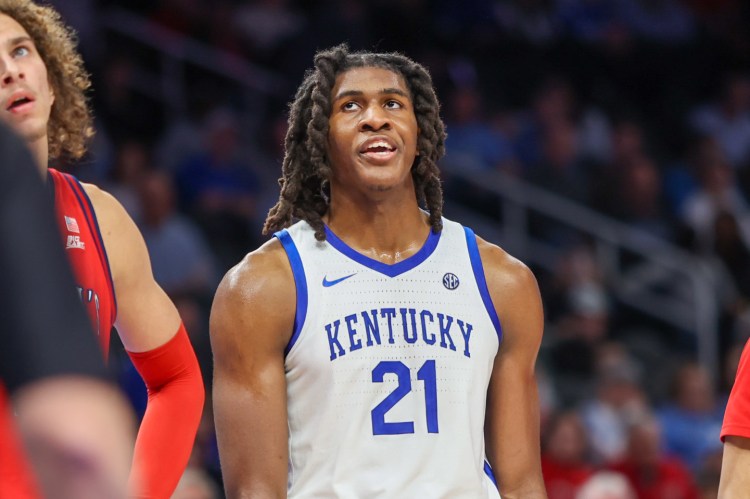
There are moments in a college basketball season when hope feels irrational — when injuries, setbacks, and long rehab timelines seem to write the ending before March even begins. And then, suddenly, a report surfaces. A strength test. A whisper of optimism. A hint that maybe, just maybe, the story isn’t finished yet. That’s where Kentucky Wildcats fans find themselves right now — holding their breath and daring to believe that a March miracle could be brewing in Lexington.
Because if there’s even a chance that Jayden Quaintance could return during the NCAA Tournament, everything changes.
The Injury That Altered Kentucky’s Trajectory
When Quaintance went down, it wasn’t just another name added to an injury report. It was a foundational piece removed from a roster built to compete deep into March.
The 6-foot-10, 255-pound forward brought a rare blend of physicality, agility, and defensive versatility. He wasn’t just a big body in the paint. He was a tone-setter — someone capable of protecting the rim, switching onto guards, rebounding in traffic, and finishing through contact.
But knee swelling tied to his surgically repaired ACL forced him to the sidelines for the final two months of the regular season. What initially appeared manageable evolved into extended caution. The medical staff prioritized long-term stability over short-term desperation.
And so Kentucky adapted.
They adjusted rotations. They restructured defensive assignments. They leaned more heavily on perimeter production and smaller lineups. There were flashes of brilliance, but there were also stretches where the absence of a dominant interior presence was impossible to ignore.
Now, with the NCAA Tournament looming, the conversation has shifted from “How do they survive without him?” to “What if he’s back?”
The Strength Test That Could Change Everything
According to reports, Quaintance is scheduled for a crucial strength test — one that will determine how well his knee has responded after swelling subsided under careful medical supervision.
This isn’t a routine check-in. It’s a benchmark.
Strength symmetry, explosiveness, lateral stability — these metrics aren’t just numbers. They’re indicators of whether a player can compete at full speed without risking re-injury. Passing the test doesn’t guarantee immediate game action, but it opens the door to practice clearance.
And once a player returns to practice, momentum builds.
Sources indicate there is growing optimism within Kentucky’s program. The training staff has reportedly gotten his knee to a stable place. There are backup recovery options available if minor setbacks occur. There is, most importantly, a push.
But optimism must coexist with realism.
Even if cleared for practice, Quaintance would still need to regain conditioning, timing, and confidence. Game speed in March is unforgiving. There are no tune-up exhibitions.
What Quaintance Means to Kentucky’s Ceiling
To understand why this possibility has BBN buzzing, you have to understand what Quaintance represents.
He isn’t just depth. He’s impact.
Kentucky’s defensive ceiling rises dramatically with him on the floor. His length alters shots. His strength discourages drives. His rebounding secures possessions that could otherwise swing tournament games.
In the NCAA Tournament, matchups dictate survival. Teams with elite guards attack mismatches relentlessly. Teams with dominant bigs punish undersized frontcourts.
Quaintance gives Kentucky flexibility.
He allows them to:
Anchor the paint defensively
Switch ball screens more confidently
Compete physically against power-heavy opponents
Control the glass in tight second-half battles
Without him, Kentucky must rely on precision and perimeter rhythm. With him, they gain margin for error.
And in March, margin for error is everything.
The Risk Factor: Playing the Long Game
There’s another layer to this conversation — one that can’t be ignored.
Quaintance is widely projected as a first-round NBA Draft pick. His professional future is bright. Scouts already know his potential. His draft stock is tied to long-term health as much as short-term performance.
So the question becomes: Is it worth it?
Is a brief NCAA Tournament return worth risking a knee that has already endured an ACL tear and extended swelling? Would limited minutes help or hurt his evaluation? Would one setback alter the trajectory of his career?
These are questions families, agents, medical staff, and coaches must weigh carefully.
From Kentucky’s perspective, player welfare comes first. The program’s reputation depends on protecting its athletes’ futures. But competitive fire burns strong in March. If he’s cleared medically and feels confident, it’s difficult to imagine him willingly watching from the sidelines.
Athletes wired like Quaintance don’t want to wonder, “What if?”
The Psychological Boost
Even beyond physical impact, his presence would energize the locker room.
Teammates who have battled through adversity all season would feel a surge of belief. Coaches could expand their tactical options. Fans would sense renewed possibility.
Momentum in March isn’t purely about statistics. It’s about confidence. It’s about emotional swings. It’s about believing you can beat anyone on a neutral floor.
A healthy Quaintance doesn’t just add size — he adds belief.
Imagine an NCAA Tournament broadcast cutting to him checking into a game for the first time in months. The crowd reaction. The bench eruption. The symbolic message: Kentucky isn’t done yet.
The Conditioning Hurdle
Still, reality demands caution.
Two months away from live competition isn’t trivial. Game conditioning cannot be replicated entirely in rehab sessions. Reaction timing, physical rhythm, and endurance require repetition.
If he returns, it likely wouldn’t be as a 30-minute anchor immediately. It might start with short bursts — five-minute defensive stretches. Key rebounding sequences. Late-game situational defense.
Even 15 effective minutes from a player like Quaintance could alter a tournament matchup.
But the staff must be precise. Overextension invites setbacks. Underutilization risks rhythm loss.
Balancing urgency with patience is one of March’s hardest coaching challenges.
The Fan Perspective: Hope vs. Guarded Expectations
Big Blue Nation knows better than to assume miracles. Kentucky fans have seen seasons shaped by injuries before. They understand how fragile momentum can be.
Yet hope lingers.
Social media buzzes with speculation. Message boards dissect strength-test timelines. Every vague update becomes headline material.
But seasoned fans are cautious.
The phrase “don’t get your hopes up” circulates frequently — a protective mechanism against disappointment. After a torn ACL and lingering swelling, expecting immediate heroics would be unfair.
And yet… what if?
What if he returns just in time for a Sweet 16 battle? What if he provides a game-saving block in the final minute? What if his comeback becomes part of Kentucky’s March folklore?
These are the dreams that make college basketball magnetic.
The Bigger Picture: Kentucky’s Identity
This season hasn’t been linear. There have been highs and lows, adjustments and resilience. Kentucky has grown in ways not fully captured by record alone.
If Quaintance returns, it would symbolize more than depth regained. It would represent perseverance — a team refusing to let adversity dictate its ceiling.
If he doesn’t return, Kentucky will still compete with the roster that carried it here. The foundation is intact. The fight remains.
But adding a potential lottery pick to a tournament rotation shifts narratives instantly.
From vulnerable to dangerous.
From limited to layered.
From hopeful to legitimately feared.
The Most Realistic Outcome
If we step back from emotion, the most realistic scenario may be measured involvement — assuming clearance happens.
Short practice windows. Limited but strategic game action. A focus on defense and rebounding rather than offensive burden.
Expecting full pre-injury explosiveness would be unfair. Expecting competitive fire? That’s reasonable.
Ultimately, medical clearance is the gatekeeper. If he doesn’t pass the strength benchmarks, the decision becomes simple: protect the future.
If he does pass them, the coaching staff faces a fascinating strategic puzzle.
A Potential Defining Chapter
College careers are brief. Windows close quickly. For Quaintance, this could be his final opportunity to wear Kentucky blue in meaningful postseason play.
That alone adds emotional weight.
The NCAA Tournament creates legends. It redeems seasons. It reshapes legacies.
Imagine returning from injury, overcoming doubt, and contributing to a deep run. That story writes itself.
But even if he never steps back onto the court this season, his impact remains undeniable. He shaped Kentucky’s defensive identity. He battled through rehab. He demonstrated resilience.
Sometimes courage is visible in comeback attempts. Sometimes it’s visible in restraint.
So… Is a March Miracle Brewing?
The honest answer: maybe.
The door is no longer completely closed. That alone is significant.
There is optimism. There is a test. There is momentum behind the possibility.
But there are also medical realities, draft considerations, and conditioning hurdles.
Kentucky fans should do exactly what many already are — hope, but carefully.
Because in March, improbable things happen.
And if Jayden Quaintance walks onto the floor in the NCAA Tournament after months of uncertainty, it won’t just be a lineup adjustment.
It will feel like destiny nudging the Wildcats forward.
Whether miracle or measured return, one thing is clear:
The story isn’t finished yet.
And in Lexington, that’s enough to keep belief alive.




