March is never kind to assumptions.
It does not care about rankings, preseason hype, recruiting stars, or highlight reels. It does not reward potential. It demands poise. It punishes hesitation. And every year, just when a fan base begins to believe its team looks unstoppable, the bracket reminds everyone of one simple truth: it only takes one off night to end everything.
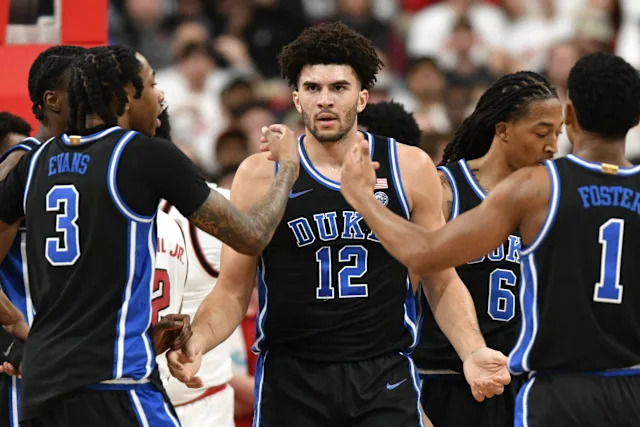
Right now, Duke looks like the team leading the charge.
The Blue Devils have stacked statement wins, overwhelmed elite opponents, and showcased a blend of youthful firepower and emerging maturity that has fans dreaming about another banner. But history warns us not to get comfortable. For every dominant regular season run, March has a way of introducing resistance — programs built to counter strengths, exploit weaknesses, and test resolve.
Duke may be out front.
But ten other teams have the tools to stand in their way.
Why Duke Looks Like the Team to Beat
Under Jon Scheyer, Duke has evolved into something balanced and dangerous. This isn’t just a collection of five-star talent. It’s a group that has grown together over the season.
Freshman phenom Cameron Boozer gives Duke a matchup nightmare in the frontcourt — skilled, composed, and capable of taking over stretches offensively. Around him, the Blue Devils have layered shooting, length, and defensive versatility. They can score in the half court. They can run. They can grind.
And perhaps most importantly, they defend.
Defense travels in March. When shots aren’t falling and nerves tighten, defensive discipline keeps teams alive. Duke’s ability to contest without fouling, switch across positions, and control the glass gives them a foundation sturdy enough for a deep run.
But dominance invites challengers.
The Big Ten Power That Won’t Back Down: Michigan
Michigan Wolverines men’s basketball has built a roster forged from experience and the transfer portal. Coached by Dusty May, the Wolverines combine maturity with skill.
They can stretch the floor. They rebound. They aren’t intimidated by brand names.
Michigan already proved it belongs in conversations about the nation’s elite. And if Duke meets them deep in the bracket, it won’t be about hype — it will be about execution. Michigan is disciplined enough to slow the tempo and force Duke into a possession-by-possession battle.
That’s where March games tighten.
The Battle-Tested Giant: Arizona
There may not be a more physically prepared team in the country than Arizona Wildcats men’s basketball.
Playing in a brutal conference schedule has sharpened them. They’ve faced elite guards, dominant bigs, and high-scoring wings. They’ve won ugly. They’ve won fast. They’ve survived chaos.
Arizona’s strength lies in its balance. No single star carries the load. Instead, they attack in waves. Against Duke’s length and athleticism, Arizona’s depth could prove critical over 40 minutes.
The Defending Mentality: Florida
The swagger is real in Gainesville.
Florida Gators men’s basketball plays with confidence — the kind that comes from winning close games and surviving elite nonconference tests. They score in bunches, defend aggressively, and carry themselves like a team expecting to win.
In March, belief matters.
If Duke encounters Florida in a high-octane showdown, it could become a scoring duel where shot-making and composure determine survival.
The Relentless Machine: Houston
There are few programs as consistently tough as Houston Cougars men’s basketball under Kelvin Sampson.
Houston defends with intensity that borders on suffocating. They rebound like every possession decides the season. They do not beat themselves.
For a young Duke squad, facing Houston would mean matching physicality and emotional resilience. It would not be pretty. It would not be flashy. It would be a fight.
The Blueblood That Refuses to Fade: UConn
Experience wins in March.
UConn Huskies men’s basketball, guided by Dan Hurley, understands tournament basketball. Veteran presence, roster continuity, and a coach who thrives under pressure make UConn dangerous.
They don’t panic. They don’t rush.
Against Duke’s youthful stars, UConn’s composure could create a fascinating contrast — energy versus experience.
The Resilient Rival: North Carolina
You can never ignore rivalry fuel.
North Carolina Tar Heels men’s basketball has already proven it can compete at the highest level this season. If fate places Duke and UNC on a collision course in March, the emotional weight alone would make it electric.
In rivalry games, strategy matters — but emotion amplifies everything. And that unpredictability makes UNC a legitimate obstacle.
The High-Octane Threat: Alabama
Few teams can score like Alabama Crimson Tide men’s basketball.
When their shooters heat up, the scoreboard can tilt quickly. Duke’s defense would be tested by Alabama’s pace and spacing. In a tournament where runs decide outcomes, facing a team capable of 12-0 bursts in two minutes is dangerous.
The Tactical Titans: Kansas
Kansas Jayhawks men’s basketball remains a March staple for a reason. Structured offense. Defensive awareness. Coaching stability.
They understand bracket survival. They adjust mid-game. They exploit weaknesses.
Against Duke’s versatility, Kansas would likely focus on limiting transition opportunities and forcing half-court execution. That chess match could define a regional final.
The Unpredictable Force: Illinois
Offensive firepower gives Illinois Fighting Illini men’s basketball upset potential against anyone.
If shots fall, they can beat anyone in the country. The risk? Defensive inconsistency.
But March doesn’t require perfection — it requires timing. If Illinois gets hot at the right moment, even Duke would feel the pressure.
The Wild Card: Gonzaga
Never underestimate familiarity with chaos.
Gonzaga Bulldogs men’s basketball, led by Mark Few, has lived in March long enough to understand its rhythms. They may not enter as the headline favorite, but they are rarely overwhelmed.
Gonzaga knows how to survive the first weekend — and once you reach the second, belief grows.
Why Duke Still Leads
With all these challengers, why does Duke still sit at the front?
Because the Blue Devils combine elite talent with growth. Early in the season, flashes of brilliance sometimes came with inconsistency. Now, there’s cohesion. Roles are clearer. Defensive rotations are sharper. Late-game execution has improved.
And Cameron Boozer’s presence changes ceilings. Players capable of taking over tournament games are invaluable.
Duke also carries something intangible — confidence without arrogance. They’ve faced pressure. They’ve responded. They look like a team aware of the target on its back.
The Reality of March
Here’s the uncomfortable truth: none of this guarantees anything.
Painter’s comment about Michigan — “They ain’t losing four games” — captured the confidence elite teams inspire. But March requires only one loss to erase dreams.
Duke doesn’t need to be perfect for four straight games.
They need to be resilient.
If they defend, rebound, and avoid the one cold shooting night that haunts so many favorites, they have every tool necessary to cut down the nets.
But the field is deeper than ever.
Michigan’s maturity.
Arizona’s balance.
Florida’s swagger.
Houston’s toughness.
UConn’s experience.
UNC’s rivalry fire.
Alabama’s scoring bursts.
Kansas’ structure.
Illinois’ shot-making.
Gonzaga’s composure.
Each presents a unique test.
It’s Duke vs. The Field
The Blue Devils lead the charge. They deserve to.
Yet March doesn’t reward paper resumes. It rewards execution in hostile arenas, quick turnarounds, and split-second decisions.
Duke has the talent.
Duke has the coaching.
Duke has the belief.
Now comes the real question:
Can they withstand the ten teams waiting for one off night?
The answer will unfold possession by possession, game by game, bracket by bracket.
And if Duke survives the gauntlet, it won’t just be because they were the favorite.
It will be because they proved — when it mattered most — that no one could stand in their way.