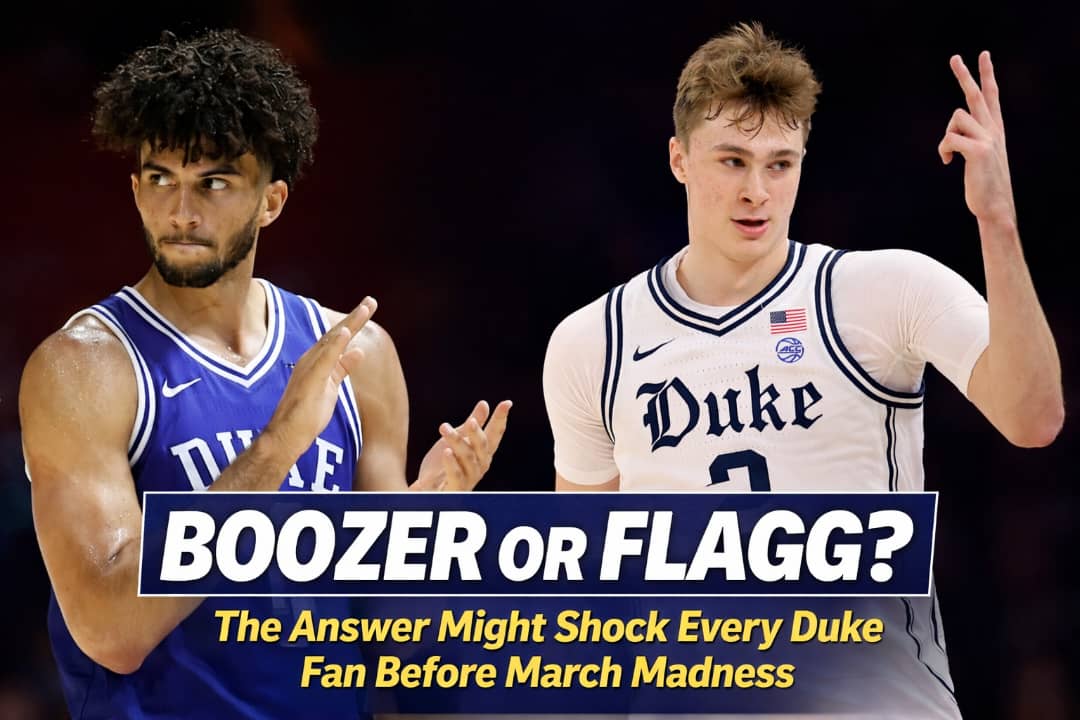
Before the bright lights of March Madness fully flipped on… before brackets were busted and legacies were carved into college basketball history… there was one debate quietly building inside the Duke fanbase.
Who truly carried Duke into March?
Was it the polished power and poise of Cameron Boozer?
Or the explosive, highlight-stealing dominance of Cooper Flagg?
On the surface, it feels simple. Two elite freshmen. Two projected stars. Two different styles.
But when you really look at the games leading up to March Madness — the tough ACC battles, the road tests, the physical grind — the answer isn’t just about stats.
It’s about impact.
It’s about tone-setting.
It’s about who made Duke feel inevitable.
And the truth? It might surprise you.
The Foundation vs. The Firestarter
Let’s start with roles.
Boozer was Duke’s foundation.
Every time the Blue Devils needed composure in the half-court… every time the offense stalled… every time a physical ACC opponent tried to bully the paint… Boozer responded with control. Footwork. Strength. Efficiency.
He didn’t chase moments.
He stabilized them.
Game after game, Boozer brought:
Reliable interior scoring
Strong rebounding presence
Smart defensive positioning
Mature decision-making beyond his age
There’s something about his rhythm that slowed games down when Duke needed calm.
Now enter Flagg.
Flagg wasn’t calm.
He was chaos — controlled chaos.
When Duke needed energy? He delivered.
When momentum shifted? He stole it back.
When opponents thought they had a clean look? He erased it.
Flagg brought:
Weak-side shot blocking
Transition bursts
Defensive versatility 1-through-4
Fearless scoring confidence
Where Boozer built the floor, Flagg blew off the roof.
The Numbers Tell One Story… The Eye Test Tells Another
If you purely analyze pre-March production, Boozer’s consistency stands out.
He rarely disappeared.
He rarely forced shots.
He rarely looked overwhelmed.
In tight conference games, he was the reliable option. The steady scorer. The rebound you could count on.
But basketball isn’t only about reliability.
It’s about gravity.
And Flagg’s gravity was different.
Opposing offenses adjusted because of him.
Coaches schemed around him.
Guards hesitated entering the paint because they knew he was lurking.
He didn’t just play defense.
He changed geometry.
And when he found his rhythm offensively? The game tilted fast.
The ACC Gauntlet Before March
The stretch leading into March Madness is rarely glamorous. It’s physical. It’s strategic. It’s draining.
Under Jon Scheyer, Duke emphasized:
Ball movement
Defensive intensity
Positionless basketball
Pace control
In that system, both Boozer and Flagg thrived — but differently.
Boozer thrived when Duke needed structure.
Flagg thrived when Duke needed disruption.
There were games where Boozer’s inside presence dictated tempo. His rebounding secured extra possessions. His mid-range confidence kept defenders honest.
And then there were games where Flagg’s energy flipped everything — a chase-down block, a steal leading to a dunk, a contested jumper that shouldn’t have gone in but did anyway.
Before March officially began, Duke’s identity felt like a blend of both.
But if you isolate influence…
That’s where things get interesting.
Clutch Composure vs. Fearless Fire
Late-game situations reveal truth.
Boozer in crunch time looked calculated. His body language never rushed. He picked his spots. He trusted fundamentals.
Flagg in crunch time looked fearless. Sometimes wild. Sometimes breathtaking. Always bold.
If Duke needed a bucket inside with 2:00 left? Boozer was the safer choice.
If Duke needed a momentum swing or defensive stop that could electrify Cameron Indoor? Flagg was the call.
So who did the better job before March Madness?
The safe answer is “both.”
But safe answers don’t build legacies.
The Ceiling vs. The Floor Debate
Here’s the real difference:
Boozer raised Duke’s floor.
No matter the opponent, Duke could rely on his physicality and presence. He gave them structure.
Flagg raised Duke’s ceiling.
When he was fully engaged, Duke looked like a national title team. His two-way versatility created championship flashes.
If Boozer represented stability, Flagg represented possibility.
And before March Madness tipped off… possibility started to feel more important.
The Emotional Edge
There’s another factor that doesn’t show up in box scores: emotion.
Flagg played with visible fire. The blocks, the transition slams, the intensity — it ignited teammates.
Boozer played with quiet authority. He anchored teammates.
Which is more valuable heading into March?
History tells us tournament runs are often fueled by momentum swings and defensive dominance.
And that’s where Flagg’s impact becomes undeniable.
So Who REALLY Did the Better Job?
If you measure:
Consistency → Boozer
Interior stability → Boozer
Game-to-game reliability → Boozer
But if you measure:
Defensive disruption → Flagg
Momentum control → Flagg
Two-way dominance → Flagg
Championship-level upside → Flagg
Then the answer shifts.
Before March Madness began, Cameron Boozer may have been Duke’s most reliable performer.
But Cooper Flagg was the player who made Duke feel dangerous.
And in March… dangerous matters more than dependable.
The Truth That Might Shock Duke Fans
The player who did the overall better job leading Duke into March wasn’t necessarily the one who scored the most or rebounded the most.
It was the one who affected every possession.
And that slight edge — that championship-style edge — belongs to Cooper Flagg.
Not because Boozer wasn’t incredible.
But because Flagg’s defensive gravity, versatility, and momentum-changing presence elevated Duke’s entire identity.
The Bigger Picture
Here’s what should excite every Duke fan:
This wasn’t a rivalry.
It was a partnership.
Boozer built the foundation.
Flagg lit the fuse.
And together, they made Duke look complete.
Heading into March Madness, the Blue Devils weren’t relying on one star.
They had:
Stability
Explosion
Composure
Fire
And that combination? That’s what wins banners.
Final Thought for Duke Nation
The debate will continue. It should.
That’s what makes college basketball special.
But instead of choosing sides, Duke fans should recognize what made this team special before March even began:
Two elite freshmen who pushed each other.
Two different styles that complemented perfectly.
Two future stars who made Duke look ready.
So the answer might shock some fans.
It’s not about who was better.
It’s about who made Duke more dangerous.
And heading into March Madness…
That edge belonged to Cooper Flagg.
Now the real question is — when the bracket pressure hit, who would own the moment?
That’s the story every Duke fan was waiting to see unfold.