


Chelsea’s long-term rebuild has once again come under the spotlight after former Arsenal defender Martin Keown singled out club captain Reece James as a symbol of what the Blues must protect amid ongoing change. At the same time, manager Liam Rosenior has delivered a pointed message about the direction of Chelsea’s ambitious transfer strategy — a message that carries significant weight as the club continues reshaping its squad.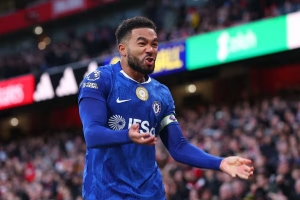
Chelsea’s project under their current ownership has been defined by heavy investment in youth, long-term contracts, and a willingness to overhaul the squad at speed. While that approach has brought exciting talent through the door, it has also sparked debate over balance, leadership, and identity.
Keown, speaking in his role as a pundit, emphasized that amid all the incoming signings and structural changes, players like James represent more than just on-field quality. The England international embodies Chelsea’s academy pathway, leadership culture, and connection to supporters. When fit, James is one of the Premier League’s most complete right-backs — strong defensively, technically gifted, and capable of influencing matches in both boxes.
However, his recent injury struggles have been a recurring concern. Chelsea’s ability to compete consistently at the highest level has often correlated with James’ availability. Keown’s remarks suggest that while recruitment is important, protecting and building around established leaders is just as vital. In a squad filled with promising but relatively inexperienced talent, the presence of a commanding figure like James cannot be understated.
Meanwhile, Rosenior’s warning reflects a broader truth about modern squad building. Recruitment projects built heavily around potential rather than proven consistency require patience — something that can be scarce at elite clubs. Chelsea’s spending has been significant, but assembling a cohesive unit takes more than assembling talent. Tactical clarity, dressing-room hierarchy, and resilience in high-pressure moments are developed over time.
The caution is not necessarily criticism, but a reminder. A project of this scale demands alignment between recruitment, coaching philosophy, and leadership on the pitch. If any of those pillars weaken, progress can stall.
Chelsea’s approach has focused on securing young stars before their market value peaks. The logic is clear: invest early, develop internally, and create a sustainable competitive core. Yet such a strategy inevitably carries risk. Young players require guidance. They need established teammates to steady performances during difficult runs. This is where James’ importance becomes even more pronounced.
As captain, he bridges the past and present. He understands the expectations of playing at Stamford Bridge, the intensity of Premier League competition, and the pressure that accompanies a club of Chelsea’s stature. Losing that continuity — whether through prolonged injuries or tactical marginalization — would leave a leadership vacuum that cannot simply be solved through transfer spending.
The challenge ahead for Chelsea is balance. They must continue developing their young signings while ensuring experienced voices remain central. Stability at the back, particularly in wide defensive areas, is crucial in modern football where full-backs are creative outlets as much as defenders.
Keown’s focus on James highlights a deeper theme: successful rebuilds require anchors. Flashy signings generate headlines, but sustained success often depends on a reliable spine. For Chelsea, James is part of that spine when healthy.
Rosenior’s broader warning serves as a reality check. Ambition must be matched by structure. Recruitment must align with tactical needs. Most importantly, patience must coexist with expectation.
Chelsea supporters will hope that the current vision delivers long-term rewards. But as Keown’s analysis and Rosenior’s comments imply, projects are fragile in their early stages. Protecting key leaders, fostering chemistry, and resisting the urge for constant upheaval may ultimately determine whether this bold transfer experiment evolves into a title-contending side or becomes another transitional chapter.
For now, all eyes remain on James — both as a player striving for sustained fitness and as a symbol of continuity in a period defined by change.




