


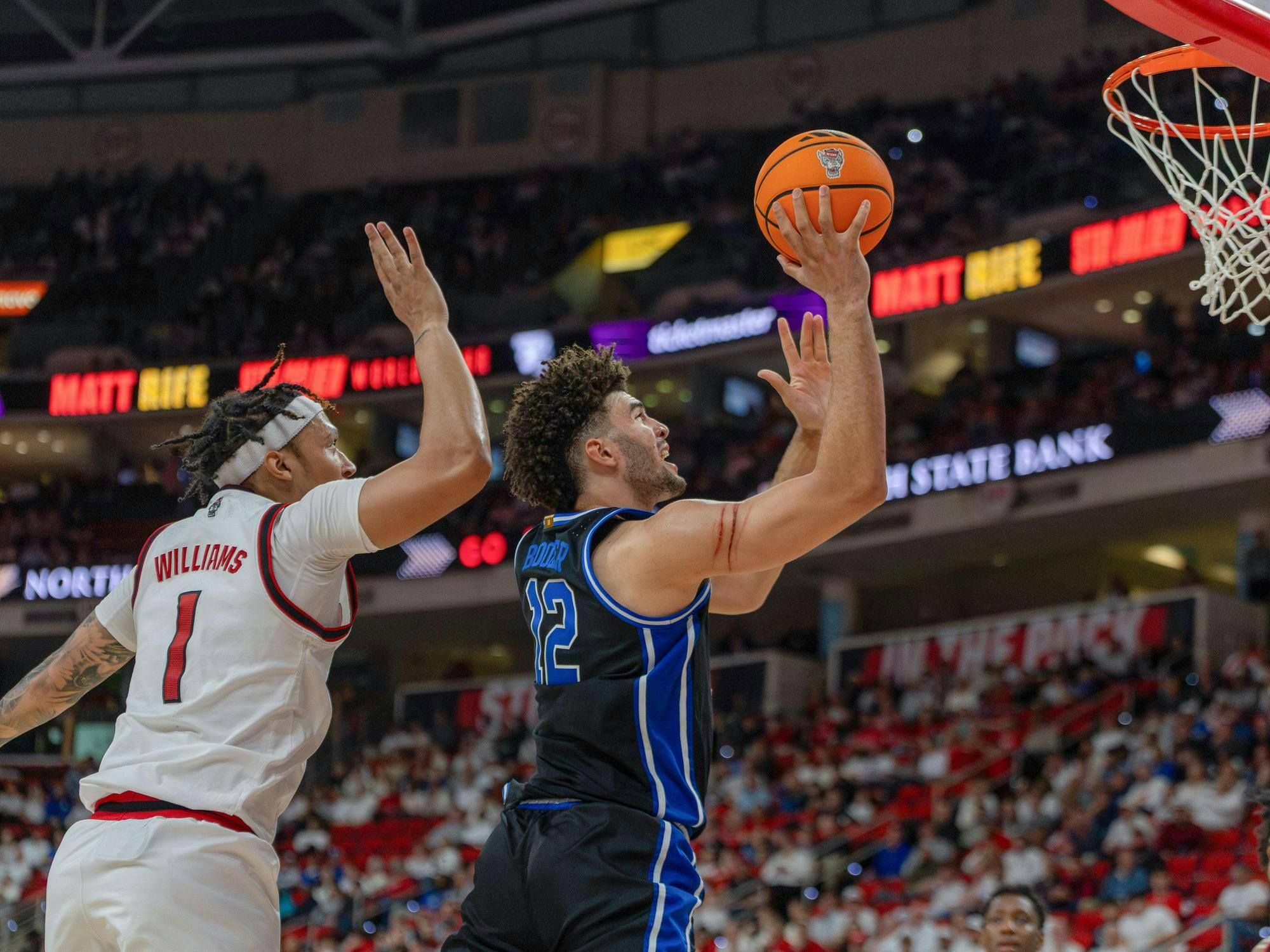
Duke didn’t just defeat NC State — it delivered a statement. A loud, emphatic, unmistakable statement.
After toppling then-No. 1 Michigan, dismantling then-No. 11 Virginia and producing a historic rout of Notre Dame, the Blue Devils arrived at the Lenovo Center with little left to prove. Yet, as elite teams do, they proved it again anyway.
NC State is never a team to overlook. Head coach Jon Scheyer understood that. Rivalry games have a way of tightening nerves and energizing underdogs, especially in a hostile environment. The Wolfpack faithful brought the noise early, and NC State threw defensive wrinkles — including a stubborn zone — at Duke in hopes of disrupting rhythm.
None of it mattered.
From the opening minutes, Duke imposed its will. The 29-point margin of victory marked the largest in the rivalry since a Jabari Parker-led Duke squad overwhelmed NC State at Cameron Indoor Stadium in 2014. This wasn’t simply a win. It was control. It was composure. It was complete and utter domination.
While some may have anticipated a closer contest given the rivalry stakes, Duke’s performance felt inevitable. The Blue Devils are no longer a team surviving tough matchups. They are a team dictating them.
Freshman phenom Cameron Boozer once again delivered a performance that would headline most games across the country — 26 points, nine rebounds and six assists while shooting an astonishing 87.6% true shooting percentage. What makes it remarkable is how routine it has become. Boozer didn’t score until the 9:48 mark of the first half, yet still finished with 11 points, five rebounds and five assists by halftime. Efficiency, patience and poise define his game.
But even on a night when Boozer filled the stat sheet, the spotlight widened. Dame Sarr emerged as a force, attacking with confidence and providing an additional scoring punch that kept NC State scrambling. Duke’s depth — once a question mark early in the season — now looks like a weapon. Different players rise on different nights, and the result remains the same.
After the game, NC State head coach Will Wade offered praise that spoke volumes.
“We got a long way to go to catch Duke right now. They’re as good a team as I’ve played against,” Wade said. “I’m not just talking about their talent. The way they operate. They’re ruthlessly efficient on both ends.”
Twice, Wade described Duke as being “in a different class.” The second time, he corrected himself after briefly grouping the Blue Devils with Virginia.
“I’m sorry, that’s not right,” Wade admitted. “Duke’s in a different class. Virginia’s kind of the next tier. And then there’s a group of everybody else.”
That separation didn’t happen by chance.
Scheyer deliberately constructed one of the nation’s toughest schedules. Through 30 games, Duke ranks second in strength of schedule, trailing only Michigan. The Blue Devils tested themselves against elite competition early and often — and responded with maturity beyond their years.
“We scheduled where, as much as you can see, we’ve seen,” Scheyer explained.
The benefits are evident. Early-season inconsistencies — sluggish starts, unnecessary nail-biters against lesser ACC opponents — have vanished. The team that once struggled to find its rhythm now sets the tempo. The group that battled Georgia Tech to the final buzzer now puts games away before halftime.
Duke has evolved.
The Blue Devils now dismantle opponents methodically. Sometimes it’s suffocating defense that forces hurried shots and careless turnovers. Other times it’s scorching perimeter shooting that stretches defenses beyond repair. Often, it’s dominance in the paint — rebounding, rim protection and relentless interior scoring. More frequently than not, it’s a blend of all three.
The lone blemish in recent memory — a heartbreaking loss to North Carolina — serves less as a warning sign and more as fuel. Since then, Duke has sharpened its focus and reinforced its identity.
And that identity is crystal clear.
This is a team built on pace, physicality and intelligence. Faster. Stronger. Smarter. Playing harder for longer stretches. Duke doesn’t rely solely on talent, though it certainly has plenty. It relies on execution. On discipline. On understanding roles.
Scheyer, when asked if he continues to learn new things about his group, offered an answer that reflects steady growth rather than surprise.
“Not necessarily that I haven’t learned anything new each game, but I think they continue to grow,” he said.
Growth is the defining word. Growth from November’s uncertainty. Growth from early defensive lapses. Growth from moments when composure wavered.
Now, there is clarity.
The Blue Devils know who they are. They embrace physical battles. They attack zones without panic. They respond to hostile crowds with poise. They share the ball. They defend with purpose. They close with authority.
Most importantly, they have faced nearly every style imaginable — high-octane offenses, grind-it-out defensive squads, veteran lineups and fearless young challengers. There are few surprises left waiting for them.
And that’s what makes this group dangerous.
March demands resilience. It demands adaptability. It demands the ability to win in multiple ways over a short span. Duke appears equipped for all of it.
The memory of last season’s disappointment in San Antonio may linger, but it no longer defines them. Instead, it motivates them.
Against NC State, Duke didn’t just win a rivalry game. It reinforced a reality the rest of college basketball is beginning to accept: the Blue Devils are operating at a different level.
There are good teams. There are great teams.
And then, right now, there is Duke.
If this trajectory continues, the conversations in March won’t center on whether Duke belongs among the elite — they will revolve around who can possibly stop them.




