


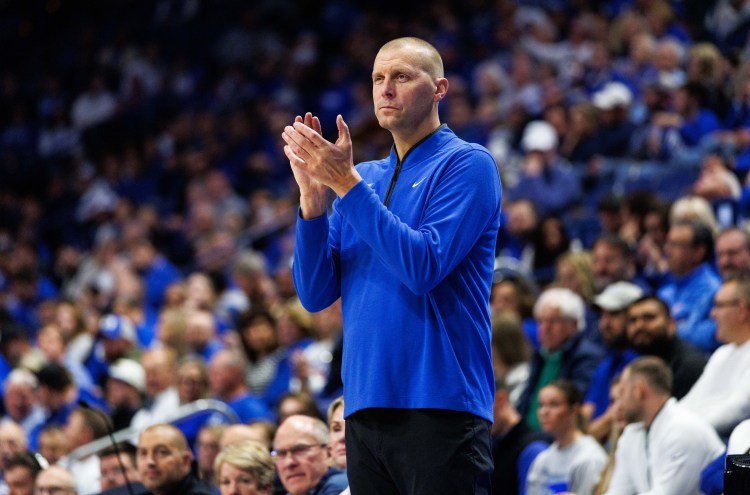
The world of college basketball recruiting has never looked quite like this. In what feels like a rapidly evolving landscape, programs are now navigating a system filled with new opportunities, new uncertainties, and entirely new types of players entering the pipeline. For coaches trying to build competitive rosters, the challenge has become more complex than ever before. And recently, Mark Pope made it clear that his staff is ready to embrace that complexity. Speaking about the future of recruiting, the Kentucky Wildcats men’s basketball head coach revealed that his program is exploring every legal avenue available — even ones that didn’t exist just a few years ago. In a time when the rules of college sports are constantly shifting, Pope believes the only way forward is to stay flexible, creative, and relentlessly proactive.
A New Era of Recruiting
For decades, recruiting in college basketball followed a fairly straightforward path. Coaches scouted high school prospects, built relationships with AAU programs, and occasionally added experienced players through junior colleges.
But that structure has been completely reshaped in recent years.
Today’s recruiting world includes multiple pathways for players to reach college basketball:
Traditional high school recruiting
The transfer portal
International prospects
Former professional players seeking NCAA eligibility
Each of these avenues presents both opportunities and challenges for coaching staffs.
Programs must now evaluate not only talent but also eligibility rules, contract situations, and NCAA regulations that seem to change almost every year.
For a coach like Mark Pope, adapting to this new environment is not optional — it’s essential.
The Dink Pate Visit That Sparked Attention
Recently, Pope traveled to Philadelphia for a visit that quickly caught the attention of basketball fans and recruiting analysts.
The Kentucky coach was there to see Dink Pate, a talented guard who once ranked among the most intriguing prospects in the Class of 2023.
Rather than playing college basketball immediately after high school, Pate chose a different path. He joined the now-defunct G-League Ignite program, which was created to allow elite prospects to develop professionally while preparing for the NBA.
At the time, the decision placed him outside the traditional college basketball pipeline.
But the situation has changed.
After entering the 2025 NBA Draft and going undrafted, Pate signed with the New York Knicks organization. He has since been playing for their G-League affiliate, the Westchester Knicks.
Now, the possibility of playing college basketball has re-entered the conversation.
That possibility alone highlights just how dramatically the recruiting landscape has shifted.
Why Players Like Pate Matter
In previous eras of college basketball, a player who chose a professional path after high school rarely returned to the college game.
Once an athlete accepted professional compensation, NCAA eligibility rules typically closed the door on college participation.
But new interpretations and evolving policies have created gray areas.
Some players who previously played in professional settings are now exploring whether they can transition into the NCAA system.
For programs like Kentucky, that represents a fascinating opportunity.
Players who have already experienced professional training environments often bring maturity, physical development, and high-level experience.
If eligible, they could immediately impact a college roster.
Pate, with his size, athleticism, and scoring ability, certainly fits that description.
Mark Pope’s Recruiting Philosophy
During a press conference, Pope addressed questions about his recruiting strategy and how visits like the one involving Dink Pate fit into the broader plan.
His answer reflected both curiosity and pragmatism.
“In terms of the general structure, you have potential avenues in every level of sport right now for recruiting,” Pope explained. “It’s just new. It’s just new.”
Those words captured the essence of the modern recruiting environment.
Coaches are essentially exploring uncharted territory.
Pope acknowledged that not every opportunity will ultimately lead to a roster addition. Some situations may become complicated due to eligibility rulings or NCAA guidelines.
But his philosophy is simple: if the NCAA says it’s legal, Kentucky will examine it closely.
“I’m not trying to go rewrite any rules,” Pope said. “But whatever rules there are, we’ll play in that space.”
Leaving No Stone Unturned
The Kentucky coaching staff has long been known for aggressive recruiting.
Historically, the program built its reputation by attracting elite high school talent. Many future NBA stars passed through Lexington, using their college season as a stepping stone to professional careers.
But in today’s era, relying on a single recruiting strategy is no longer enough.
Roster construction now requires multiple contingency plans.
A player expected to stay might suddenly enter the transfer portal.
Another recruit might choose the NBA G-League or an overseas opportunity.
Unexpected eligibility changes can also introduce entirely new prospects into the recruiting pool.
For Pope and his staff, the key is preparation.
They must constantly evaluate potential scenarios and be ready to act quickly when opportunities arise.
The Transfer Portal Factor
One of the most transformative developments in college basketball has been the rise of the transfer portal.
Players now have unprecedented freedom to change programs, often seeking larger roles, better exposure, or different competitive environments.
For coaches, the portal functions almost like a second recruiting season.
Programs can rebuild or reshape their rosters within a matter of weeks.
Kentucky, like many major programs, closely monitors the portal for players who can contribute immediately.
But Pope’s comments suggest the staff is thinking even beyond that.
The Professional Pipeline
The possibility of recruiting players with professional experience represents one of the most intriguing developments in the sport.
Athletes who previously bypassed college might now reconsider if the circumstances are right.
Some may want to rebuild their draft stock.
Others may seek a different development environment.
Still others might simply want the exposure that comes with playing for a major college program.
For coaches willing to explore these possibilities, the recruiting pool could expand dramatically.
That appears to be exactly what Pope has in mind.
Building the Future Roster
Ultimately, every recruiting decision comes down to a single goal: building a team capable of competing at the highest level.
For Kentucky, expectations are always enormous.
The program’s fan base demands success, and national championships remain the ultimate objective.
To achieve that goal in the modern era, flexibility is crucial.
Pope understands that the best roster might come from a mix of players:
Elite high school recruits
Experienced transfers
International prospects
Unique cases like former professionals seeking college eligibility
Combining those elements effectively could give Kentucky a competitive advantage.
A Wild Timeline for College Basketball
Pope himself acknowledged how unusual the current moment feels.
College basketball is experiencing a period of rapid transformation.
Name, Image, and Likeness (NIL) opportunities have changed the financial dynamics of the sport.
The transfer portal has altered roster stability.
And evolving eligibility rules continue to create unexpected scenarios.
For fans, it can feel like the sport is reinventing itself in real time.
For coaches, it means constant adaptation.
What Comes Next
Whether or not Dink Pate ultimately joins a college program remains uncertain.
Eligibility questions, professional contracts, and NCAA rulings could all influence the outcome.
But the mere possibility illustrates how wide the recruiting landscape has become.
Players who once seemed permanently outside the college system might now find their way back.
And programs willing to explore those possibilities could discover hidden gems.
Mark Pope’s Vision
Through it all, Mark Pope’s message is clear.
Kentucky will remain proactive.
The staff will explore every legal recruiting path available.
And they will continue searching for players capable of making an immediate impact.
In a sport defined by constant change, standing still is not an option.
As Pope and his staff navigate this new era, their willingness to adapt could shape the future of Kentucky basketball.
One thing is certain: in today’s unpredictable world of college sports, the recruiting trail has never been more fascinating.
And coaches like Mark Pope are determined to master it.




