


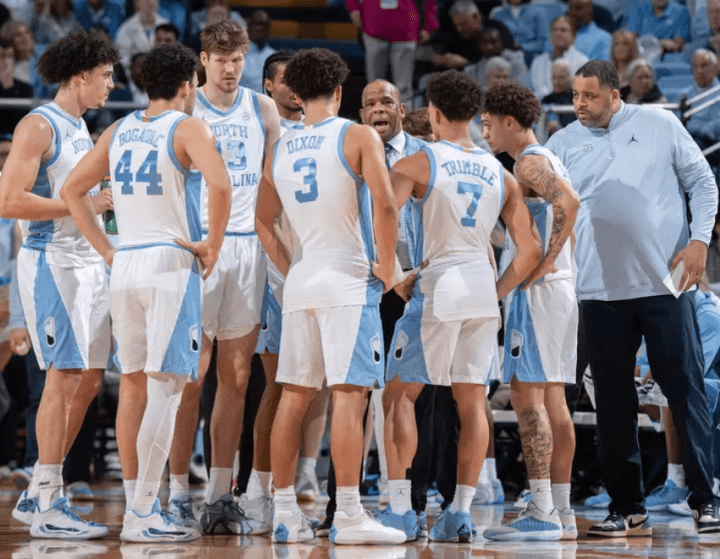
There are moments in every season when the outside world gets loud. Critics speak. Doubts grow. Losses pile up. For the Tar Heels of North Carolina Tar Heels men’s basketball, those moments arrived this year in waves. But instead of fracturing under pressure, the players and coaches leaned into a simple phrase introduced by their head coach, Hubert Davis: “Just us.” It wasn’t a complicated strategy or a flashy slogan. It was a mindset — one that quietly held the locker room together when everything around them seemed to be pulling them apart.
A Simple Idea Before the Storm
Long before the criticism began, Davis had already planted the seed.
During preseason meetings, he spoke to the team about unity, trust, and the importance of staying connected no matter what the season might bring. College basketball seasons are long and emotional, and even the most talented teams inevitably face moments of adversity.
Davis wanted his players to be prepared for those moments.
His message was simple: this team would rely on each other first and foremost.
He reminded them that outside voices — media analysts, opposing fans, and even social media — would always have opinions. Those opinions could shift dramatically depending on the outcome of a single game.
But inside the locker room, the focus had to remain constant.
That’s where the phrase “Just us” was born.
It represented the idea that when everything else becomes chaotic, the only voices that truly matter belong to the teammates and coaches inside the circle.
At the time, it sounded like a motivational line.
Later, it became something much deeper.
When the Season Got Tough
Every college basketball season includes difficult stretches, and this year proved no different for North Carolina.
The Tar Heels experienced several frustrating road losses that quickly fueled criticism from the outside world.
Defeats at places like SMU Mustangs men’s basketball, Stanford Cardinal men’s basketball, California Golden Bears men’s basketball, and NC State Wolfpack men’s basketball created questions about the team’s consistency.
Each loss seemed to amplify the noise.
Fans debated the team’s direction. Commentators questioned the coaching decisions of Hubert Davis. Social media filled with criticism about everything from rotations to defensive schemes.
For the players, it could have easily become overwhelming.
But inside the locker room, the message never changed.
Just us.
The Power of the Circle
The concept of the “Just Us” circle became more than a phrase.
It became a physical and emotional ritual.
During timeouts, practices, and postgame discussions, players would gather tightly together. The circle symbolized unity — a reminder that everyone inside it shared the same goals, frustrations, and determination.
In those moments, the outside noise faded away.
Instead of focusing on criticism, the Tar Heels focused on communication. Teammates challenged each other. Leaders spoke up. Coaches reinforced the team’s identity.
This approach created something powerful: accountability without division.
Players understood that mistakes would happen.
But they also understood that the solution would come from within the group, not from the voices outside it.
Leadership Inside the Locker Room
Every successful team needs leaders, and North Carolina’s locker room features several players capable of guiding the group through adversity.
Veteran guard R. J. Davis has been one of the emotional anchors of the team. Known for his competitive fire and steady scoring, Davis has also embraced a leadership role.
During difficult stretches, his voice inside the “Just Us” circle carried weight.
He reminded teammates that one tough loss didn’t define the entire season.
He encouraged younger players to remain confident.
And most importantly, he reinforced the belief that the team’s best basketball was still ahead.
Leadership like that helped transform the “Just Us” concept from a motivational phrase into a genuine team culture.
Why the Message Worked
Some motivational slogans fade quickly.
Players hear them once during preseason workouts and rarely think about them again.
But the “Just Us” idea worked because it was simple and consistent.
Hubert Davis didn’t just introduce it once — he repeated it constantly.
Every time adversity appeared, the message returned.
Every time criticism surfaced, the team came back to the circle.
That repetition created a sense of identity.
Instead of reacting emotionally to outside criticism, the Tar Heels learned to center their focus on internal improvement.
And in college sports, that kind of mental discipline can be incredibly powerful.
Blocking Out the Noise
Modern athletes face something previous generations never had to deal with at the same level: constant online commentary.
Every game is dissected instantly on social media. Every mistake becomes a highlight clip. Every loss invites waves of criticism.
For young college athletes, that environment can easily become distracting.
Hubert Davis understood that reality.
The “Just Us” message wasn’t about ignoring feedback entirely — it was about prioritizing the voices that matter most.
Inside the locker room.
Inside the practice facility.
Inside the circle.
When players limited their focus to those trusted voices, the pressure from outside criticism began to feel less overwhelming.
A Turning Point in Team Chemistry
Adversity often reveals the true character of a team.
Some teams fracture under pressure. Frustrations grow. Finger-pointing begins.
But for North Carolina, the difficult moments strengthened their chemistry.
The repeated challenges forced the players to lean on each other more often.
Team meetings became more honest.
Practices became more intense.
Players held each other accountable while still maintaining a sense of unity.
The “Just Us” circle acted like a reset button.
Every time the noise grew louder, the Tar Heels returned to the same place emotionally: together.
Hubert Davis’ Leadership Style
Since taking over the program once led by legendary coach Dean Smith, Hubert Davis has emphasized relationships and culture.
His leadership style focuses heavily on trust, communication, and emotional connection with players.
The “Just Us” philosophy reflects that approach.
Rather than relying solely on tactical adjustments or motivational speeches, Davis built a mindset that players could carry with them throughout the season.
It’s the type of culture-building strategy that often goes unnoticed outside the program.
But inside the locker room, it can define how a team responds when adversity strikes.
Why This Matters Moving Forward
As the season progresses toward its most important stretch, the lessons learned during difficult moments could become one of North Carolina’s biggest strengths.
Teams that survive adversity together often develop resilience that becomes invaluable during postseason play.
Close games require trust.
Pressure situations demand composure.
And both qualities grow stronger when a team believes fully in the people standing beside them.
The Tar Heels may still face challenges ahead.
But the foundation built around the “Just Us” mentality gives them something powerful to rely on.
More Than Just a Phrase
At first glance, the phrase “Just us” might sound simple.
Two small words.
But inside the North Carolina locker room, those words represent something much bigger.
They represent trust between teammates.
They represent confidence in the coaching staff.
They represent the belief that no matter how loud the outside world becomes, the answers will always be found inside the circle.
For the Tar Heels, that mindset turned criticism into motivation and adversity into unity.
And sometimes, in the unpredictable world of college basketball, the strongest teams are the ones that learn to shut out the noise and believe in each other.
For North Carolina, the message remains the same today as it was before the season began.
Just us.




