


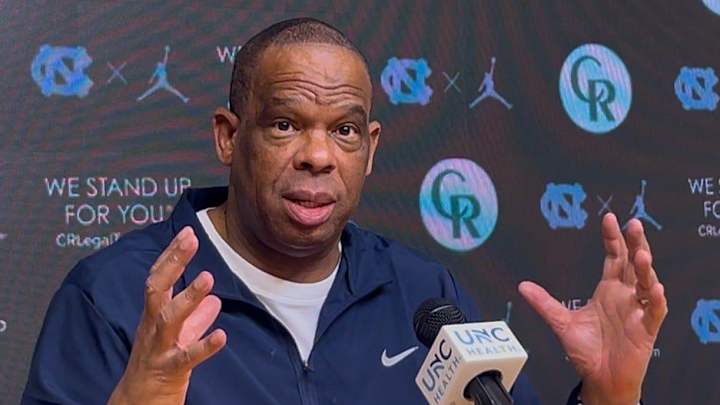
The fallout from North Carolina’s stunning NCAA Tournament exit has sent shockwaves through Chapel Hill, and at the center of it all is Hubert Davis. What should have been a routine first-round victory turned into a nightmare scenario, as the Tar Heels squandered a commanding lead and fell 82–78 in overtime to VCU. While the loss itself may not have been entirely unexpected given the volatility of March Madness, the manner in which it happened has ignited serious concerns about the direction of the program.
North Carolina once led by as many as 19 points and still held a comfortable 14-point advantage late in the second half. Then everything unraveled. Defensive lapses, poor execution, and a lack of composure allowed VCU to claw back into the game. By the time overtime arrived, momentum had completely shifted, and UNC looked like a team out of answers. This wasn’t just a loss—it was a collapse, and one that may define Davis’s tenure if things don’t change quickly.
Over five seasons, Davis’s track record has become increasingly difficult to defend. The Tar Heels have now exited in the first round of the NCAA Tournament in three of those seasons. For a program with North Carolina’s history and expectations, that level of inconsistency is unacceptable. This is a school that measures success not just in tournament appearances, but in deep runs and championships. Repeated early exits simply don’t meet the standard.
Ironically, the biggest reason Davis still holds his position is also the most misleading data point on his résumé. In 2022, UNC made an improbable run to the national championship game as a No. 8 seed. That Cinderella journey captured the imagination of college basketball fans and bought Davis significant goodwill. But as time passes, it increasingly looks like an outlier rather than a sign of sustained excellence. Without that magical run, the conversation around his job security might already be over.
Beyond that one postseason surge, there has been only one truly strong regular season under Davis. In 2024, North Carolina earned a No. 1 seed in the NCAA Tournament, showcasing what the program is capable of at its best. However, that success has not been replicated. The other seasons have been marked by inconsistency, underachievement, and an inability to maintain elite performance over time.
Former Tar Heel great Tyler Hansbrough summed up the frustration shared by many fans and analysts. He noted that this kind of collapse isn’t surprising anymore—it’s become a pattern. That’s perhaps the most damning critique of all. Occasional losses happen to every team, but recurring issues point to deeper structural problems.
Defensive inconsistency has been a recurring theme throughout Davis’s tenure. North Carolina has struggled to impose its will on opponents, particularly away from home. Leads often feel fragile, and games that should be under control have a tendency to slip away. These are not isolated incidents—they are patterns that have persisted into Year 5, raising legitimate questions about coaching, preparation, and in-game adjustments.
When compared to past UNC coaching legends, the contrast becomes even more stark. Roy Williams, for example, lost just one first-round NCAA Tournament game in his entire career. That level of consistency set a benchmark that Davis has not come close to matching. Even more telling is the historical patience the program has shown in the past. Dean Smith, one of the greatest coaches in college basketball history, had a relatively slow start before eventually building a dynasty. That precedent is one reason Davis is likely to get another season.
However, patience is not unlimited. The 2026–27 season is shaping up to be a make-or-break year for Davis. He will not be fired immediately—North Carolina is not a program that makes impulsive decisions—but the margin for error has essentially disappeared. The expectations moving forward are clear and non-negotiable.
To secure his future, Davis must deliver tangible results. That means either guiding the Tar Heels to a top-four seed in the NCAA Tournament—evidence of a strong and consistent regular season—or making a meaningful postseason run. At the very least, UNC must advance past the first round. Another early exit, especially as a middling seed, would almost certainly seal his fate.
Ideally, North Carolina should be competing for a spot in the Sweet 16 or beyond. That’s the level where elite programs operate, and anything less will continue to fuel criticism. The talent is there, the resources are unmatched, and the expectations are crystal clear. What remains to be seen is whether Davis can bring it all together when it matters most.
In many ways, this moment represents a crossroads—not just for Hubert Davis, but for the entire North Carolina basketball program. Another season of mediocrity would force difficult decisions and potentially usher in a new era. But a strong bounce-back campaign could silence critics and reestablish UNC as a national powerhouse.
For now, the message is simple: the clock is ticking, and the next chapter will determine everything.




