


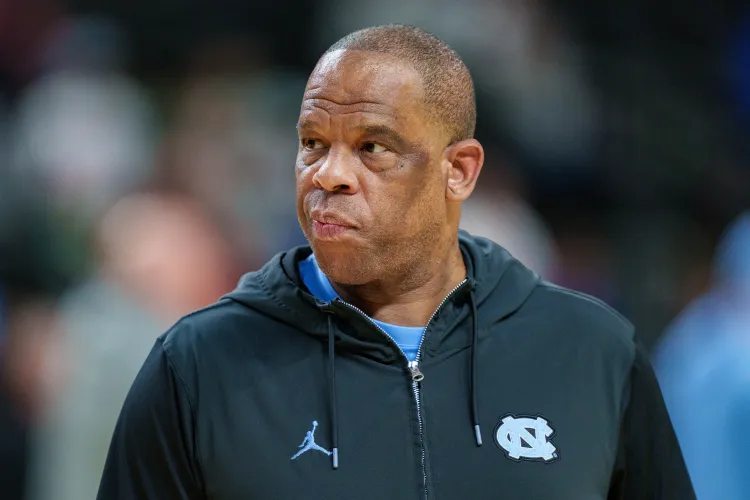
The number alone is enough to make anyone pause. As frustration builds after another crushing March exit, one question is suddenly impossible to ignore—just how far would UNC actually go to make a change? Behind the scenes, the price of moving on from Hubert Davis isn’t just significant… it’s eye-opening, and it could shape the future of Carolina basketball more than the loss itself.
A Collapse That Sparked Bigger Questions
For the North Carolina Tar Heels men’s basketball, the loss itself was painful. But what made it unforgettable—and potentially program-altering—was how it happened.
UNC didn’t just lose in the first round of the NCAA Men’s Basketball Tournament. It collapsed.
A 19-point second-half lead vanished. Shot after shot stopped falling. Possession after possession slipped away. And in overtime, the Tar Heels failed to score a single field goal. The final result—an 82–78 loss to VCU—wasn’t just an upset. It was a moment that forced everyone, from fans to administrators, to ask uncomfortable questions.
Because this wasn’t a one-off.
It was the second straight year UNC exited the tournament in the Round of 64.
When “The Standard” Meets Reality
At North Carolina, expectations are not flexible—they are fixed.
“The standard is the standard.”
That phrase, often repeated by Hubert Davis, reflects a program built on championships, consistency, and excellence. UNC isn’t measured by regular-season wins alone. It’s measured by March.
And lately, March hasn’t been kind.
2022: National championship game appearance
2023: Missed the NCAA Tournament
2024: Sweet 16 exit as a No. 1 seed
2025 & 2026: Back-to-back first-round exits
That trajectory tells a story of inconsistency—a program capable of greatness, but unable to sustain it.
And at a place like UNC, inconsistency can be just as troubling as failure.
The Buyout That Changes Everything
If this were purely about performance, the conversation might be straightforward. But it’s not.
It’s about money, too.
According to contract details, Hubert Davis is signed through June 30, 2030. If UNC were to move on as of April 1, the university would owe him approximately $5.312 million.
That’s not just a number—it’s a decision point.
In college athletics, buyouts serve as both protection and deterrent. They ensure stability, but they also make sudden changes costly. For UNC, that cost is significant enough to demand careful consideration.
Would the program be willing to pay that price after back-to-back early exits?
Or would it choose patience?
Breaking Down the Contract
To understand the situation fully, you have to look beyond the buyout figure.
Davis’ compensation structure includes:
Base salary: $1.25 million annually
Supplemental pay: $1.8 million (increasing by $100,000 each year)
University expenses: $50,000 annually
Outside income: Endorsements and media deals, including partnerships with major brands
For the 2026 contract year, his total compensation is approximately $3.85 million, with built-in raises over time.
In other words, UNC isn’t just committed to Davis now—it’s financially tied to him well into the future.
That makes any decision far more complex.
Context Matters: The Caleb Wilson Factor
Before rushing to judgment, context is essential.
UNC didn’t enter the tournament at full strength.
Freshman standout Caleb Wilson—who led the team in:
Points (19.4)
Rebounds (9.4)
Steals (1.5)
Blocks (1.4)
—was sidelined with a broken thumb.
His absence wasn’t just noticeable—it was game-changing.
Wilson’s versatility and production made him the engine of the team. Without him, UNC had to adjust its identity on the fly. And while the Tar Heels showed resilience at times, the lack of a go-to presence became glaring late in games.
Still, even without Wilson, a 19-point lead should have been enough.
Which brings the focus back to execution—and coaching.
Execution vs. Explanation
After the loss, Hubert Davis pointed to execution, not fatigue.
He insisted the team got good looks. That the shots simply didn’t fall.
And to an extent, that’s true. Basketball can be cruel that way.
But when a team:
Misses its final nine shots
Fails to score a field goal in overtime
Allows a historic comeback
…it raises deeper concerns.
Was it just bad luck?
Or was it a failure in late-game management, adjustments, and composure?
Those are the questions that don’t go away easily.
The Weight of History
UNC is not just another program—it’s a benchmark.
With:
Six national championships
21 Final Four appearances
…the Tar Heels operate in a different tier of expectation.
That history doesn’t just inspire—it pressures.
Every coach, including Hubert Davis, is measured against legends like Roy Williams.
And while even Williams faced challenges late in his tenure, he built a legacy defined by championships and consistency.
That’s the bar.
The Duke Factor
No discussion about UNC is complete without mentioning Duke.
Under Jon Scheyer, the Duke Blue Devils men’s basketball have maintained a high level of success:
Consistently winning 27+ games
Back-to-back 30-win seasons
Regular deep tournament runs
The comparison is unavoidable—and increasingly uncomfortable for UNC.
Rivalries amplify everything. Wins feel bigger. Losses feel worse.
And right now, Duke appears to have the edge.
Is Hubert Davis on the Hot Seat?
The answer isn’t simple.
On one hand, Davis has:
Won 20+ games in each of his five seasons
Guided UNC to a national title game
Maintained recruiting strength
On the other hand:
The program has lacked consistency
March results have declined
Back-to-back early exits raise concerns
The buyout complicates things further.
Firing a coach isn’t just about performance—it’s about timing, finances, and long-term vision.
At this moment, Davis is not definitively on the hot seat.
But the seat is warming.
What UNC Must Decide
The decision facing UNC isn’t just about one game.
It’s about direction.
Option 1: Stay the Course
Trust Davis. Build around returning talent. Improve execution. Hope that continuity leads to results.
Option 2: Make a Change
Absorb the financial hit. Reset the program. Take a risk in pursuit of higher consistency.
Neither option is easy.
And neither guarantees success.
The Bigger Picture
College basketball is evolving.
With the transfer portal, NIL deals, and increased parity, maintaining dominance is harder than ever. Programs that once ruled the sport now face constant challenges from rising teams.
That context matters.
But so does tradition.
UNC doesn’t just want to compete—it expects to contend.
And right now, it’s stuck somewhere in between.
The Offseason That Will Define Everything
Regardless of what UNC decides, the offseason becomes critical.
Key priorities include:
Rebuilding depth
Adjusting late-game strategy
Developing leadership
Reinforcing identity
Every move will be scrutinized.
Every decision will be analyzed.
Because the margin for error is shrinking.
Final Thought
The loss to VCU didn’t just end a season—it started a conversation.
About expectations.
About consistency.
About the cost—both financial and cultural—of falling short.
For Hubert Davis, the challenge is clear: prove that the program is still on the right path.
For UNC, the question is even bigger:
Is patience the answer…
or is it time to pay the price for change?




