


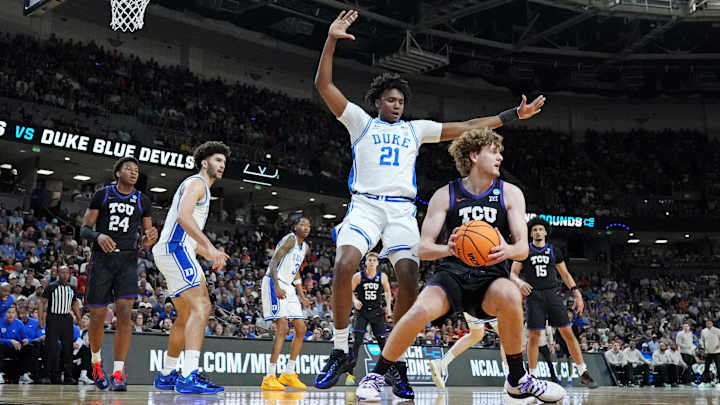
JON SCHEYER TOOK THE HEAT: He Sat Patrick Ngongba Against Siena. Everyone Had an Opinion. Then Came TCU. And Suddenly? Silence. Here’s How the Gamble Paid Off in Ways the Box Score Doesn’t Show
The criticism came quickly.
When Jon Scheyer made the decision to sit freshman big man Patrick Ngongba during Duke’s matchup against Siena Saints men’s basketball, it didn’t take long for the reaction to spread.
Questions turned into debates.
Debates turned into frustration.
Why bench a promising young talent at such a critical point in the season? Why disrupt rotation rhythm when the stakes were rising?
In a program like Duke Blue Devils men’s basketball, every decision is magnified.
And this one? It was under a microscope.
A Decision That Didn’t Make Sense—At First
Ngongba had shown flashes—energy, physicality, and a growing presence in the paint. For many fans, his absence wasn’t just noticeable—it felt like a mistake.
Sitting him against Siena raised eyebrows not because of who Siena was, but because of what Duke was trying to become.
March is about tightening rotations, not experimenting.
At least, that’s the conventional thinking.
But Scheyer wasn’t thinking conventionally.
Looking Beyond One Game
What many didn’t see in that moment was the longer view.
Scheyer wasn’t just coaching for Siena.
He was coaching for what came next.
For matchups that demanded versatility. For moments where spacing, defensive switches, and tempo would matter more than size alone. For games where experience and composure could outweigh raw potential.
And that next test came quickly.
Enter TCU—and a Different Kind of Game
When Duke faced the TCU Horned Frogs men’s basketball, the tone shifted immediately.
This wasn’t a game that could be controlled with size alone. TCU brought pressure, pace, and unpredictability—the kind of opponent that forces adjustments on the fly.
For 25 minutes, Duke was pushed.
Tested.
Forced out of rhythm.
And then, something clicked.
The Adjustment That Changed Everything
Without Ngongba anchoring the floor, Duke leaned into a different identity—one built on mobility, switching defense, and offensive spacing.
Lineups became quicker. Rotations became sharper. The ball moved with more freedom.
And slowly, Duke began to take control.
It wasn’t just about scoring runs or defensive stops.
It was about fluidity.
The kind of cohesion that doesn’t always show up in the box score but defines how a team functions under pressure.
What the Box Score Won’t Tell You
Ngongba’s absence didn’t produce a stat.
It produced a shift.
A shift in how Duke defended pick-and-rolls.
A shift in how they spaced the floor offensively.
A shift in how quickly they could adapt when the game sped up.
Those changes created advantages that aren’t measured in points or rebounds—but in momentum, rhythm, and control.
Scheyer saw it coming.
Even when others didn’t.
From Criticism to Silence
As Duke pulled away and secured control against TCU, the conversation changed.
The same voices that questioned the decision grew quieter.
Not because the questions were unfair—but because the results offered a different perspective.
What looked like a risky move suddenly looked intentional.
Calculated.
Even necessary.
Trusting the Process
For Jon Scheyer, this moment reinforced something every coach understands but few fans fully accept:
Not every decision is about the present.
Some are about preparation.
About anticipating challenges before they arrive.
About sacrificing short-term comfort for long-term success.
What This Means for Ngongba
This isn’t the end of Ngongba’s role.
Far from it.
If anything, the situation highlights his importance within a larger system. His development remains a priority, and his presence will matter in matchups where size and interior play become critical.
But it also sends a message:
Minutes aren’t guaranteed.
They’re strategic.
A Coach’s Gamble That Paid Off
March basketball is defined by adjustments.
By moments where coaches must trust instincts over perception.
Scheyer took that risk.
He absorbed the criticism.
And when the moment arrived—against a team capable of exposing weaknesses—his decision paid off.
Not loudly.
Not dramatically.
But effectively.




