


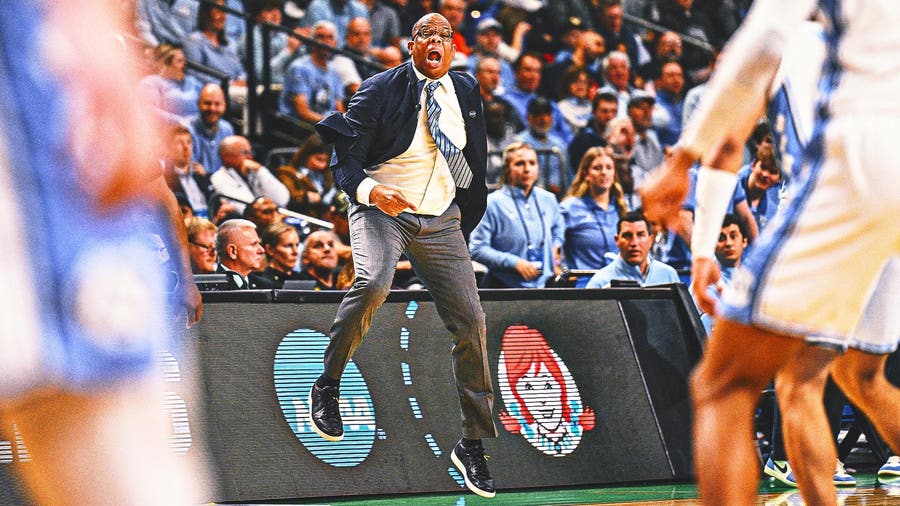
Hubert Davis Signed a Two-Year Extension Last Spring. Now, After the VCU Meltdown, UNC Is Quietly Doing the Math—and the Number $5,000,000 Keeps Coming Up
The Silence Is Broken: What Bubba Cunningham Said—And Didn’t Say—About Hubert Davis Could Define the Future of North Carolina Tar Heels men’s basketball Basketball
For days, there was nothing.
No statement. No reassurance. No denial.
Just silence.
In Chapel Hill, that silence grew louder with every passing hour after the North Carolina Tar Heels men’s basketball suffered a stunning collapse against the VCU Rams men’s basketball in the NCAA Tournament—a 19-point lead erased in a loss that felt less like a defeat and more like a breaking point.
Then, late Saturday, Bubba Cunningham finally spoke.
And instead of clarity, he delivered something else entirely:
Uncertainty.
A Statement That Opened the Door
Cunningham’s words were brief. Measured. Familiar on the surface.
He spoke about evaluating “all facets” of the program. About working with university leadership. About continuing discussions in the coming days.
But there was one glaring omission:
He never mentioned Hubert Davis by name.
He didn’t say Davis would return.
He didn’t say he wouldn’t.
And in a program where public support is usually clear and immediate, that absence was impossible to ignore.
Because in college athletics, silence within a statement often says more than the words themselves.
The $5 Million Question
Behind the scenes, the conversation has shifted.
This is no longer just about performance.
It’s about cost.
Last spring, Davis signed a contract extension meant to stabilize the program and reinforce confidence in his leadership. Now, that same deal has introduced a difficult reality:
Moving on would come with a price—roughly $5 million in base buyout, potentially rising to $6–7 million with additional terms.
For a program with the resources of North Carolina, that number isn’t impossible.
But it isn’t insignificant either.
Because firing a coach isn’t just about paying him to leave.
It’s about what comes next:
- Hiring a new coach at a competitive salary
- Rebuilding a roster in the transfer portal era
- Re-establishing recruiting momentum
The real question isn’t just can UNC afford it.
It’s whether they believe they can afford not to.
The Collapse That Changed the Tone
The loss to VCU wasn’t just another tournament exit.
It was symbolic.
A 19-point lead, gone.
Momentum, lost.
Confidence, shaken.
But perhaps most importantly, it felt familiar.
Under Davis, the Tar Heels have shown flashes of brilliance—moments where they look like a national contender. Yet those moments have too often been followed by inconsistency, defensive lapses, and struggles to close games.
This wasn’t a one-off.
It was a pattern.
And for a program that measures success in championships, patterns like that don’t go unnoticed.
From Breakthrough to Backslide
Davis’s tenure has been defined by extremes.
In his first season, he led North Carolina to the national championship game—a run that instantly validated his hiring and earned widespread praise.
But what followed has been far less stable:
- A missed tournament appearance
- A Sweet 16 run that ended in disappointment
- And now, a first-round exit marked by one of the most dramatic collapses in recent tournament history
In total, just three NCAA Tournament wins since that title game appearance.
For most programs, that might be acceptable.
At North Carolina, it raises alarms.
The Case for Patience
Despite the growing pressure, Davis’s case isn’t without merit.
He remains deeply connected to the program’s identity—a former player, a former assistant, a coach who understands the expectations in Chapel Hill better than most.
He has recruited talent.
He has maintained academic standards.
He has represented the university with professionalism.
And perhaps most importantly, he has shown—at least once—that he can lead a team to the highest level.
For some, that still matters.
The Case for Change
But college basketball doesn’t operate on potential.
It operates on results.
And right now, the results are raising difficult questions:
- Why does inconsistency persist?
- Why do late-game struggles continue?
- Why hasn’t the program built sustained momentum?
Add in concerns about transfer portal decisions and roster construction, and the pressure intensifies.
Because in today’s game, adaptability isn’t optional.
It’s essential.
A Decision Bigger Than One Coach
What makes this moment so critical is what it represents.
This isn’t just about Hubert Davis.
It’s about direction.
Does North Carolina stay the course, believing that continuity will eventually lead to stability?
Or does it embrace change, even at a financial cost, to reset expectations and rebuild momentum?
Cunningham’s statement suggests one thing clearly:
That decision has not yet been made.
The Clock Is Already Ticking
Time is not on UNC’s side.
The transfer portal is active.
Recruits are watching.
Competing programs are moving quickly.
Every day without clarity creates uncertainty—not just within the program, but outside it.
And in modern college basketball, uncertainty can be costly.




