


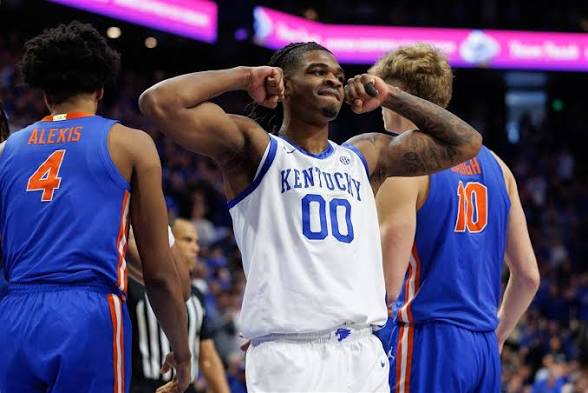
8The season may have ended in disappointment, but for the rising stars of Kentucky Wildcats men’s basketball, the journey is far from over. After a tough NCAA Tournament exit against Iowa State Cyclones men’s basketball, the spotlight has shifted from what went wrong to what lies ahead. And if there’s one clear takeaway, it’s this: Kentucky’s newcomers have built a foundation that promises growth, resilience, and unfinished business.
At the center of that narrative is Malachi Moreno, a freshman who exceeded expectations while still holding himself to an even higher standard. Despite earning All-SEC Freshman Team honors and becoming a consistent starter, Moreno didn’t shy away from self-criticism. His late-season dip in scoring—failing to hit double figures in the final seven games—clearly weighed on him. Yet, his mindset reveals maturity beyond his years.
Moreno averaged 7.8 points, 6.3 rebounds, and 1.5 blocks per game while appearing in all 36 contests—a testament to both durability and trust from the coaching staff. More importantly, he embraced the grind of college basketball, crediting teammates and daily work ethic for his growth. While his performance tapered off late, his overall impact positions him as a cornerstone for Kentucky’s future.
Rather than letting the tournament loss define him, Moreno is channeling it into motivation. His focus is clear: improve, stay mentally strong, and ensure no regression in his game. With NBA Draft buzz building but expectations leaning toward a return, his sophomore season could mark a major leap forward.
Meanwhile, Andrija Jelavic experienced a season defined by adaptation and perseverance. Arriving with professional experience from Europe, Jelavic’s transition wasn’t seamless. Missing summer practices put him behind early, and his role fluctuated throughout nonconference play.
However, the start of SEC competition marked a turning point. Jelavic stepped into a starting role and held it for the final 20 games, demonstrating resilience and growth. Though his minutes and production were inconsistent—averaging 5.5 points and 4.0 rebounds while shooting 27.6% from three—his journey highlighted the importance of patience and mental toughness.
Jelavic’s reflections reveal a player who values development over immediate success. He learned to maximize limited opportunities, contribute in small bursts, and stay ready despite uncertainty. His professional background helped him navigate adversity, and his appreciation for Kentucky’s high-pressure environment suggests he’s embracing the challenge rather than resisting it.
Then there’s Jasper Johnson, whose freshman season proved to be the most challenging among the trio. Entering with significant hype as a top recruit, Johnson struggled to translate his high school scoring prowess into consistent college production.
Limited to just 28 minutes across postseason play, Johnson found it difficult to secure a steady role, especially after injuries created opportunities he couldn’t fully capitalize on. Ball security issues and physical mismatches against experienced opponents hindered his progress. He finished with 57 assists to 35 turnovers, reflecting inconsistency in decision-making.
Still, Johnson’s response is what stands out. He openly acknowledged his shortcomings—particularly the need to get stronger and refine his ball-handling and shooting. Rather than deflecting blame, he’s taking ownership of his development, committing to offseason improvement with a clear sense of purpose.
His honesty and accountability suggest that this season, while difficult, could serve as a turning point. Players often make their biggest leaps after adversity, and Johnson appears determined to do just that.
Beyond individual performances, the bond formed among Kentucky’s first-year players adds another layer of optimism. Shared experiences—on and off the court—have built relationships that extend beyond basketball. From late-night gaming sessions to everyday camaraderie, these connections have created a support system that will be crucial moving forward.
Veteran presence also played a role in guiding the newcomers. Collin Chandler offered insight into their mental resilience, praising their ability to handle frustration without letting it show. According to Chandler, their consistency in effort and attitude—even during tough stretches—speaks volumes about their character.
That mental toughness could be the defining factor in their evolution. College basketball is as much a psychological battle as it is physical, and the ability to stay grounded amid highs and lows is essential for long-term success.
Kentucky’s season may have ended earlier than hoped, but the experience gained by its newcomers is invaluable. Moreno’s emergence, Jelavic’s perseverance, and Johnson’s lessons learned collectively paint a picture of a team in transition—but one with significant upside.
The disappointment of March will linger, but it also serves as fuel. These players are not satisfied, not complacent, and certainly not finished. With a full offseason ahead, the expectation isn’t just improvement—it’s transformation.
For Kentucky fans, the message is clear: this group is “nowhere near done.” And if their mindset is any indication, the next chapter could be far more compelling than the last




