


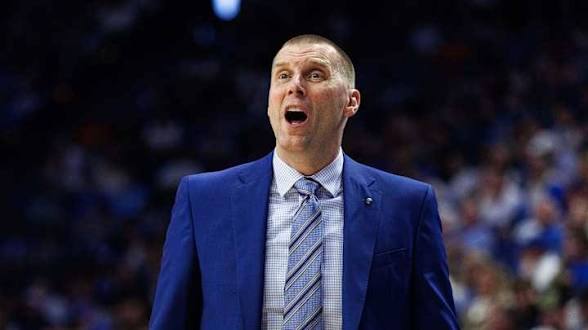
The noise outside is deafening, the frustration impossible to ignore—but inside the locker room, something entirely different is unfolding, as the players of the Kentucky Wildcats rally behind Mark Pope with a level of belief that is as surprising as it is powerful.
The end of a season always brings reflection, but when that ending arrives earlier than expected—especially in a program as historic and demanding as Kentucky—the spotlight quickly shifts from performance to accountability. For Mark Pope, that reality has arrived with full force.
Kentucky’s exit from the NCAA Tournament, particularly a Round of 32 loss to the Iowa State Cyclones, has ignited intense scrutiny. A season that already included 13 losses became even more difficult to defend once March hopes were cut short. In Lexington, expectations are never modest—and patience is often in short supply.
Yet, amid the rising tension, criticism, and speculation about Pope’s future, a fascinating and somewhat unexpected narrative has emerged: the unwavering support of his players.
Pressure Mounting in Lexington
To understand the current moment, you have to understand Kentucky basketball. This is not just another program—it is one of the most decorated, tradition-rich powerhouses in college sports. Championships are the standard. Deep tournament runs are expected. Anything less often feels like failure.
Mark Pope arrived with optimism and belief. His first season showed promise, as he guided the Wildcats to a 24–12 record and a Sweet 16 appearance. That run gave fans hope that the program was stabilizing and perhaps even on the verge of something bigger.
But in college basketball, momentum is fragile.
This season did not build on that foundation the way many expected. Instead, inconsistency crept in. Injuries disrupted rhythm. Rotations shifted. Chemistry was tested. And by the time the postseason arrived, Kentucky looked like a team still searching for answers.
The loss to Iowa State was not just a defeat—it felt like a missed opportunity. And in a place like Kentucky, missed opportunities often come with consequences.
Fan Frustration Reaches a Boiling Point
It didn’t take long for the reaction to spill over.
Across social media, fan forums, and sports talk shows, the tone shifted from disappointment to frustration—and in many cases, outright anger. Calls for change began to grow louder. Questions about Pope’s ability to lead the program to championship contention became more pointed.
For some fans, the argument is simple: Kentucky should not be exiting the tournament this early, especially not in consecutive seasons without deeper progress.
Others point to the 13 losses as evidence that something isn’t working.
And then there are those who believe the program is at a crossroads—one where leadership decisions in the coming weeks could define its trajectory for years.
Inside the Locker Room: A Different Reality
But while the outside world debates and speculates, the atmosphere inside the Kentucky locker room tells a very different story.
Rather than distancing themselves from their coach, the players have done the opposite—they’ve closed ranks around him.
One of the most powerful voices came from Collin Chandler, who didn’t hesitate to make his stance clear after the loss.
“We love Coach Pope. I’ve believed in Coach Pope since I was 15 years old. I know what he can do, what he can be. The type of person he is. A type of person like that finds success. I’m riding with Coach Pope.”
In just a few sentences, Chandler captured something that statistics and results often fail to measure: trust.
This wasn’t a generic, media-trained response. It was personal. It was emotional. And it revealed a level of belief that goes beyond wins and losses.
Why Player Loyalty Matters
In modern college basketball, player support can be one of the most telling indicators of a coach’s impact.
Schemes and strategies matter. Recruiting matters. Results matter. But culture—the environment a coach creates—often determines whether a program thrives or collapses under pressure.
And culture is built on relationships.
The loyalty shown by Kentucky’s players suggests that Mark Pope has not lost the locker room. In fact, it suggests the opposite: that his players are deeply invested in his vision.
That kind of backing is not easily earned, especially in a high-pressure environment where frustration can quickly lead to finger-pointing.
Instead of assigning blame, the players are expressing belief.
Instead of creating distance, they are showing unity.
And in a moment when everything seems uncertain, that unity stands out.
Mark Pope’s Perspective: A Season of Adversity
For his part, Mark Pope has not shied away from addressing what went wrong.
After the loss, he acknowledged the challenges his team faced throughout the season—particularly in terms of roster stability and health.
“We didn’t get to play the way that we planned to. We didn’t get to play with the personnel we planned to. And all of that changed. I think our guys raised up and they made the very, very best of a complicated, difficult situation roster-wise and health-wise, and I couldn’t be more proud of them.”
To some, those words may sound like excuses. In a results-driven world, explanations are often dismissed when they aren’t accompanied by success.
But context matters.
Injuries can derail even the most talented teams. Constant lineup changes can disrupt chemistry. And when a team is forced to adapt on the fly, consistency becomes difficult to achieve.
Pope’s comments highlight a reality that doesn’t always show up in the box score: this was not a smooth season behind the scenes.
The Fine Line Between Patience and Pressure
The question now facing Kentucky’s leadership is not just about what happened—it’s about what comes next.
Do they view this season as a setback caused by circumstances? Or as a sign of deeper issues?
Do they prioritize continuity and trust in a coach who has his players’ full support? Or do they respond to external pressure and pursue change?
It’s a delicate balance.
On one hand, college basketball history is filled with examples of programs that benefited from patience—where coaches were given time to build, adjust, and ultimately succeed.
On the other hand, Kentucky is not just any program. The expectations are immediate. The spotlight is constant. And the margin for error is incredibly small.
What the Players See That Others Might Not
Perhaps the most intriguing part of this situation is the gap between perception and reality.
Fans see results. They see losses. They see early exits.
Players, however, see something more.
They see the daily work. The preparation. The leadership behind closed doors. The way a coach responds in adversity.
They experience the culture firsthand.
And when players like Collin Chandler speak so strongly in support of their coach, it suggests that there is something meaningful happening beneath the surface—something that statistics alone cannot capture.
A Program at a Crossroads
As the offseason begins, Kentucky finds itself at a critical juncture.
The coming weeks will likely be filled with evaluation—of players, of systems, and most importantly, of leadership.
Transfer portal decisions will shape the roster. Recruiting efforts will influence the future. And administrative choices will determine the direction of the program.
But amid all of that, one factor should not be overlooked: the voice of the players.
Because while fans demand results and analysts debate performance, the players are offering something equally important—insight into the character and impact of the man leading them.
The Bigger Picture
It’s easy to focus on what went wrong.
The losses. The inconsistency. The early exit.
But seasons are rarely defined by a single narrative.
This was a year of challenges for Kentucky—a year where expectations were not met, but effort was not lacking.
A year where outcomes disappointed, but belief remained intact.
And perhaps most importantly, a year that revealed the strength of the bond between a coach and his players.
Final Thoughts: Loyalty in the Face of Uncertainty
In college basketball, pressure can fracture teams. It can create divisions. It can expose cracks.
But in Kentucky’s case, it has done something different.
It has revealed loyalty.
As Mark Pope’s future hangs in the balance, the voices of his players are cutting through the noise—clear, confident, and unwavering.
They believe in him.
They trust him.
And in a moment when everything else feels uncertain, that belief might be the most important factor of all.
Because while wins and losses shape narratives, it’s relationships that define legacies—and right now, Mark Pope still has the one thing many coaches lose under pressure:
his locker room.




