


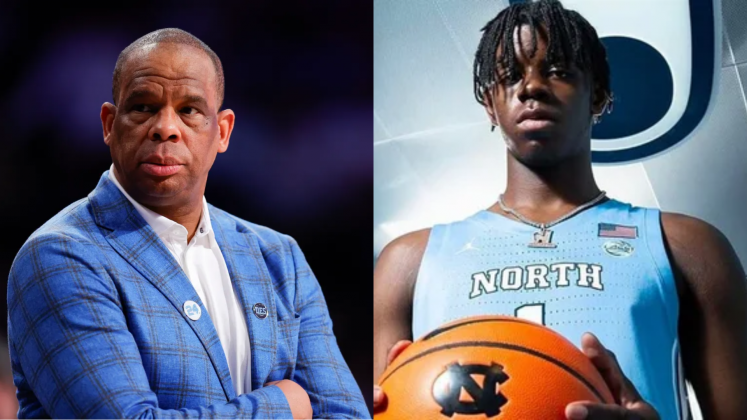
The moment North Carolina fans feared—and others quietly anticipated—has finally arrived, and it’s sending shockwaves far beyond Chapel Hill. After weeks of tension, speculation, and mounting frustration, the University of North Carolina has officially pulled the trigger, ending the era of Hubert Davis in a move that has instantly reshaped the future of one of college basketball’s most iconic programs. But just when emotions were at their peak, one voice cut through the noise in a way no one expected. Freshman star Caleb Wilson—a rising phenom with the spotlight already firmly on him—finally broke his silence. And what he said didn’t just react to the moment… it changed how people are looking at it.
The End of an Era at North Carolina
The dismissal of Hubert Davis marks one of the most significant turning points in recent North Carolina basketball history. When Davis was appointed as the successor to legendary coach Roy Williams in 2021, the decision symbolized continuity, trust, and belief in the program’s culture.
Davis wasn’t just another hire—he was family. A former Tar Heel player, a longtime assistant, and someone who understood the DNA of North Carolina basketball. His appointment was seen as a seamless transition, a passing of the torch that would preserve tradition while ushering in a new era.
And for a brief moment, it looked like the plan was working perfectly.
In his very first season, Davis led the Tar Heels on an electrifying run to the national championship game, reigniting the passion of a fanbase that thrives on March success. That run wasn’t just impressive—it was symbolic. It felt like validation that the program had made the right choice.
But as quickly as hope surged, expectations followed—and expectations at North Carolina are unlike anywhere else.
From Promise to Pressure
College basketball is unforgiving, especially at a place like UNC. Success isn’t celebrated for long—it’s demanded year after year.
After that magical first season, the Tar Heels struggled to find consistency. While there were flashes of brilliance, they were often overshadowed by disappointing losses, missed opportunities, and growing concerns about the program’s direction.
This season, the pressure reached its peak.
Despite a strong 24–9 record and a respectable 12–6 finish in conference play, the Tar Heels entered the NCAA Tournament with something to prove. Critics questioned their resilience, their depth, and their ability to handle high-pressure moments.
Then came the game that would define everything.
The Collapse That Changed Everything
Facing the VCU Rams in the opening round, North Carolina looked dominant early. At one point, they held a commanding 19-point lead in the second half—a cushion that should have guaranteed advancement.
But what followed was nothing short of a nightmare.
The Rams chipped away at the lead with relentless energy. Possession by possession, the momentum shifted. Shots that once fell with ease suddenly missed. Defensive lapses opened the door wider.
By the time overtime arrived, the outcome felt inevitable.
An 82–78 loss sealed the Tar Heels’ fate—and, ultimately, Davis’ future.
Back-to-back first-round exits in the NCAA Tournament proved too much for a program built on championship expectations.
The Decision Heard Across College Basketball
When news broke that University of North Carolina had parted ways with Hubert Davis, reactions poured in from every corner of the basketball world.
Some saw it as a necessary move—a program refusing to settle for mediocrity. Others viewed it as a harsh decision, given Davis’ early success and deep ties to the university.
But regardless of perspective, one thing was clear: this wasn’t just another coaching change.
This was a statement.
North Carolina wasn’t willing to wait.
Caleb Wilson Steps Into the Spotlight
Amid the chaos, one name began to rise above the noise—Caleb Wilson.
Wilson arrived in Chapel Hill as one of the most highly touted recruits in the nation. A five-star prospect in the 2025 class, he had his pick of elite programs, including powerhouse schools like Kentucky and Ohio State.
Choosing North Carolina wasn’t just about basketball—it was about belief.
He believed in the program.
He believed in the vision.
And most importantly, he believed in Hubert Davis.
During his freshman season, Wilson quickly proved why he was so highly regarded. Averaging 19.8 points, 9.4 rebounds, 2.7 assists, and 1.5 steals per game, he wasn’t just contributing—he was dominating.
For many fans, he represented the future.
A Season Cut Short
Just as Wilson’s star was rising, adversity struck.
In a February matchup against the Miami Hurricanes, he suffered a fractured hand—a devastating injury that would sideline him for the remainder of the season.
The timing couldn’t have been worse.
Not only did Wilson miss critical games down the stretch, but he was also forced to watch from the sidelines as his team entered the NCAA Tournament—a stage every player dreams of.
For a competitor of his caliber, that absence was heartbreaking.
And yet, even in that moment, his focus remained on the team—and his coach.
“His Message Says It All”
After the news of Davis’ departure became official, Wilson took to X (formerly Twitter) to share a simple but powerful message:
“Thank you for everything coach Davis, one of the best men and coaches in my life.”
It wasn’t long.
It wasn’t complicated.
But it was deeply meaningful.
In just a few words, Wilson offered a perspective that statistics and headlines often miss—the human side of coaching.
Behind every win and loss are relationships, mentorship, and trust. For Wilson, Davis wasn’t just a coach—he was someone who made a lasting impact in a short period of time.
And that message resonated.
Reading Between the Lines
Wilson’s statement may have been brief, but it spoke volumes.
At a time when criticism of Davis was at its peak, one of the program’s brightest young stars chose gratitude over frustration.
That decision matters.
It suggests that, despite the struggles on the court, Davis’ influence within the locker room remained strong. It highlights the respect he commanded from his players—a factor that often goes unnoticed in public discussions.
And it raises an important question:
Was the problem really about leadership—or something more complex?
The Future of North Carolina Basketball
With Davis gone, the focus now shifts to what comes next for the University of North Carolina.
Coaching searches are never simple, especially for a program with such a rich history. Every potential candidate will be measured against legends like Roy Williams, and expectations will remain sky-high.
But beyond the coaching decision, there’s another critical factor to consider:
The players.
Will stars like Caleb Wilson stay committed to the program?
Will the incoming recruiting class remain intact?
How will the locker room respond to such a major change?
These questions could shape the program’s trajectory for years to come.
A Defining Moment for Caleb Wilson
For Wilson, this moment represents both uncertainty and opportunity.
On one hand, he’s losing the coach who believed in him and helped guide his early development. On the other hand, he now has a chance to become the face of a new era in North Carolina basketball.
That’s a rare position for a freshman.
How he navigates this transition could define not only his college career but also his future beyond it.
The Emotional Side of the Game
It’s easy to focus on results—wins, losses, and statistics—but moments like this remind us that sports are deeply personal.
For players, coaches, and fans alike, these decisions carry emotional weight.
Davis’ departure isn’t just a headline—it’s the end of relationships, routines, and shared experiences.
Wilson’s message captured that reality in a way no analysis could.
Final Thoughts
In the aftermath of a decision that has shaken college basketball, it’s often the smallest moments that leave the biggest impact.
A short message.
A simple thank you.
A reminder of what really matters.
Caleb Wilson didn’t deliver a long statement or spark controversy. Instead, he offered something far more powerful—perspective.
And in doing so, he may have told the most important part of the story.
As North Carolina moves forward into an uncertain future, one thing is clear:
The legacy of Hubert Davis won’t be defined solely by wins and losses—but also by the players he impacted along the way.
And if Wilson’s words are any indication, that impact runs deeper than many realize.




