


Chapel Hill
When Bill Belichick was introduced as North Carolina’s football coach in December 2024, athletic director Bubba Cunningham opened his news conference remarks with a brief quip. “Over the last four or five years, anytime there’s been a search anywhere in the country, they thought the first two people you should call are Brad Stevens and Jay Wright,” Cunningham said. “So that’s who I called first.”
At most programs, that line would land as the familiar truth about the modern coaching carousel — wide-ranging searches, big-name targets and aspirational phone calls. But that’s not how North Carolina has traditionally operated when it comes to its men’s basketball program. For decades, the Tar Heels have promoted from within a tight coaching lineage that traces from Dean Smith to Bill Guthridge to Roy Williams and, most recently, Hubert Davis.
Now, that model is being tested.
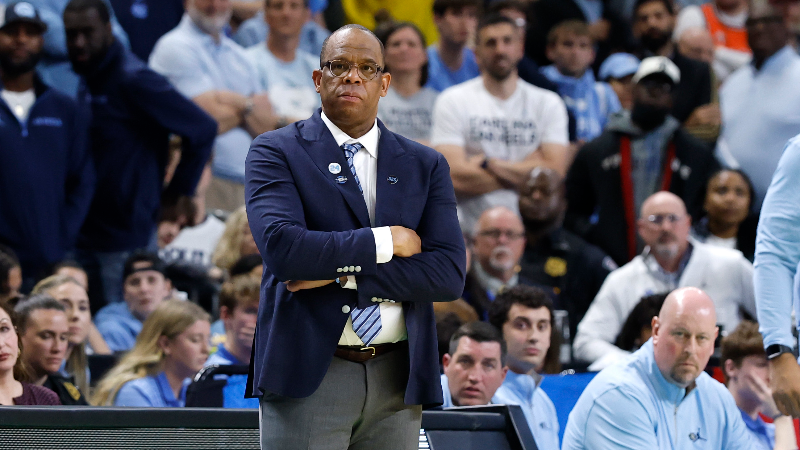
North Carolina officially parted ways with Davis on Tuesday night, the school announced, truly opening up one of college basketball’s premier jobs for the first time in decades and setting the stage for a search that will likely look fundamentally different from those that came before it. With no clear successor who fits the traditional “Carolina family” mold, the university is casting a wider net. Cunningham, incoming AD Steve Newmark and university chancellor Lee Roberts are leading the search, which will include assistance from executive firm TurnkeyZRG and consultant Chad Chatlos. The school said it will also rely on an advisory group of former players, coaches and key stakeholders.
“A lot of people say, ‘Well, you should know all the coaches, and you should be able to do that,’” Cunningham said in a recent episode of UNC’s Carolina Insider podcast. “When a job like this comes open, there are so many requests, and you really want to get back to people and have respect for what they’re trying to bring to you. And so it does help us filter that.”
“Certainly we’ve talked about, and we’ll continue to talk about potential candidates and a timeline in the entire process,” Cunningham continued, “but having an outside firm be a shelter or shield to really screen a lot of the calls that are coming will be very helpful for us.” Both Cunningham and Newmark emphasized they will lean on the legacy of UNC basketball — such as former players and coaches — as they navigate the process in the coming days. Neither has provided a timeline on when a new coach will be hired. “We want to get the right person,” Cunningham said in the podcast. “And if it takes a couple of days, great. If it takes a little bit longer than that, then that’s what it’s going to have to take.”
Both Cunningham and Newmark were present at a Wednesday meeting of UNC’s Board of Trustees at the Rizzo Center at Chapel Hill. They went into a closed session with the board and, after the session concluded, could be seen speaking with multiple members of the board.
Cunningham declined to provide much further comment when approached by the N&O, but confirmed the Trustees’ sole role in the hiring process will be approving the eventual hire. UNC’s Board of Trustees came under fire for reported meddling in the hiring of Belichick.
As North Carolina begins a search that could redefine its identity, it’s worth revisiting how we got here. Here’s a look back at the program’s coaching transitions (in reverse chronological order):
April 5, 2021: The next in line
If Williams’ retirement marked the end of an era, the hiring of Davis reinforced what North Carolina had long valued: continuity. Four days after Williams announced he was stepping down, Cunningham named Davis the program’s next head coach, extending a lineage that stretched back decades.
That announcement came on Monday, April 5. On Tuesday, April 6, Davis was introduced as the head coach in a press conference held at the Dean E. Smith Center. That day, he looked up at the rafters — where his uncle, Walter Davis, is enshrined — and took in the weight of it all. He stood by his father as video boards flashed his name as head coach.
“I’m an emotional guy,” Davis said that day. But his path to that stage had been anything but guaranteed.
As a recruit, Davis once had to convince Smith he belonged at North Carolina at all. Smith initially suggested Davis consider a smaller school before ultimately offering a scholarship — a turning point that Davis seized immediately.
From there, Davis developed into a standout guard, finishing his career as one of the program’s most efficient perimeter shooters. He went on to play 12 seasons in the NBA and serve as a college basketball analyst for ESPN before returning to Chapel Hill in 2012 as an assistant under Williams. That unconventional path — from player to broadcaster to coach — made his hiring something of a departure in experience, but certainly not in philosophy.
Davis was steeped in the culture UNC sought to preserve.




