


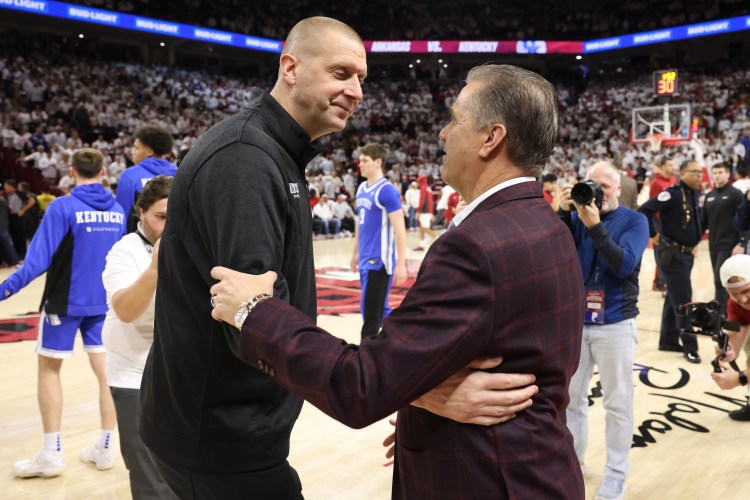
In the fast-changing, high-stakes world of college basketball, few voices carry as much weight as that of John Calipari. A national championship-winning coach, a master recruiter, and one of the most recognizable figures in the sport, Calipari has never been one to stay silent—especially when the game itself is shifting beneath everyone’s feet.
And this time, he didn’t just speak—he sounded the alarm.
Fresh off Arkansas’ Sweet 16 loss to Arizona, Calipari peeled back the curtain on what’s really happening behind the scenes in college basketball today. His words weren’t just about one program. They weren’t even just about one offseason. They were about a growing crisis—one that is now staring the Kentucky Wildcats directly in the face.
“There are a lot of people who have no recruits, no idea who’s coming back, who don’t have the money you had a year ago,” Calipari said. “You do not. And now, all of a sudden, you’re trying to keep guys, figure out who else out there wants to come, and who wants to put on a bidding war, which we won’t be involved in.”
On the surface, it sounded like a general observation. But to those paying close attention, it felt like something much deeper: a brutally honest breakdown of the exact storm currently surrounding Kentucky basketball.
A New Era That Changed Everything
College basketball is no longer what it used to be. Gone are the days when blue-blood programs like Kentucky could rely almost entirely on tradition, prestige, and NBA pipelines to reload every season. Today, the game is shaped by two powerful forces: Name, Image, and Likeness (NIL) deals, and the ever-expanding transfer portal.
Together, they’ve created a system that is as unpredictable as it is competitive.
Players are no longer bound by the same limitations. They can transfer more freely, explore better financial opportunities, and leverage their value in ways that were unimaginable just a few years ago. For athletes, it’s empowerment. For coaches, it’s controlled chaos.
And for programs like Kentucky? It’s a complete reset of how success is built.
The Illusion of Stability Is Gone
One of the biggest takeaways from Calipari’s comments is this: stability is now an illusion.
A year ago, a program might feel secure with its recruiting class, confident in its returning players, and optimistic about its financial backing. But today? Everything can change overnight.
A top recruit could decommit. A key player could enter the portal. A major NIL contributor could pull back funding. Suddenly, what looked like a championship-caliber roster becomes a puzzle missing half its pieces.
This is the reality Kentucky now faces.
Despite reportedly assembling a roster valued at around $22 million last season, the Wildcats fell short of expectations, exiting in the Round of 32 against Iowa State. It wasn’t just a disappointing finish—it was a wake-up call.
Because now, the question isn’t just “How do you get better?”
It’s “How do you even stay together?”
The NIL Pressure Cooker
NIL has changed the recruiting game in ways that are still being fully understood. What was once about relationships, development, and exposure is now heavily influenced by financial opportunity.
And while Kentucky remains one of the biggest brands in college basketball, even powerhouse programs are feeling the pressure.
Calipari’s remark about “not being involved in bidding wars” speaks volumes. It highlights a growing divide in the sport: programs that are willing to spend aggressively to secure talent, and those that are trying to maintain a more structured, sustainable approach.
For Kentucky, this creates a delicate balancing act.
Spend too little, and you risk losing top talent.
Spend too much, and you risk creating a system that’s difficult to sustain long-term.
Either way, the margin for error is razor-thin.
The Transfer Portal Dilemma
If NIL is one side of the coin, the transfer portal is the other.
Players now have the freedom to leave at any time, often seeking better roles, better exposure, or better financial opportunities. For coaches, this means that roster management is no longer a seasonal task—it’s a year-round challenge.
Retention has become just as important as recruitment.
And this is where Kentucky’s offseason could be won or lost.
Keeping key players in the program requires more than just promises of playing time. It requires trust, development plans, and, yes, competitive NIL opportunities. Lose too many pieces, and the entire foundation of the team can crumble.
Enter Mark Pope: A Different Kind of Challenge
While Calipari’s comments may not have been directed at anyone specifically, they inevitably cast a spotlight on Kentucky’s current head coach, Mark Pope.
Pope is navigating one of the most complex transitions in college basketball: following a legendary figure while trying to establish his own identity in a completely new era of the sport.
It’s not just about winning games. It’s about rebuilding a system that can thrive under modern conditions.
Pope’s approach appears to lean more toward development, culture, and long-term stability. But in an era dominated by quick turnarounds and instant results, patience can be a hard sell—especially to a fanbase as passionate as Kentucky’s.
The Fans Are Watching—Closely
Big Blue Nation is not known for sitting quietly.
Kentucky fans expect excellence. They expect Final Four runs. They expect banners.
And when those expectations aren’t met, the scrutiny intensifies.
Calipari’s comments, whether intentional or not, have added fuel to an already burning conversation. Are Kentucky’s struggles a result of systemic changes in college basketball? Or are they a reflection of decisions made within the program?
The answer, most likely, is both.
So… What’s the Fix?
Here’s where things get interesting.
Because while Calipari laid out the problems with striking clarity, the real story lies in the potential solutions—some of which are already beginning to take shape.
1. Prioritizing Player Retention
In today’s game, keeping your best players might be more valuable than signing new ones. Continuity builds chemistry, and chemistry wins games.
For Kentucky, this means investing in relationships, creating clear development paths, and ensuring players feel valued both on and off the court.
2. Smarter NIL Strategy
Instead of chasing every high-priced recruit, programs can focus on building a balanced NIL structure—one that rewards performance, loyalty, and team success.
This approach not only helps with retention but also fosters a stronger team culture.
3. Targeted Portal Additions
The transfer portal isn’t just a risk—it’s also an opportunity.
By identifying players who fit specific roles and team needs, Kentucky can build a more cohesive roster rather than simply collecting talent.
4. Rebuilding Identity
Perhaps the most important solution is also the most intangible: identity.
What does Kentucky basketball stand for in this new era? Is it still the one-and-done pipeline? Or is it evolving into something more sustainable?
Answering this question will shape every decision moving forward.
A Defining Offseason
There’s no sugarcoating it: this offseason could define the next chapter of Kentucky basketball.
The challenges are real. The pressure is immense. And the margin for error is almost nonexistent.
But within that pressure lies opportunity.
Because if Kentucky can navigate this moment—if it can adapt, evolve, and find the right balance—it won’t just survive this new era.
It could dominate it.
Final Thoughts
John Calipari didn’t just describe a problem. He revealed a reality that many programs are still struggling to fully grasp.
“No money, no recruits, no direction.”
It’s a dramatic statement—but it’s also a warning.
For Kentucky, the path forward won’t be easy. It will require tough decisions, innovative thinking, and a willingness to embrace change.
But as daunting as the situation may seem, one thing remains true:
In college basketball, fortunes can change quickly.
And if the Wildcats find the right formula—if they turn this crisis into a catalyst—this offseason might not be remembered as the beginning of a decline…
…but as the moment everything changed.




