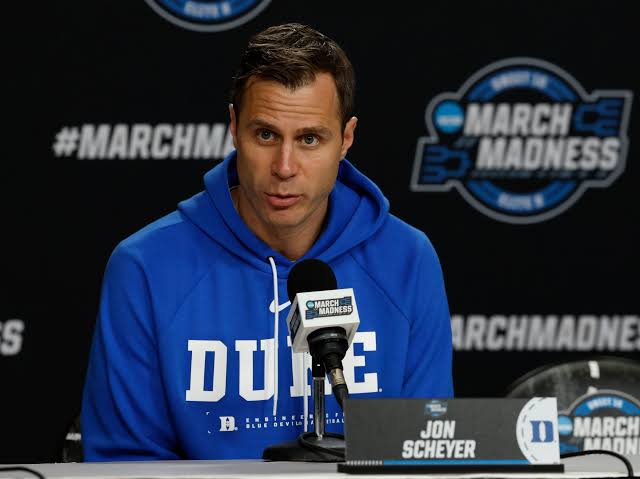
The silence in Duke’s postgame press room on Sunday night said almost as much as Jon Scheyer’s words.
Moments after the Blue Devils suffered a devastating 73-72 Elite Eight loss to UConn, a game that slipped away in the most painful way possible, Duke’s head coach stepped to the podium carrying the full weight of a season that had suddenly ended. What should have been a celebration of a Final Four berth instead became an emotional autopsy of one of the most shocking collapses of March Madness.
As is customary, Scheyer was asked to begin with an opening statement. For a moment, it seemed like he couldn’t.
“I’ll just take questions,” Scheyer said, his disappointment obvious after the one-point defeat.
But almost immediately, he paused, gathered himself, and decided he owed his players more than a quick dismissal.
What followed was one of the most raw and revealing postgame moments of his coaching career.
“I’ll just say this, and then if there’s not questions, we’ll let Cam answer and go. I could not be more disappointed and feeling for our guys, at the same time of just trying to process what happened. I don’t have the words. I don’t have the words.”
That line alone captured the mood around Duke basketball.
This was not just another tournament defeat. This was a crushing ending to a season that carried championship expectations, elite-level talent, and the kind of momentum that made many believe Scheyer’s Blue Devils were destined for the Final Four.
Instead, the defining image became the coach himself, stunned and searching for language.
Scheyer then turned his focus to what his players had endured simply to reach that stage.
“What I do know is literally this team, what each individual player went through just to play the game, I’ve never seen anything like it. What these guys did to have to get ready, their foot injuries, he’s (Cameron Boozer) got a black eye, he’s playing the whole game.”
That detail added another emotional layer to the defeat.
It wasn’t merely a tactical collapse. It was a wounded, battle-tested group pushing through pain, exhaustion, and pressure on the sport’s biggest stage. Cameron Boozer sitting beside Scheyer with visible bruising only reinforced the coach’s point: Duke’s stars gave everything they had.
And yet, it still wasn’t enough.
Scheyer’s disappointment quickly turned into visible empathy for his team.
“I’m incredibly sorry for these guys that they’ve got to go through this. This is on us. We’re going to be in this together. The year that this guy’s had has been absolutely incredible, absolutely incredible. I don’t have words other than just how proud I am of these guys and how disappointed we are.”
That combination of pride and heartbreak is what made the moment so powerful.
He was not deflecting blame.
He was not making excuses.
He was owning the pain with his players.
Still, the question everyone wanted answered centered on the final possession — the moment that changed everything.
Duke had the ball.
The Blue Devils were in control.
A foul was available.
A timeout was looming.
All they needed to do was secure the basketball.
Instead, one of the smallest mistakes imaginable turned into the biggest moment of the season.
Scheyer’s explanation revealed how thin the margin truly was.
“Yeah, we just have to secure it, right? We got it. They had a foul. I was ready for a timeout. We’ve just got to hold on.”
Those words will likely echo through Duke’s offseason because they capture the brutal simplicity of the collapse.
Not a complicated breakdown.
Not a genius defensive scheme by UConn.
Just one possession Duke failed to survive.
Still, Scheyer refused to reduce the loss to a single sequence.
“It’s easy to look at that play — I look at every play that happened, especially in that second half, this is not about one play. It’s about every play that put us in that position.”
That answer may be the most telling part of the entire press conference.
Great coaches rarely allow one play to define an outcome, and Scheyer clearly sees the loss through a wider lens. The final seconds were devastating, but they were only possible because Duke’s grip on the game had already weakened long before that moment.
And the biggest reason was turnovers.
As UConn mounted its furious comeback, Duke repeatedly gave away possessions that turned into easy points the other way. What had once been a comfortable lead suddenly became fragile, then dangerous, then gone.
Scheyer admitted that reality without hesitation.
“Of course. We just gave them easy baskets. We just had to secure the ball better, and that’s a recipe to put yourself in that position. That was the big difference in the game obviously.”
In March, that kind of honesty matters.
Championship games are often decided not by spectacular highlights but by the invisible details: late-game ball security, execution under pressure, and composure when momentum swings.
Duke lost all three in the second half.
That’s why this defeat feels bigger than the scoreboard.
A one-point loss in the Elite Eight can become a defining wound because it leaves behind endless “what ifs.”
What if Duke protected the ball?
What if the timeout came one second earlier?
What if one of those second-half turnovers never happens?
What if the Blue Devils simply slow the game down?
Scheyer himself admitted those questions are already playing in his mind.
“There’s not a person in this room, including me, that doesn’t replay everything that you could do and how you can help. I mean, obviously.”
That may be the most human quote of the night.
Behind the suit and the title of head coach is someone who knows every second of that collapse will be replayed over and over, not just by fans, but by himself.
He understands the burden that comes with leading Duke basketball.
“That’s part of being in this seat. That’s part of being in this spot.”
And he’s right.
At Duke, Elite Eight appearances are celebrated only briefly. The standard is championships. The expectation is composure in defining moments. The burden of every close loss becomes heavier because the margin between greatness and heartbreak is so small.
This particular loss may become a turning point for Scheyer’s program.
The Blue Devils clearly have the talent.
They clearly have the recruiting pipeline.
They clearly have stars capable of carrying them deep into March.
What they must now develop is the late-game ruthlessness that championship teams possess.
The “moment that changed everything” may have been the final possession, but the larger lesson lies in the entire second half. Duke allowed UConn life, and once the Huskies believed, the game became dangerous.
That’s what March Madness does.
It punishes every loose pass.
Every rushed decision.
Every moment of hesitation.
Scheyer’s postgame comments showed a coach already processing those lessons in real time.
For Duke fans, that may be the one hopeful takeaway from the heartbreak.
The pain is immediate, but the growth could be lasting.
Because if Scheyer and this core use this collapse as fuel, the night may eventually be remembered not as the end of a dream, but as the beginning of something stronger.
For now, though, the image remains the same:
A disappointed coach.
A bruised star sitting beside him.
A one-point loss.
A season over.
And a single possession that changed everything.
That is everything Jon Scheyer said after Duke basketball’s stunning Elite 8 heartbreak loss to UConn — and why those words may shape what comes next for the Blue Devils.