


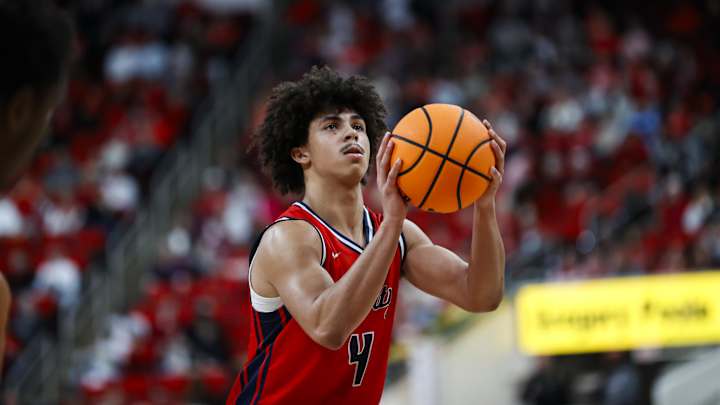
The buzz around the transfer portal is already heating up, but every now and then, a name emerges that doesn’t just generate interest—it demands attention. This time, that name is Brett Decker Jr. And if there’s anyone who should be watching closely, it’s Mark Pope.
The moment Decker Jr., a former standout guard for Liberty Flames men’s basketball, announced his intention to enter the transfer portal on April 7, it sent ripples through the college basketball landscape. In today’s era of roster turnover and rapid rebuilds, elite shooters are among the most valuable commodities in the sport. And Decker Jr. isn’t just a good shooter—he’s operating at a level that places him among the very best in the country.
A Shooter Kentucky Can’t Afford to Miss
Let’s start with the numbers, because they’re impossible to ignore.
Decker Jr. averaged 16.9 points per game this past season while shooting an astonishing 49.9% from the field and 47.1% from beyond the arc. Those aren’t just solid stats—they’re elite, bordering on absurd for a high-volume perimeter player. Shooting nearly 50% from three is something you rarely see at any level, let alone in Division I basketball where defenses are faster, longer, and far more sophisticated.
For a program like Kentucky Wildcats men’s basketball, which struggled at times to find consistent perimeter shooting last season, a player like Decker Jr. isn’t just a luxury—he’s a necessity.
The Kentucky Identity Crisis
There was a time when Kentucky basketball thrived on versatility and explosiveness, but modern college basketball has evolved. Spacing, shooting, and offensive efficiency now dictate success more than ever. And last season, Kentucky found itself lagging behind in one of those critical areas: three-point consistency.
While players like Collin Chandler provided flashes of brilliance from deep, the Wildcats often lacked a dependable, night-in and night-out threat from beyond the arc. Supporting contributors such as Otega Oweh, Denzel Aberdeen, and Kam Williams showed promise, but none consistently struck fear into opposing defenses the way elite shooters do.
And that matters more than it might seem.
Without reliable shooting, defenses collapse into the paint. Driving lanes shrink. Post players face double teams. Offensive rhythm disappears. Even the most talented rosters can look ordinary if spacing isn’t respected.
That’s where Decker Jr. changes everything.
The Gravity Effect
Great shooters don’t just score points—they warp the game around them.
When a player is shooting over 47% from three, defenders don’t just guard him at the line. They chase him over screens. They extend coverage. They hesitate to help off him. That single presence creates space for everyone else on the floor.
Imagine Decker Jr. running off screens in a Southeastern Conference matchup. Imagine defenders scrambling to stay attached while Kentucky’s guards attack open lanes. Imagine post players operating one-on-one instead of fighting through constant double teams.
That’s the kind of impact a truly elite shooter provides—and it’s exactly what Kentucky lacked.
A Perfect Fit for Mark Pope’s System
If there’s one thing we’ve learned about Mark Pope’s offensive philosophy, it’s this: he values spacing, ball movement, and shooting.
Pope’s system thrives when players can stretch the floor and make defenses pay from the perimeter. Without that, the entire structure starts to break down. With it, everything clicks.
Decker Jr. isn’t just a fit in that system—he’s a catalyst for it.
His ability to knock down shots at a high clip would immediately elevate Kentucky’s offensive ceiling. More importantly, it would allow Pope to fully implement the style of play he wants without compromise.
This isn’t about adding depth. This is about unlocking potential.
The Kentucky Native Factor
And then there’s the storyline that makes this even more compelling.
Decker Jr. is a Kentucky native from Elizabethtown. In a sport where connections, pride, and home-state ties still carry weight, that matters.
There’s something powerful about bringing a homegrown talent back to represent the state’s flagship program. It resonates with fans. It builds identity. It creates a sense of purpose that goes beyond wins and losses.
For Kentucky supporters, landing Decker Jr. wouldn’t just be about adding a great player—it would feel personal.
And in recruiting, emotion can be just as important as strategy.
The Koby Brea Role—Reimagined
In many ways, Decker Jr. projects as the ideal player to fill a role similar to what sharpshooters like Koby Brea have provided at other programs: a reliable, high-efficiency scoring option who can change a game with just a few possessions.
But Decker Jr. might offer even more upside.
At just a sophomore, he’s still developing. His game isn’t finished. His ceiling hasn’t been reached. That’s what makes this opportunity so intriguing—and so urgent.
If Kentucky lands him now, they’re not just getting a shooter. They’re potentially getting a future star who could evolve into one of the best players in the nation over the next two seasons.
That’s the kind of move that doesn’t just improve a roster—it reshapes a program’s trajectory.
The Transfer Portal Arms Race
The reality is simple: Kentucky won’t be the only program pursuing Decker Jr.
In today’s transfer portal era, elite talent doesn’t stay under the radar for long. Coaches across the country are already identifying needs, making calls, and preparing pitches. A shooter with Decker Jr.’s efficiency and production is going to be at the top of many lists.
That means this recruitment won’t be easy.
It will require urgency. It will require vision. And it will require Mark Pope and his staff to make a compelling case—not just about playing time, but about development, exposure, and long-term success.
Because when multiple programs come calling, the difference often comes down to who can paint the clearest picture of the future.
Learning from Last Season
If there’s one lesson Kentucky must take from last season, it’s this: you can’t afford to neglect shooting.
Talent alone isn’t enough. Athleticism alone isn’t enough. In modern college basketball, shooting is the great equalizer.
Teams that can consistently knock down threes have a margin for error that others don’t. They can overcome slow starts. They can erase deficits quickly. They can dictate tempo instead of reacting to it.
Kentucky learned that lesson the hard way.
Now, the question is whether they’ll act on it.
Building a Complete Roster
Of course, landing Decker Jr. wouldn’t solve everything.
Kentucky would still need to add more shooters, more depth, and more versatility. One player, no matter how talented, can’t carry an entire offensive system.
But every great rebuild starts with a cornerstone.
Decker Jr. could be that cornerstone.
He represents exactly what Kentucky needs: efficiency, consistency, and the ability to stretch defenses in ways that open up the entire floor.
From there, the rest of the roster can fall into place.
The Bigger Picture
This isn’t just about one player.
It’s about direction.
It’s about whether Kentucky is ready to fully embrace the modern game—or risk falling behind programs that already have.
Adding a player like Decker Jr. sends a message. It says that Kentucky understands where the game is headed. It says they’re willing to adapt. It says they’re serious about competing at the highest level.
And perhaps most importantly, it gives fans a reason to believe.
Final Thoughts
Opportunities like this don’t come around often.
A Kentucky native. An elite shooter. A developing star. A perfect system fit. All available at the exact moment Kentucky needs him most.
That’s not coincidence—that’s timing.
And in college basketball, timing can define everything.
Mark Pope doesn’t just have a chance here. He has a responsibility.
Because if Kentucky lets a player like Brett Decker Jr. slip away—especially one who fits so perfectly into what they need—it won’t just be a missed opportunity.
It will be a turning point.
The kind that fans remember.
The kind that shapes seasons.
And the kind that determines whether a program rises… or watches someone else do it first.




