


The walls inside Chapel Hill aren’t just whispering anymore—they’re shaking.
What once appeared to be a routine coaching transition for the North Carolina Tar Heels has rapidly spiraled into something far more dramatic, far more complicated, and far more consequential than anyone could have imagined just days ago. The departure of Hubert Davis was supposed to mark the beginning of a new era. Instead, it has ignited a behind-the-scenes power struggle that is exposing deep fractures within one of college basketball’s most tradition-rich programs.
This is no longer just about hiring a basketball coach.
This is about identity. Legacy. Control.
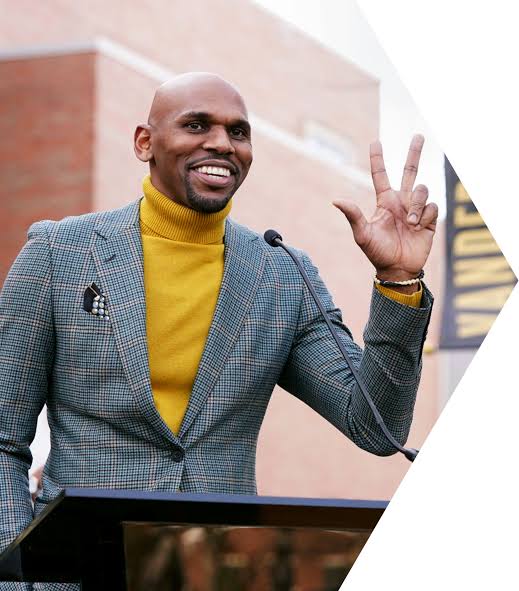
And at the center of it all stands a name that few expected to dominate the conversation: Jerry Stackhouse.
A PROGRAM AT WAR WITH ITSELF
For decades, North Carolina basketball has operated with a sense of certainty. Built on the foundation laid by Dean Smith, elevated to national dominance under Roy Williams, and sustained by a philosophy that valued continuity, loyalty, and internal growth, UNC was never supposed to face this kind of existential dilemma.
But modern college basketball has changed the rules.
The rise of NIL money, the explosion of the transfer portal, and the increasing professionalization of the sport have created a new reality—one where tradition alone no longer guarantees success. And for the first time in decades, UNC finds itself struggling to reconcile its past with its future.
Inside the program, sources suggest there is a growing divide.
On one side are those who believe UNC must remain true to its roots—hiring from within the “Carolina Family,” preserving the culture that made the program iconic, and resisting the temptation to chase trends.
On the other side are decision-makers who see the writing on the wall. They understand that in today’s landscape, adaptability is survival. To them, sticking too rigidly to tradition could mean falling behind permanently.
This isn’t just a disagreement.
It’s a philosophical battle.
THE FALL OF HUBERT DAVIS — AND WHAT IT REALLY MEANT
When Hubert Davis took over, he was seen as the perfect bridge between eras. A former player. A respected voice. A man who understood what Carolina basketball was supposed to represent.
And for a moment, it worked.
That improbable run to the national championship game in 2022 felt like validation. It felt like proof that UNC could still thrive without abandoning its identity.
But what followed told a very different story.
Inconsistent seasons. Recruiting challenges. A growing disconnect between traditional values and modern player expectations. Davis’ emphasis on culture and patience clashed with a generation of athletes navigating NIL deals, brand-building, and immediate opportunities.
In the end, it wasn’t a lack of effort that cost Davis.
It was timing.
He was trying to uphold an old blueprint in a game that had already rewritten itself.
And now, UNC is left to pick up the pieces.
ENTER JERRY STACKHOUSE — THE UNLIKELY CONTENDER
At first glance, Jerry Stackhouse doesn’t seem like the obvious choice.
His tenure at Vanderbilt was far from dominant. He didn’t lead the program to the NCAA Tournament. His record, on paper, doesn’t scream “home run hire.”
But that’s exactly why this situation is so fascinating.
Because beneath the surface, Stackhouse represents something far more compelling than a win-loss record.
He represents balance.
A former Tar Heel who understands the program’s DNA, Stackhouse also brings something UNC has been missing: edge. As a player, he was fierce, competitive, unapologetically intense. Those qualities have carried over into his coaching style, where toughness and accountability are non-negotiable.
And perhaps most importantly, he has evolved.
His time in the NBA, particularly under Steve Kerr, has expanded his perspective. He’s been exposed to modern systems, advanced strategies, and the kind of player management that defines today’s game.
That combination—Carolina roots plus NBA evolution—is starting to turn heads.
Quietly.
Quickly.
WHY INSIDERS ARE STARTING TO BELIEVE
There’s a growing sentiment among those close to the program that Stackhouse may be uniquely positioned to succeed where others might struggle.
At Vanderbilt, he was operating with limited resources—particularly in the NIL space. Competing in the SEC with a fraction of the financial backing available to rival programs, Stackhouse was often fighting an uphill battle.
And yet, there were flashes.
A Coach of the Year award. Noticeable player development. Competitive performances against more talented teams.
Now imagine him at UNC.
Imagine him with elite recruiting resources. With a national brand. With the ability to compete financially in the NIL era.
The equation changes dramatically.
Some insiders believe that what looked like mediocrity at Vanderbilt might actually have been overachievement under difficult circumstances.
And that possibility is fueling the buzz.
THE BIG-NAME THREAT STILL LOOMS
Of course, Stackhouse isn’t the only name in the mix.
Far from it.
Proven winners like Mark Few, rising stars like Dusty May, and established NBA minds like Billy Donovan all bring undeniable appeal.
They offer experience. Stability. Immediate credibility.
And for those pushing UNC to move beyond its internal traditions, these are the types of candidates that make the most sense.
But here’s the catch.
Hiring one of them would signal a clear shift away from the “Carolina Way.”
It would be an admission that tradition alone is no longer enough.
And for a program built on legacy, that’s not a decision taken lightly.
A FANBASE ON EDGE
As speculation intensifies, the UNC fanbase finds itself caught in the middle.
Some are demanding a bold move—a coach who can dominate in today’s chaotic landscape, regardless of ties to the program.
Others are pleading for loyalty to the foundation that made UNC special in the first place.
Social media is flooded with debates. Former players are weighing in. Alumni networks are buzzing with tension.
Because everyone understands what’s at stake.
This hire isn’t just about the next season.
It’s about the next decade.
THE ARENA DEBATE ADDS FUEL TO THE FIRE
As if the coaching search wasn’t complicated enough, another issue looms in the background: the future of the program’s home.
The Dean E. Smith Center has been a symbol of Carolina basketball since 1986. But discussions about building a new arena—one designed to maximize revenue in the NIL era—are gaining traction.
Once again, the same question emerges:
Do you honor tradition?
Or do you evolve?
Even Roy Williams has publicly advocated for preserving the Smith Center, highlighting the emotional and historical significance it holds.
But in a world where financial power increasingly dictates success, sentiment alone may not be enough.
THE DECISION THAT WILL DEFINE EVERYTHING
As the search continues, one thing is becoming increasingly clear:
There is no safe choice.
Every option comes with risk.
Hiring from within could preserve identity—but potentially limit adaptability.
Going outside could bring innovation—but at the cost of tradition.
And right in the middle of that tension stands Jerry Stackhouse.
A candidate who embodies both sides of the debate.
A choice that could unite the program—or divide it even further.
FINAL THOUGHT: A PROGRAM AT THE CROSSROADS
North Carolina basketball has spent decades setting the standard.
Now, it’s being forced to redefine itself.
The decision ahead isn’t just about wins and losses. It’s about philosophy. Direction. Survival in a rapidly changing sport.
And if the current momentum is any indication…
The most unexpected outcome might be the one that actually happens.
Because in a search filled with uncertainty, rising tension, and shifting priorities—
Jerry Stackhouse is no longer just a name to watch.
He’s a name that could change everything.




