


In today’s college basketball landscape, where name, image, and likeness (NIL) opportunities have transformed the way decisions are made, it takes something truly unexpected to shake the foundation of fan expectations. Money talks—loudly. Programs build around it. Players leverage it. Fans debate it endlessly.
So when a player reportedly turns away from a massive $2 million NIL deal, the question isn’t just what happened—it’s why.
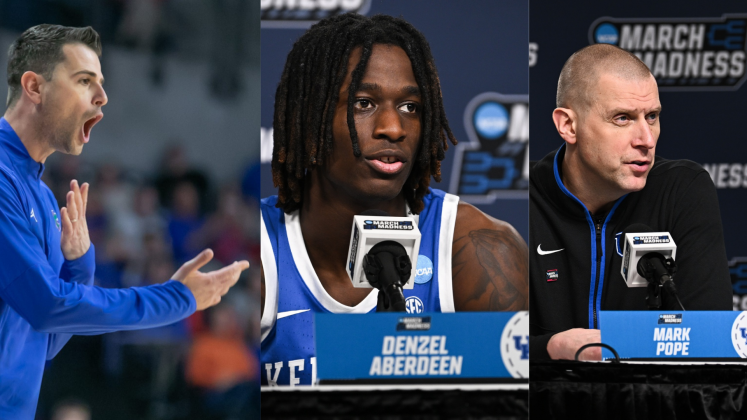
That’s exactly the situation surrounding Denzel Aberdeen, the talented guard who, after spending a season with Kentucky under Mark Pope, has made the stunning decision to return to the Florida Gators and head coach Todd Golden.
At first glance, it doesn’t make sense. Not in this era. Not with those numbers. Not with the trajectory Aberdeen seemed to be on.
But beneath the surface, this move reveals something deeper about college basketball today—something that goes beyond money, stats, or even immediate success.
The Shocking Decision That No One Saw Coming
Aberdeen’s departure from Kentucky isn’t just another transfer portal headline. It’s a moment that forces fans, analysts, and even fellow players to rethink what truly drives decisions at the highest level of college basketball.
After a strong season in Lexington, where he emerged as a key contributor and one of the Wildcats’ most reliable backcourt options, Aberdeen seemed poised to take an even bigger leap. With a lucrative NIL deal reportedly in place and a growing role under Mark Pope, everything pointed toward continuity.
Instead, he chose to walk away.
Not for a bigger paycheck. Not for a more high-profile program. But for something far less tangible—and far more powerful.
A return home.
A Journey That Comes Full Circle
Before his stint at Kentucky, Aberdeen was already a part of something special at Florida.
Spending three seasons in Gainesville, he developed within Todd Golden’s system, learning the nuances of the program and growing both as a player and as a person. While he wasn’t always the centerpiece, he was part of a culture that ultimately reached the pinnacle—Florida’s 2025 national championship run.
That experience leaves a mark.
Championship programs aren’t just about talent; they’re about trust, chemistry, and a shared understanding of what it takes to win. Aberdeen was there for that. He lived it. And even after leaving, that connection didn’t fade.
So when the opportunity arose to return—potentially for a fifth and final season, pending NCAA approval—it wasn’t just a basketball decision.
It was personal.
The Kentucky Chapter: Growth, Opportunity, and Breakthrough
To fully understand the weight of Aberdeen’s decision, you have to appreciate what he accomplished at Kentucky.
Under Mark Pope, he stepped into a larger role and thrived. No longer just a rotational piece, Aberdeen became a consistent starter, showcasing a level of confidence and production that hadn’t fully materialized during his earlier years at Florida.
His numbers tell the story:
13.5 points per game
2.5 rebounds per game
3.4 assists per game
But beyond the statistics, it was his presence on the court that stood out. He played with poise. He made smart decisions. He embraced responsibility.
For Kentucky fans, he became more than just a transfer—he became a key piece of the team’s identity.
That’s what makes his departure so difficult to process.
Why Walk Away From $2 Million?
This is the question that continues to dominate conversations.
In an era where NIL deals can dictate movement, turning down—or walking away from—a reported $2 million opportunity is almost unheard of. It challenges the narrative that financial incentives are the primary driver of every decision.
So what could outweigh that kind of money?
The answer likely lies in a combination of factors:
1. Familiarity and Comfort
Returning to Florida means stepping back into an environment Aberdeen knows intimately. The coaching staff, the system, the campus—it’s all familiar. That comfort can translate into confidence, and confidence can elevate performance.
2. Legacy and Unfinished Business
Being part of a championship team is one thing. Returning to help sustain that success—or restore it after a disappointing season—is another. Aberdeen may see this as an opportunity to solidify his legacy at Florida.
3. Role and Vision
While he thrived at Kentucky, the long-term vision at Florida might align more closely with his personal goals. Whether it’s leadership, usage, or system fit, those details matter.
4. Relationships
Connections with coaches and teammates often play a bigger role than outsiders realize. Trust isn’t built overnight, and returning to a place where it already exists can be a powerful draw.
Todd Golden’s Perspective: No Distractions, Just Business
Interestingly, when Kentucky faced Florida during the season, Todd Golden addressed Aberdeen’s presence with a calm, measured approach.
He emphasized that the game would be treated like any other, downplaying any potential distractions while still acknowledging Aberdeen’s contributions.
That response now feels even more significant.
Golden didn’t burn bridges. He didn’t create tension. He maintained professionalism—and perhaps, intentionally or not, kept the door open.
Now, that door has been walked through.
Florida’s Rollercoaster Season and Renewed Commitment
Despite entering the 2025-26 season with high expectations, Florida’s campaign didn’t end the way many had hoped. Early exits in both the SEC Tournament and March Madness left a sense of unfinished business lingering around the program.
But the university’s response was clear: they believe in Todd Golden.
Athletic director Scott Stricklin made that known, emphasizing the school’s commitment to rewarding successful coaches and ensuring stability within the program.
Golden’s contract adjustments—raising his salary significantly and maintaining a substantial buyout—send a strong message: Florida isn’t looking to rebuild. They’re looking to reload.
And bringing back a player like Aberdeen fits that vision perfectly.
What This Means for Kentucky
For Kentucky, Aberdeen’s departure is a reminder of the challenges that come with the modern era of college basketball.
Even with strong NIL backing, talented coaching, and national exposure, roster continuity is never guaranteed.
Mark Pope now faces the task of adjusting once again—finding new pieces, redefining roles, and ensuring that the team remains competitive in an ever-changing landscape.
The Wildcats have the resources and reputation to bounce back. But losing a player who had just begun to hit his stride is never easy.
Big Picture: A Shift in the Narrative
Aberdeen’s decision represents something bigger than one player or one program.
It challenges the assumption that money is always the deciding factor. It highlights the importance of environment, relationships, and personal fulfillment.
And it reminds everyone—fans, analysts, and even recruits—that every decision has layers.
Sometimes, the biggest moves aren’t about chasing something new.
They’re about returning to something meaningful.
What Comes Next
As Aberdeen awaits potential NCAA approval for a fifth year, anticipation continues to build.
If granted, his return to Florida could have a significant impact—not just on the team’s performance, but on the broader narrative surrounding player movement in college basketball.
Can he elevate the Gators back to championship contention?
Can he build on the growth he experienced at Kentucky?
And perhaps most intriguingly—will his decision inspire others to prioritize fit and fulfillment over financial gain?
Those questions remain unanswered.
But one thing is certain:
Denzel Aberdeen’s decision has already changed the conversation.
Final Thoughts
In a world where headlines are often driven by numbers—contracts, salaries, rankings—this story stands out because it’s about something deeper.
It’s about connection.
It’s about identity.
It’s about understanding where you truly belong.
Aberdeen had everything in front of him at Kentucky—momentum, opportunity, and financial security. Yet, he chose a different path.
Not because it was easy.
But because, for him, it was right.
And in doing so, he reminded everyone that even in the business-driven world of modern college basketball, the human element still matters.
Sometimes more than anything else.




