


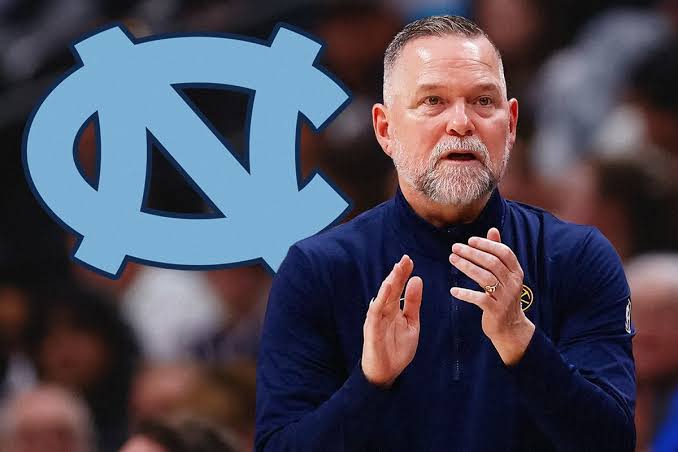
Michael Malone has wasted no time making his intentions clear as the new leader of the North Carolina Tar Heels, and his early comments suggest a program that is about to undergo a significant identity shift.
In his first detailed remarks about roster building, Malone didn’t focus on star ratings or recruiting rankings. Instead, he zeroed in on intangibles — the kind of qualities that often separate good teams from great ones in March.
For Malone, the foundation of his system begins with effort. Not occasional bursts of energy, but a relentless, consistent motor that shows up on every possession, regardless of the opponent or situation.
“I love guys that have a motor, that play hard,” Malone emphasized, reinforcing a standard that leaves little room for inconsistency. It’s a message that resonates across all levels of basketball, but one that he appears determined to make central in Chapel Hill.
That approach signals a cultural reset. In an era where talent often dominates headlines, Malone is prioritizing players who are willing to outwork opponents and embrace the less glamorous aspects of the game.
Equally important in his evaluation process is self-motivation. Malone made it clear that he wants players who hold themselves accountable, rather than relying on coaches to constantly push them.
That distinction matters. Teams built on internal drive tend to sustain success longer, especially in high-pressure environments like the ACC and NCAA Tournament, where resilience is constantly tested.
Malone also stressed the importance of toughness — not just physical, but mental. According to him, toughness is reflected in how players respond to adversity, whether it’s a missed shot, a defensive breakdown, or a hostile road environment.
“It’s not something you can measure with money,” Malone suggested, underscoring his belief that true competitiveness comes from within. For a program with the history and expectations of North Carolina, that mindset could prove critical.
Another pillar of Malone’s philosophy is basketball IQ. He wants players who understand spacing, timing, and decision-making at a high level — athletes who can process the game quickly and adapt on the fly.
In today’s game, where schemes are more complex and defenses more sophisticated, that level of intelligence can be the difference between a good possession and a great one. Malone’s emphasis here reflects a coach who values efficiency and precision.
Speaking of efficiency, Malone also pointed to specific statistical markers he considers essential. Free-throw shooting and three-point accuracy stood out as key metrics he evaluates across all five positions.
That detail is particularly noteworthy. Traditionally, those shooting benchmarks were emphasized more heavily for guards and wings, but Malone’s approach suggests a modern system where every player on the floor must be a scoring threat.
By prioritizing shooting across positions, Malone is aligning North Carolina with the evolving landscape of basketball, where spacing and perimeter efficiency often dictate success.
It also hints at a more versatile offensive scheme, one that relies on ball movement, floor spacing, and players who can stretch defenses rather than operate in confined roles.
At the same time, Malone’s vision doesn’t abandon the program’s traditional strengths. Toughness, effort, and discipline have long been associated with successful UNC teams, and his philosophy appears to reinforce those values rather than replace them.
What makes this approach intriguing is how it blends old-school principles with modern analytics. Malone isn’t choosing between grit and skill — he’s demanding both.
For returning players, the message is clear: adaptation will be necessary. Those who embrace the new standard will likely thrive, while others may struggle to find a role in the evolving system.
For recruits, Malone’s blueprint provides a clear roadmap. Prospects who pride themselves on work ethic, intelligence, and shooting ability will immediately stand out as ideal fits.
Ultimately, Malone’s early comments offer more than just insight — they provide a glimpse into the future of North Carolina basketball. It’s a future built not just on talent, but on mindset, discipline, and a commitment to doing the little things right.
If his vision takes hold, the Tar Heels may soon be defined less by individual star power and more by collective identity — a team that plays hard, thinks the game at a high level, and executes with precision.
And in a sport where margins are often razor-thin, that combination could be exactly what North Carolina needs to return to championship contention.




