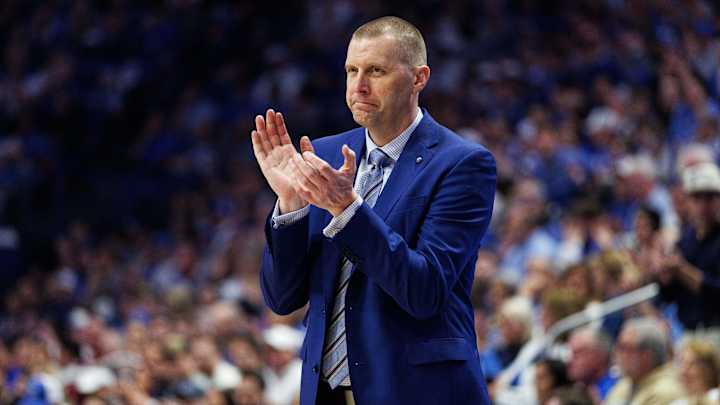
LEXINGTON, Ky. — The noise never really stops when you’re the head coach at Kentucky. It hums in the background during practice, roars on game nights, and swells into a constant drumbeat the moment the offseason begins. Every roster move is dissected. Every recruiting decision is debated. Every quote is amplified.
So when Mark Pope sat down for his final weekly radio show of the 2025–26 season and chose his words carefully—but pointedly—it didn’t take long for them to ripple across Big Blue Nation.
“We are desperate to bring creators here to Kentucky,” Pope said.
Desperate.
In a program built on confidence, swagger, and expectation, that word landed with weight. It wasn’t panic—but it wasn’t far from urgency either. And in the modern era of college basketball, where the transfer portal dictates the pace of roster construction, urgency can define everything.
Because what Pope revealed in that moment wasn’t just a need.
It was a promise.
The Kentucky Standard: No Time for Patience
At most programs, a rebuilding year buys time. At Kentucky, it buys scrutiny.
The Wildcats aren’t judged on potential—they’re judged on results. Banners. Deep tournament runs. NBA draft picks. The margin for error is razor thin, and the timeline for success is immediate.
That’s the environment Mark Pope stepped into. And to his credit, he hasn’t shied away from the challenge. Instead, he’s leaned into it, embracing the pressure while trying to reshape how Kentucky builds its roster in a rapidly evolving college basketball landscape.
Gone are the days when elite freshmen alone could carry a team through March. Experience matters now. Chemistry matters. And perhaps most importantly—creation matters.
Pope knows it.
And now, he’s said it out loud.
“Creators” — The Missing Piece
In today’s game, “creators” aren’t just nice to have—they’re essential.
They’re the players who can break down defenses when a possession stalls. The ones who can manufacture offense when plays collapse. The ones who can take over late in games when everything tightens and every shot matters.
They don’t just score.
They generate scoring.
For themselves. For teammates. For the entire system.
And last season, Kentucky didn’t have enough of them.
There were flashes, moments of brilliance, stretches where the offense hummed. But when defenses locked in—especially against elite competition—the Wildcats too often found themselves searching for answers.
Possessions became predictable. Ball movement slowed. Shot quality dipped.
And in those moments, the absence of true creators became glaring.
That’s the problem Pope is now determined to fix.
A Promise That Raises the Stakes
Coaches make promises all the time. But at Kentucky, promises carry consequences.
When Mark Pope told Big Blue Nation that he’s “desperate” to bring creators into the program, he wasn’t just outlining a strategy—he was setting an expectation.
Fans heard it.
Recruits heard it.
And perhaps most importantly, the transfer portal heard it.
Because in this era, words like that aren’t just statements. They’re signals.
They tell potential transfers exactly what a program needs—and how badly it needs it.
That can be a powerful recruiting tool. Elite players want opportunity. They want the ball in their hands. They want the freedom to create.
Pope is offering that.
But there’s a flip side.
When you publicly declare a need and fail to address it, the criticism becomes louder. Sharper. More unforgiving.
That’s the risk.
Navigating the Chaos of the Transfer Portal
The transfer portal isn’t just busy—it’s chaotic.
Hundreds of players enter. Dozens of programs pursue the same targets. NIL negotiations complicate everything. And decisions are made quickly, often unpredictably.
It’s a high-stakes marketplace where timing is everything.
For Mark Pope, the challenge is twofold: identify the right creators and convince them that Kentucky is the best place to maximize their talents.
That’s not always as simple as it sounds.
Other programs are making similar pitches. Some offer clearer paths to immediate stardom. Others bring established systems built around high-usage guards. And many come armed with competitive NIL packages.
Kentucky still carries prestige. Tradition. Visibility.
But in the portal era, those advantages aren’t always enough on their own.
You have to close.
The Weight of Expectation from Big Blue Nation
Few fanbases are as passionate—or as demanding—as Big Blue Nation.
They show up. They support. They invest emotionally in every game, every player, every season.
And in return, they expect excellence.
Not progress.
Not potential.
Excellence.
That’s why Pope’s words resonate so strongly. Fans aren’t just hoping for improvement—they’re expecting transformation.
They want to see a team that can compete with anyone in the country. A team that can dictate games, not react to them. A team with players who can take over when it matters most.
In short, they want creators.
And now, they’ve been promised exactly that.
The Balancing Act: Portal vs. High School Recruiting
While the transfer portal dominates the conversation, high school recruiting hasn’t disappeared.
Kentucky is still in the mix for elite prospects. Names that could shape the program’s future for years to come.
But here’s the challenge: balancing immediate needs with long-term development.
Transfers provide instant impact. They bring experience, maturity, and often proven production.
Freshmen bring upside. Potential. The possibility of greatness—but not always consistency right away.
Mark Pope is trying to blend both.
It’s a delicate balance. Lean too heavily on transfers, and you risk losing continuity. Lean too heavily on freshmen, and you risk inconsistency.
The ideal roster has both.
But building that roster—especially under pressure—is no easy task.
What Happens If the Promise Isn’t Kept?
This is where things get complicated.
If Kentucky lands multiple high-level creators, the narrative flips instantly. Pope is seen as proactive. Strategic. In control.
But if those players don’t materialize?
The questions get louder.
Did Kentucky miss on key targets?
Is the system appealing enough to elite creators?
Can Pope adapt quickly enough in this new era?
And perhaps most importantly:
Is the program losing ground to its rivals?
These aren’t questions anyone in Lexington wants to be asking.
The Rivalry Factor
Adding another layer to this situation is the ongoing battle with Louisville.
While Pat Kelsey has been aggressive and effective in the portal, Kentucky has faced more scrutiny.
Fair or not, comparisons are inevitable.
Every commitment Louisville lands—and Kentucky doesn’t—feeds a growing narrative. One that suggests momentum may be shifting.
That’s why Pope’s promise matters even more.
It’s not just about improving Kentucky.
It’s about keeping pace—and potentially regaining the edge—in one of college basketball’s most intense rivalries.
Reasons for Optimism
Despite the pressure, it’s not all uncertainty.
There are reasons to believe Mark Pope can deliver.
He understands the game at a deep level. He’s proven he can develop players. And he’s shown a willingness to adapt—something that’s crucial in the constantly evolving landscape of college basketball.
Kentucky still offers unmatched exposure. Elite facilities. A passionate fanbase.
For the right players, it’s still one of the most attractive destinations in the sport.
And if Pope can align that appeal with the right roster pieces?
Things can change quickly.
A Defining Offseason
Every coach has moments that define their tenure.
For Mark Pope, this feels like one of them.
Not because of a single game.
Not because of a single recruit.
But because of a statement.
A promise.
“We are desperate to bring creators here to Kentucky.”
It’s bold. It’s honest. And it sets the stage for everything that comes next.
Final Thought: Pressure Creates Clarity
Pressure can break programs.
Or it can sharpen them.
Right now, Kentucky is feeling that pressure. The expectations, the comparisons, the urgency—it’s all there.
But within that pressure lies opportunity.
An opportunity to redefine the roster.
An opportunity to reshape the narrative.
An opportunity to prove that the program isn’t just adapting to the modern era—it’s mastering it.
The transfer portal chaos isn’t going away.
The scrutiny isn’t fading.
And the expectations certainly aren’t lowering.
But if Mark Pope delivers on his promise—if he finds the creators Kentucky so desperately needs—this moment won’t be remembered as panic.
It will be remembered as the turning point.
If he doesn’t?
Big Blue Nation won’t forget that, either.