


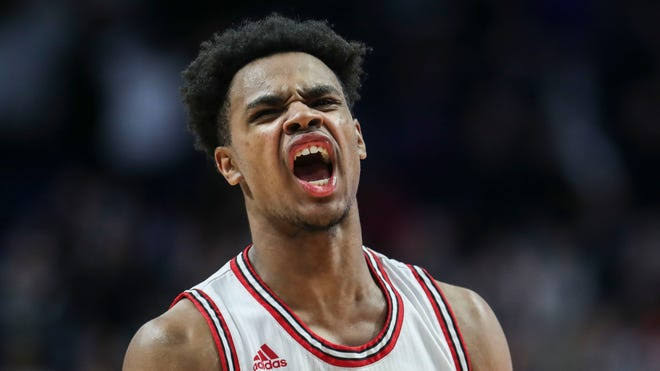
Something big is unfolding in Lexington—and it’s happening faster than anyone expected. What once looked like a long rebuilding process is suddenly turning into a full-scale transformation. With each new addition, each bold decision, and now the commitment of Jerone Morton, the picture is becoming clearer: Kentucky isn’t waiting around. They’re reloading—and they’re doing it aggressively.
When Mark Pope took over the Kentucky program, he didn’t just inherit a roster—he inherited expectations. This is not a program that tolerates mediocrity or extended rebuilding timelines. Kentucky basketball operates in a different universe, one where success is demanded, tradition is sacred, and every season carries championship-level pressure.
Replacing a figure like John Calipari only amplified that pressure. Calipari’s tenure defined an era of Kentucky basketball—stacked recruiting classes, NBA-bound talent, and consistent national relevance. His departure left behind not just a vacancy, but a massive question:
What comes next?
For Mark Pope, the answer appears to be clear: adapt, evolve, and move fast.
The New Era Begins
From the moment Pope stepped into the role, there were signs that things would be different. While Calipari built his reputation on landing elite freshmen year after year, Pope’s approach is shaping up to be far more fluid—leaning heavily into the transfer portal and experienced talent.
That shift isn’t accidental.
College basketball has changed. The transfer portal has turned roster building into a year-round process, where teams can be reshaped almost overnight. Programs that embrace this reality can gain a competitive edge. Those that resist risk falling behind.
Pope has chosen to embrace it fully.
And the addition of Jerone Morton is a perfect example of that strategy in action.
Jerone Morton: More Than Just a Piece
Morton’s commitment might not carry the same headline-grabbing weight as a top-five high school recruit, but make no mistake—this is a significant addition.
Players like Morton represent something incredibly valuable in today’s game: experience, maturity, and readiness.
While young prospects bring potential, transfers often bring production. They’ve already faced high-level competition. They’ve already gone through the learning curve. They understand what it takes to compete at the college level.
That matters.
For Kentucky, adding a player like Morton isn’t just about filling a roster spot—it’s about raising the floor of the entire team.
He brings shooting ability, court awareness, and a level of composure that can stabilize a lineup still coming together. In a system that will likely demand quick adaptation, those qualities are essential.
But perhaps more importantly, Morton represents a shift in philosophy.
He is not just a player—he is a signal.
A signal that Kentucky is no longer relying solely on potential. They are prioritizing readiness.
Building a Roster in Real Time
One of the most fascinating aspects of Kentucky’s offseason is how quickly the roster is evolving.
What once looked uncertain is now starting to take shape.
Transfers are coming in. Roles are being defined. A system is beginning to form.
And it’s all happening in real time.
This kind of rapid transformation is both exciting and risky.
On one hand, it allows for immediate improvement. Weaknesses can be addressed quickly. New dynamics can be introduced. The team can pivot as needed.
On the other hand, it creates challenges.
Chemistry doesn’t develop overnight. Trust takes time. Systems require repetition.
Pope is essentially building a team from scratch—and doing so under intense scrutiny.
That’s not easy.
But it’s also an opportunity.
The Pressure of the Kentucky Standard
At most programs, a rebuilding year is accepted—sometimes even expected.
At Kentucky, it’s different.
Fans expect results.
They expect competitiveness.
They expect the team to look like Kentucky.
That standard doesn’t change, regardless of roster turnover or coaching transitions.
For Pope, that means balancing two priorities: building for the future while competing in the present.
It’s a delicate balance.
Lean too heavily on development, and you risk falling short in the short term.
Focus too much on immediate results, and you risk sacrificing long-term stability.
Finding the middle ground is the challenge.
What’s Happening Behind the Scenes
While the additions and headlines grab attention, some of the most important work is happening behind the scenes.
Culture.
Identity.
Accountability.
These are the elements that define successful programs, and they don’t show up in box scores.
Pope’s reputation suggests a focus on discipline and structure. His teams are known for their organization, their effort, and their commitment to system play.
If that translates to Kentucky, it could mark a significant shift from the previous era.
Not necessarily better or worse—just different.
And different can be powerful.
A new voice, a new approach, a new energy—these can reinvigorate a program.
But they also require buy-in.
From players.
From staff.
From fans.
The Role of Experience
One of the key themes emerging from Kentucky’s offseason is the emphasis on experience.
In a landscape where young talent often dominates headlines, experienced players can be the difference-makers.
They understand game flow.
They handle pressure better.
They make fewer mistakes.
Morton fits that mold.
And he likely won’t be the last.
As the roster continues to take shape, expect Kentucky to prioritize players who can contribute immediately.
Because in this environment, there’s little room for waiting.
The Bigger Picture
What’s happening at Kentucky isn’t just about one player or one offseason.
It’s about evolution.
The game is changing, and Kentucky is adapting.
That adaptation could define the program’s trajectory for years to come.
If successful, it could establish a new model—one that blends tradition with modern strategy.
If it falls short, questions will arise.
That’s the nature of high-stakes programs.
The Unknown Factor
Despite all the moves, all the additions, all the planning—there’s still uncertainty.
How will the pieces fit?
Who will emerge as leaders?
Can chemistry develop quickly enough?
These questions don’t have answers yet.
And that’s what makes this situation so compelling.
It’s not just about what we know—it’s about what we don’t.
A Fanbase Watching Closely
Kentucky fans are among the most passionate in sports.
They care deeply.
They invest emotionally.
They expect excellence.
Right now, they’re watching closely.
Every move is analyzed.
Every addition is debated.
Every decision is scrutinized.
That’s part of what makes Kentucky special—but it also adds pressure.
For Pope and his players, there will be no quiet moments.
Everything will be under the spotlight.
Final Thoughts
The commitment of Jerone Morton may seem like just another roster move—but in reality, it represents something much bigger.
It’s part of a larger transformation.
A shift in philosophy.
A new direction.
Kentucky basketball is entering a new era.
And while the outcome is uncertain, one thing is clear:
They’re not standing still.
They’re moving forward—fast.
And if the pieces come together the way they hope, this “rebuild” might not take as long as anyone expected.
Because sometimes, change doesn’t happen gradually.
Sometimes, it happens all at once.
And right now, that’s exactly what it feels like in Lexington.




