


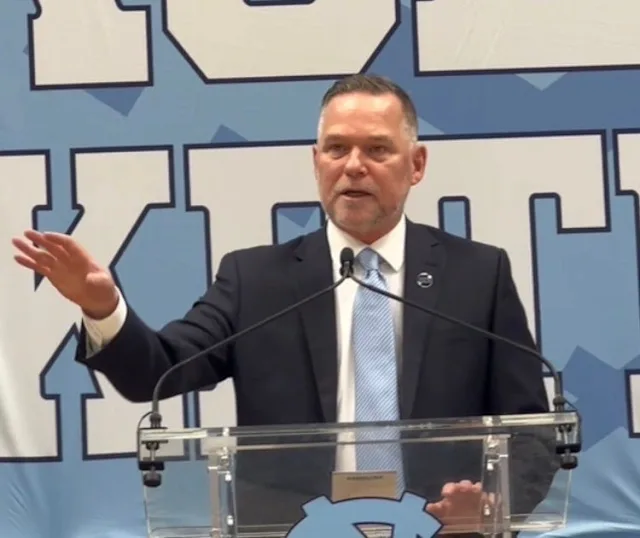
North Carolina basketball is entering a new era, and early signs suggest a fascinating mix of size, international talent, and proven experience under first-year head coach Michael Malone.
As the 2026–27 season approaches, several things about this Tar Heels roster are already becoming clear.
For one, this team will carry a strong international presence.
Players from France, Greece, and Mali are expected to play key roles, giving UNC a global identity rarely seen in Chapel Hill.
Sayon Keita, a 7-footer from Mali who developed at FC Barcelona, headlines that group.
Joining him are Greek guard Neo Avdalas and French center Maxim Logue, forming a unique core with diverse playing styles.
Another defining trait of this roster is its size.
UNC could realistically roll out a lineup where every player stands between 6-foot-6 and 7-foot, creating a physical mismatch against most opponents.
That kind of length is not just impressive—it mirrors, and in some cases exceeds, the average size of NBA teams today.
Beyond size and international flair, experience is another strength.
Seven of the projected 11 scholarship players have already competed at high-major levels across top conferences like the ACC, Big 12, Big Ten, and SEC.
This blend of veterans and rising talent gives Malone a solid foundation to build from.
On paper, the Tar Heels look capable of returning to the NCAA Tournament.
But at a program like UNC, simply making the tournament isn’t the goal—competing for championships is the expectation.
To reach that level, two major factors could determine whether this team becomes great or just good.
The first key lies in Malone’s ability to establish a clear system, especially in the backcourt.
UNC’s guard rotation is talented but potentially complicated.
Avdalas, Terrence Brown, and Matt Able all bring different strengths, but none are traditional point guards.
Avdalas has shown flashes as a playmaker, but his assist-to-turnover ratio last season raised questions.
Brown, meanwhile, is more of a scoring guard and has struggled with efficiency from three-point range.
Able adds another dimension, but fitting all three into a cohesive system will be a challenge.
Without clear roles and structure, the backcourt could become inconsistent.
Malone’s task will be to design an offense that maximizes each player’s strengths while minimizing overlap.
The second key revolves around UNC’s freshmen stepping up quickly.
Maximo Adams and Sayon Keita are both highly regarded prospects, but they are only 18 years old.
That youth brings potential, but also uncertainty.
Keita, despite his professional experience in Spain, played limited minutes at the highest level.
His development will be crucial, especially in areas like rebounding and rim protection.
Adams, a McDonald’s All-American, enters with high expectations as a versatile wing.
However, history shows that not all elite freshmen dominate immediately at the college level.
Some thrive right away, while others take time to adjust—or never fully meet expectations.
UNC doesn’t necessarily need superstar production from its freshmen, but it does need meaningful contributions.
If Adams and Keita can provide consistent support, the roster becomes far more balanced.
Ultimately, this Tar Heels team has the pieces to be dangerous.
But talent alone won’t be enough.
How quickly the system comes together—and how fast the young players grow—will determine whether UNC can rise from a good team to a true contender in Malone’s debut season.




