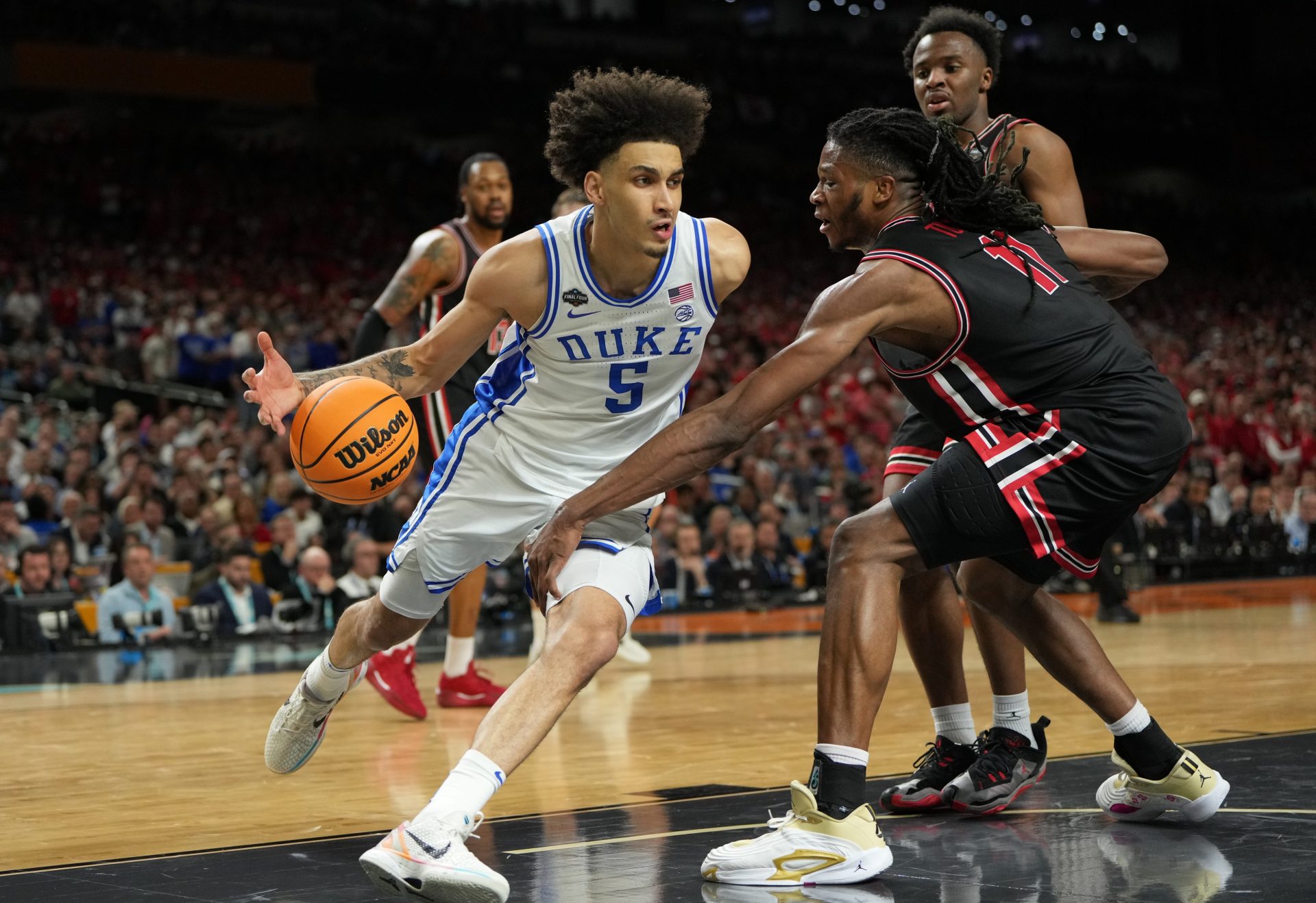
Tyrese Proctor’s journey from college standout to NBA prospect has been defined by growth, confidence, and a strong sense of identity—and that identity is still deeply tied to Duke basketball. After playing a key role for the Blue Devils from 2022 to 2025, Proctor transitioned to the professional stage when he was selected 49th overall in the NBA Draft by the Cleveland Cavaliers. While his NBA career is just beginning, his time at Duke continues to shape how fans and analysts view his trajectory.
Now part of a Cavaliers organization known for developing young talent, Proctor is in an ideal position to refine his game. Cleveland’s system emphasizes patience and player growth, giving rising prospects like him the opportunity to evolve without overwhelming pressure. Still, no matter how far he goes at the professional level, his Duke legacy remains a defining chapter.
That legacy recently came back into focus during an interview where Proctor was asked a classic—and often controversial—question: Who belongs on Duke basketball’s Mount Rushmore?
It’s the kind of debate that sparks passionate responses from fans across generations. Duke’s storied history is filled with icons, national champions, and cultural game-changers. Narrowing that down to just four names is never easy, and Proctor’s answer proved just how personal those choices can be.
His selections were both thoughtful and revealing. Proctor named Shane Battier, JJ Redick, and Jon Scheyer—all players who not only excelled individually but also helped define eras of Duke basketball. For his fourth spot, after some consideration, he chose Cooper Flagg, a rising star widely regarded as one of the most promising talents of the next generation.
On the surface, it’s a strong list. Battier represents leadership and defensive excellence, Redick embodies scoring brilliance and longevity, and Scheyer bridges the program’s past and present as both a former player and current head coach. Flagg, meanwhile, symbolizes the future—a player whose potential has already captured national attention.
But it wasn’t who Proctor included that stirred conversation—it was who he left out.
Noticeably absent from his Mount Rushmore was Christian Laettner, a name that many consider synonymous with Duke greatness. Laettner’s résumé is nearly unmatched in college basketball history. He led Duke to back-to-back national championships in the early 1990s, delivered one of the most iconic shots in NCAA Tournament history, and earned numerous individual accolades along the way.
For many fans, Laettner isn’t just a candidate for Duke’s Mount Rushmore—he’s a cornerstone of it.
Proctor acknowledged Laettner’s greatness and admitted he considered including him. However, his reasoning for ultimately leaving him off offers insight into how today’s players view legacy. Rather than relying solely on historical achievements, Proctor leaned into personal experience. He chose players he either played with or felt a direct connection to, emphasizing familiarity over tradition.
That perspective led him to Flagg, a player Proctor has seen up close and believes in. While Flagg has yet to build a legacy comparable to Laettner’s, his inclusion reflects confidence in what he will become rather than what he has already accomplished.
It’s a generational shift in thinking. Where older fans may prioritize championships and accolades, younger players often value firsthand experience, chemistry, and the evolution of the game. Proctor’s list isn’t meant to diminish the past—it highlights how each era defines greatness differently.
And that’s what makes debates like this so compelling.
Duke basketball isn’t just a program—it’s a timeline of excellence spanning decades. From Laettner’s dominance in the ’90s to Redick’s shooting in the 2000s, to today’s rising stars, every generation brings its own identity. There’s no single “correct” Mount Rushmore because the program itself continues to evolve.
Proctor’s choices reflect where he stands within that timeline: a modern player shaped by recent teammates, current coaching, and the promise of what’s next.
As his NBA career unfolds in Cleveland, Proctor will have the chance to build a legacy of his own—one that could eventually earn him a place in conversations like this. And if that happens, future players might one day include his name on their own Mount Rushmore lists, guided not just by stats or titles, but by the impact he had on them personally.
In the end, Proctor’s selections aren’t just about ranking greatness—they’re about connection, perspective, and the ever-changing definition of what it means to be a Duke legend.