


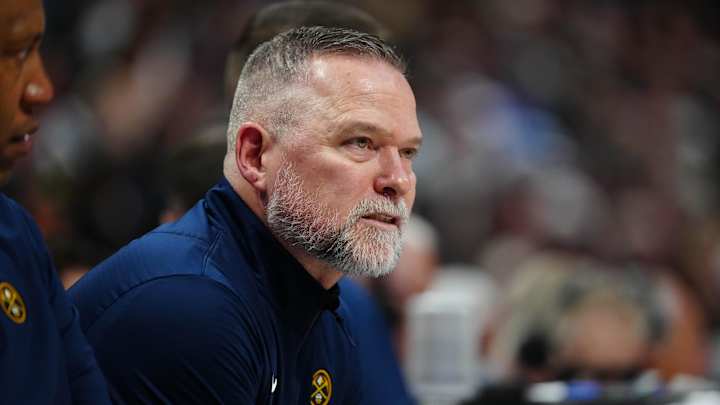
How do you rebuild an entire roster, land elite talent, inject belief into a historic program—and still get left out like you don’t exist? That’s the question surrounding Michael Malone and North Carolina right now… and the answer might say more about college basketball than anyone wants to admit.
There are offseason snubs… and then there are statements.
When Casey Jacobsen released his latest “too-early” Top 25 rankings for Fox Sports, the absence of North Carolina wasn’t just noticeable—it was jarring. Not because the Tar Heels are a lock to dominate next season, but because of what has transpired in Chapel Hill over the past few weeks.
What Michael Malone has done in such a short span isn’t normal. It isn’t typical. And depending on how things unfold, it might end up being one of the boldest—and most misunderstood—offseason rebuilds in recent memory.
Yet here we are, staring at a Top 25 list that doesn’t include North Carolina at all.
Not even a courtesy nod.
A “Too-Early” Ranking… Or a Too-Easy Dismissal?
Let’s be fair: preseason rankings, especially the “too-early” kind, are built on projection, not proof. Analysts weigh returning production, coaching continuity, recruiting classes, and portal additions. It’s a guessing game dressed up as insight.
Jacobsen’s top five—Florida, Illinois, Michigan, Duke, and Louisville—reflects programs with either established momentum or strong returning cores. There’s logic there.
But leaving North Carolina completely out?
That’s where logic starts to blur into assumption.
Because if there’s one thing this offseason has made clear, it’s that the Tar Heels are not standing still—they’re reinventing themselves.
Walking Into Chaos—and Owning It
When Michael Malone stepped into Chapel Hill, he didn’t inherit stability.
He inherited a situation most coaches would hesitate to touch.
A mass exodus of players. A roster stripped to its foundation. A fanbase uncertain about the future. And a college game he hadn’t been part of in decades.
That last point matters.
Malone’s résumé includes an NBA championship—a credential that commands respect—but the college game is a different beast. Recruiting, NIL dynamics, transfer portal maneuvering—it’s a nonstop grind that requires adaptability and speed.
And yet, instead of easing into the role, Malone attacked it head-on.
No hesitation. No excuses.
The Transfer Portal Gamble
Modern college basketball is defined by the transfer portal, and Malone wasted no time diving into it.
He understood the assignment immediately: rebuild the roster—and do it fast.
One of the most eye-catching additions was Terrence Brown, a high-scoring guard who averaged nearly 20 points per game at Utah. That kind of offensive production doesn’t just fill a gap—it reshapes a backcourt.
Then came Matt Able, a standout freshman from NC State who showed flashes of becoming one of the ACC’s most dynamic players. Pairing him with Brown gives North Carolina a backcourt with both experience and upside.
But Malone didn’t stop there.
Building Size, Skill, and Versatility
Rebuilding a team isn’t just about guards—it’s about balance.
And this is where Malone’s approach becomes even more intriguing.
Neoklis Avdalas brings a unique skill set as a 6-foot-9 wing with the ability to stretch the floor. Shooting nearly 39% from three-point range at Virginia Tech, he offers spacing that can transform offensive schemes.
Then there’s Cade Bennerman, a big man who redshirted at Northwestern. While he hasn’t seen much game action, his potential adds depth and size to a frontcourt that desperately needed reinforcements.
And perhaps the most headline-grabbing addition: five-star center Sayon Keita.
Landing Keita wasn’t just a recruiting win—it was a statement. It signaled that North Carolina, even amid uncertainty, can still attract elite talent.
So… Where’s the Respect?
This is where the frustration begins to build.
Because when you step back and look at the totality of what Malone has accomplished—rebuilding a roster, adding high-level talent, creating a new identity—it’s hard to justify complete exclusion from a Top 25 list.
Are there questions? Absolutely.
Will chemistry take time? Without a doubt.
But that’s true for many teams that did make the rankings.
So why is North Carolina being treated differently?
The Shadow of Uncertainty
Part of the answer lies in the unknown.
Malone hasn’t coached in college basketball in over two decades. That alone creates skepticism. Analysts wonder: Can he adapt? Can he recruit consistently? Can he connect with today’s players?
Those are fair questions.
But they’re also questions that can only be answered over time—not assumptions that should automatically disqualify a team from consideration.
Because if we’re being honest, what Malone has done so far suggests he’s not just adapting—he’s thriving.
Chemistry vs. Talent: The Eternal Debate
Another factor working against North Carolina is the classic debate between chemistry and talent.
Teams with returning cores are often favored in preseason rankings because they’ve already built cohesion. They know each other’s tendencies. They’ve been through battles together.
North Carolina, on the other hand, is essentially starting from scratch.
That’s risky.
But it’s also an opportunity.
Because sometimes, a fresh start creates a level of hunger and focus that established teams lack.
The ACC Factor
Let’s not forget the environment North Carolina is stepping into.
The ACC is as competitive as ever, with programs like Duke continuing to reload with elite talent. Navigating that landscape won’t be easy, especially for a team still finding its identity.
But again, difficulty doesn’t equal impossibility.
And if anything, it makes North Carolina’s story even more compelling.
A Chip on the Shoulder
If there’s one thing this ranking might have done, it’s give the Tar Heels motivation.
Being overlooked can be a powerful fuel.
Players notice these things. Coaches use them. And when a team feels disrespected, it often responds with intensity.
Malone, with his NBA pedigree, understands the psychology of competition. He knows how to channel doubt into drive.
And right now, there’s plenty of doubt to work with.
Proving Them Wrong
At the end of the day, rankings don’t win games.
Performance does.
North Carolina will have every opportunity to prove its worth on the court. Early-season matchups, conference play, marquee games—each one is a chance to shift the narrative.
And if Malone’s roster comes together the way he envisions, this team won’t just crack the Top 25—it could climb it quickly.
The Bigger Picture
This isn’t just about one ranking.
It’s about perception.
It’s about how quickly narratives form—and how difficult they are to change.
Right now, the narrative around North Carolina is uncertainty.
But narratives evolve.
And sometimes, the teams that start outside the spotlight end up stealing it entirely.
Final Thoughts
Michael Malone didn’t take the easy path.
He walked into chaos and chose to build something new. He embraced the challenges of modern college basketball and made bold moves to reshape a historic program.
Whether it works remains to be seen.
But one thing is clear: ignoring what’s happening in Chapel Hill might be a mistake.
Because if this roster clicks—even a little—the conversation will shift.
And when it does, the same rankings that left North Carolina out will start scrambling to catch up.
For now, though, the message is loud and clear:
No respect.
Just motivation.




