


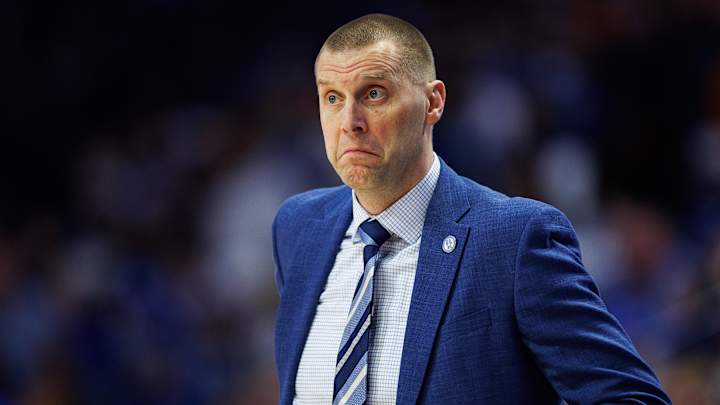
It’s one thing to be ranked lower than expected. It’s another thing entirely to be left out—completely. That’s the reality facing Kentucky Wildcats as the early outlook for the 2026–27 season begins to take shape. And while it may still be months before a single meaningful game is played, the message from the national stage is already loud enough to spark frustration, debate, and perhaps even motivation within Big Blue Nation.
Because when ESPN released its “Way-Too-Early” Top 25 rankings—compiled by college basketball analyst Jeff Borzello—Kentucky wasn’t just outside the Top 25.
They weren’t even among the next five teams looking in.
For a program with Kentucky’s history, expectations, and fanbase, that kind of omission doesn’t go unnoticed. It raises questions. It invites criticism. And more than anything, it creates a sense that something isn’t quite right.
A Ranking That Speaks Volumes
At the top of Borzello’s rankings sits Florida Gators, followed by a group of familiar powerhouses: Duke Blue Devils, Michigan Wolverines, Illinois Fighting Illini, and UConn Huskies.
There’s little controversy at the top. Each of those programs brings a combination of returning talent, recruiting success, and proven systems that justify early optimism.
But rankings aren’t just about who’s included—they’re also about who’s missing.
And Kentucky’s absence feels like more than just a casual oversight. It feels intentional. Calculated. A reflection of how uncertain the Wildcats’ current situation appears from the outside.
The Reality of Year 3 Under Mark Pope
For Mark Pope, this upcoming season represents a pivotal moment.
Year 3 is often where a coach’s vision either begins to fully materialize—or starts to face serious scrutiny. It’s the stage where rebuilding excuses begin to fade and expectations become more concrete.
And right now, the perception surrounding Kentucky suggests that the national media isn’t convinced that Pope’s project is ready to take that next step.
That doesn’t mean it won’t happen. But it does mean that belief, at least externally, is in short supply.
The SEC Gauntlet
Part of the skepticism surrounding Kentucky comes from the environment they’re competing in.
The Southeastern Conference is expected to be one of the toughest conferences in the country once again. According to Borzello’s rankings, six SEC teams are projected to land in the Top 15—a staggering number that underscores the level of competition Kentucky will face on a nightly basis.
That kind of depth creates a brutal path forward.
Even a talented team can struggle to stand out when surrounded by elite opponents. Every game becomes a challenge. Every loss carries weight. And consistency becomes incredibly difficult to maintain.
For Kentucky, that means there’s very little margin for error.
Louisville’s Rise—and What It Means
One of the more interesting inclusions in the rankings is Louisville Cardinals at No. 15.
That alone is enough to catch attention, given the historic rivalry between the two programs. But what makes it even more intriguing is that Louisville’s ranking came before the addition of Obinna Ekezie Jr., one of the top freshmen in the incoming class.
In other words, Louisville could be even better than initially projected.
And for Kentucky fans, that adds another layer to the frustration. Not only are the Wildcats absent from the rankings, but their in-state rival is climbing—with momentum on its side.
Breaking Down Kentucky’s Roster
Despite the skepticism, Kentucky’s roster is far from devoid of talent.
In fact, there are several pieces that could develop into something special.
Take Zoom Diallo and Alex Wilkins, for example. Both guards possess the kind of skill set that can thrive in the modern game. They’re dynamic, versatile, and capable of making an impact on both ends of the floor.
If they take the expected leap, Kentucky’s backcourt could quickly become one of its biggest strengths.
Then there’s Malachi Moreno.
His decision regarding the NBA Draft looms large over the team’s outlook. If he chooses to return, his presence would provide stability, experience, and a much-needed interior presence. If he doesn’t, Kentucky will have to adjust—and potentially scramble to fill the void.
The Intrigue of Ousmane N’Diaye
Another name generating quiet excitement is Ousmane Ndiaye.
At 6-foot-11, the forward from Senegal brings size, athleticism, and a level of intrigue that’s hard to ignore. Players with his physical profile often take time to develop, but when they do, the results can be game-changing.
The question is how Mark Pope plans to utilize him.
Will he be a rotational piece? A defensive specialist? Or could he evolve into something more?
That uncertainty is both a risk and an opportunity.
The X-Factor: Internal Development
If there’s one area that could dramatically shift Kentucky’s outlook, it’s player development.
Kam Williams showed flashes of brilliance last season before a mid-season foot injury cut his momentum short. Those glimpses, however, were enough to suggest that there’s significant potential waiting to be unlocked.
A fully healthy season could change everything for him—and by extension, for Kentucky.
Then there’s Braydon Hawthorne.
Few players on the roster carry as much mystery. Ranked in the Top 35 of his recruiting class, he entered the program with high expectations. Yet, his true impact remains largely unknown.
That kind of unpredictability can be frustrating—but it can also be exciting.
Because sometimes, the biggest leaps come from the players no one is fully watching.
Why the Snub Might Not Be So Shocking
As frustrating as it may be for fans, Kentucky’s omission from the Top 25 isn’t entirely without explanation.
From an outsider’s perspective, there are legitimate concerns:
The roster isn’t fully settled
Key players still have decisions to make
Developmental leaps are assumed, not proven
The competition within the SEC is overwhelming
When analysts build early rankings, they often lean toward certainty. Known quantities. Proven production. Established chemistry.
Kentucky, at least for now, represents potential more than proof.
And in the world of preseason projections, potential doesn’t always carry enough weight.
The Portal Factor
Another important element to consider is the transfer portal.
Kentucky’s roster may not be finished. There’s still time for additions—potentially even impactful ones.
An international player, another experienced guard, or a frontcourt reinforcement could all change the narrative quickly.
That’s the nature of modern college basketball.
Teams can transform overnight.
And if Kentucky makes the right moves, today’s skepticism could become tomorrow’s oversight.
Motivation or Warning Sign?
So what does this ranking really mean?
Is it a warning sign that Kentucky isn’t where it needs to be?
Or is it a source of motivation—a reminder that nothing will be given, and everything must be earned?
The answer likely lies somewhere in between.
For players and coaches, being overlooked can be powerful. It can create a chip on the shoulder. It can fuel offseason work. It can sharpen focus.
And for a program like Kentucky, that kind of edge can be dangerous—in the best possible way.
The Road Ahead
There’s still a long way to go before the 2026–27 season tips off.
Practices will happen. Rosters will evolve. Players will improve. Narratives will shift.
What feels like a slight today could feel irrelevant in a few months.
But for now, the message is clear:
Kentucky has something to prove.
Not just to analysts. Not just to rankings.
But to itself.
Final Thoughts
Being left out of a “Way-Too-Early” Top 25 won’t define Kentucky’s season.
But it will shape the conversation around it.
It will influence perception. It will drive expectations. And it will linger—at least until the Wildcats have a chance to respond on the court.
Because at the end of the day, rankings are just projections.
Performance is reality.
And if Kentucky can turn its potential into production, this early snub won’t just be forgotten—it’ll be remembered as the moment everything started to change.




