


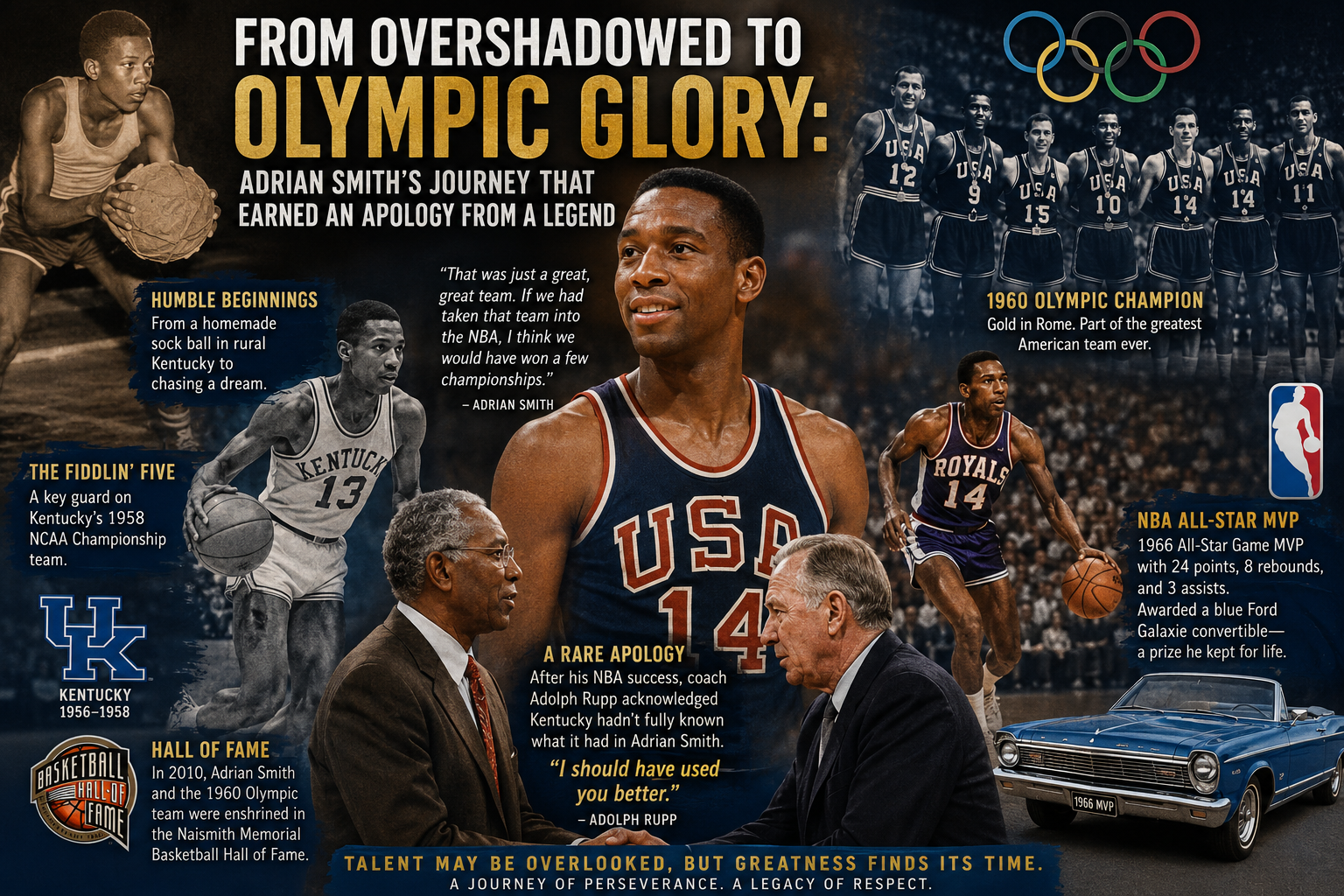
The name Adrian Smith is forever etched in Kentucky basketball history as a starting guard on the famed “Fiddlin’ Five,” the team that captured the 1958 NCAA championship. Yet, while his college career was impressive, it was what Smith accomplished after leaving the University of Kentucky that truly defined his legacy—and ultimately led to a rare and meaningful acknowledgment from his legendary coach, Adolph Rupp.
Smith’s story is one of resilience, patience, and quiet determination. Born into a poor family in rural Graves County, Kentucky, he was the fifth of six children. Resources were scarce, but his love for basketball was undeniable. With no proper equipment, Smith learned the game using a makeshift ball crafted by his mother from rolled-up socks. That humble beginning would shape the mindset of a player who never relied on hype, only hard work.
At Farmington High School, Smith developed into a standout player despite his small frame. Standing just 5-foot-10 and weighing only 135 pounds, he lacked the physical presence recruiters typically sought. As a result, his opportunities were limited. Only Murray State extended a scholarship offer, and even that chance slipped away when the offer was withdrawn before he could accept it.
For many, that setback might have ended the dream. For Smith, it became motivation. A recommendation from a rival high school coach led him to a junior college in Mississippi. There, everything began to change. By his sophomore year, Smith had grown physically and matured as a player, emerging as a prolific scorer. His performances caught the attention of major Southeastern Conference programs, opening doors that had once seemed permanently closed.
Eventually, Smith made his way to Kentucky, where he became part of a championship-winning team. However, his role within the system never fully showcased his offensive abilities. Known for his discipline and team-first approach, Smith played within the structure, contributing to success but not standing out as a dominant individual force.
That perception would soon change on a much bigger stage.
In 1959, Smith earned a spot on the United States team for the Pan American Games, where he helped secure a gold medal. The following year, he was selected for what would become one of the greatest basketball teams ever assembled—the 1960 U.S. Olympic team. Competing in Rome, Smith joined a roster filled with future legends and helped lead the team to a dominant gold medal victory.
The team’s performance was historic, winning every game by massive margins and showcasing an unmatched level of talent. Smith played a crucial role, averaging double figures in scoring and proving he could compete with—and excel among—the very best. His contributions were no longer overlooked; they were undeniable.
That Olympic success opened doors to the professional ranks. Smith joined the Cincinnati Royals, where he reunited with former Olympic teammates. Over a decade-long NBA career, he steadily built a reputation as a reliable and skilled guard. His defining moment came during the 1965–66 season, when he averaged 18.4 points per game and earned a spot in the NBA All-Star Game.
On that stage, Smith delivered a performance that would become the highlight of his professional career. He scored 24 points, grabbed eight rebounds, and dished out three assists, earning MVP honors. As part of the award, he received a blue Ford Galaxie convertible—a prize he cherished and kept for the rest of his life.
Despite these accomplishments, one of the most meaningful moments for Smith came not during a game, but afterward. Following his success in the NBA, Adolph Rupp—the coach known for his demanding and often rigid approach—offered Smith an apology of sorts. It was a rare admission that Kentucky had not fully recognized or utilized Smith’s potential during his college years.
For Smith, that acknowledgment carried immense weight. It validated what his journey had already proven: that his abilities extended far beyond what had once been seen. It also underscored the idea that greatness is not always immediately recognized, even by the most experienced eyes.
In 2010, Smith’s legacy was further cemented when he and his 1960 Olympic teammates were inducted into the Naismith Memorial Basketball Hall of Fame. The honor reflected not only the team’s dominance but also Smith’s role in one of the greatest squads in basketball history.
Looking back on his life and career, Smith often expressed gratitude. He saw himself as someone who had been given opportunities and made the most of them, even when the path was uncertain. From a boy playing with a homemade ball to an Olympic champion and NBA All-Star MVP, his journey stands as a powerful example of perseverance.
Adrian Smith’s story is more than a tale of basketball success. It is a reminder that recognition may come late, but true ability will always find its moment. And sometimes, the most meaningful victories are not measured in points or trophies, but in the respect and acknowledgment earned along the way.




